
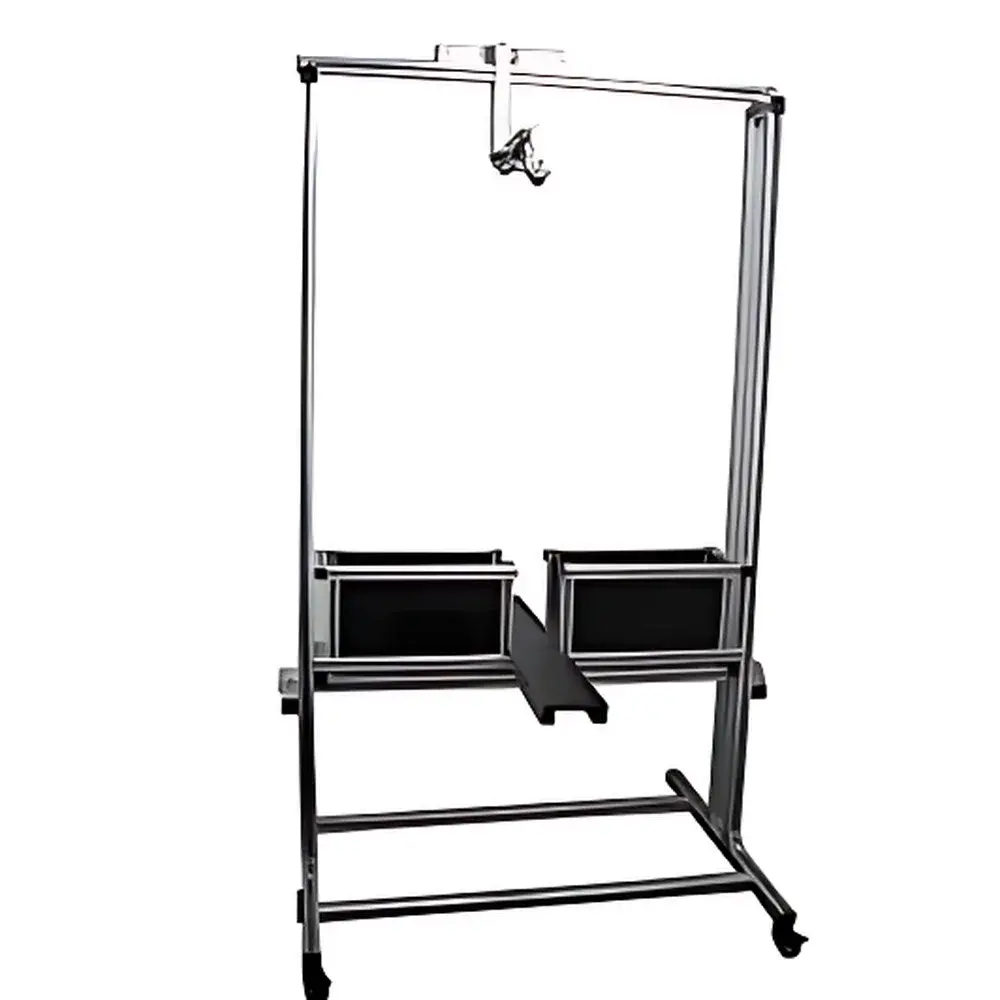
Elevated Plus Maze (EPM) System
| Origin | USA |
|---|---|
| Manufacturer Type | Distributor |
| Origin Category | Imported |
| Model | Elevated Plus Maze |
| Pricing | Upon Request |
Overview
The Elevated Plus Maze (EPM) is a widely validated, ethologically grounded behavioral assay designed to assess unconditioned anxiety-like responses in rodents. Based on the natural conflict between exploratory drive and innate aversion to open, elevated, and brightly lit spaces, the EPM consists of two open arms and two enclosed arms extending from a central platform—arranged in a plus (+) configuration—elevated 50–70 cm above the floor. This geometry induces measurable behavioral inhibition in anxious animals, primarily reflected in reduced time spent in and entries into the open arms. The system operates without reinforcement or punishment, making it ideal for pharmacological screening (e.g., anxiolytics, anxiogenics), genetic phenotyping, and neurobehavioral studies under standardized environmental conditions.
Key Features
- Two standardized configurations available: mouse-sized (arm length 30 cm, arm width 5 cm, wall height 15 cm) and rat-sized (arm length 50 cm, arm width 10 cm, wall height 40 cm), both constructed from high-grade, non-reflective acrylic with matte black or gray finish to minimize visual distraction and ensure consistent contrast for automated tracking.
- Modular, bolt-together aluminum support frame with adjustable leveling feet; load-rated for stability during repeated handling and cleaning cycles; compliant with NIH Guide for the Care and Use of Laboratory Animals structural safety recommendations.
- Integrated mounting interface compatible with leading video-tracking platforms (e.g., EthoVision XT, ANY-maze, Noldus, ViewPoint), supporting both top-down and angled camera positioning with minimal parallax distortion.
- Hardware engineered for durability and reproducibility: UV-resistant acrylic surfaces, corrosion-inhibited fasteners, and rounded edge profiles to prevent injury during spontaneous rearing or grooming behaviors.
Sample Compatibility & Compliance
The EPM is validated for use with Mus musculus (C57BL/6, BALB/c, Swiss Webster) and Rattus norvegicus (Sprague-Dawley, Wistar) across standard age ranges (6–12 weeks). It supports both acute and chronic dosing paradigms and integrates seamlessly into GLP-compliant behavioral testing workflows. All components meet ASTM F2100-22 standards for laboratory equipment surface integrity and are compatible with common disinfectants (70% ethanol, 1% sodium hypochlorite) without degradation. The maze design adheres to published IACUC protocol guidelines for spatial dimensions, illumination (≥300 lux in open arms, ≤50 lux in enclosed arms), and ambient noise control (<60 dB).
Software & Data Management
When paired with third-party tracking software, the system delivers quantitative output including: time in open arms (%), open arm entries (%), total distance traveled (cm), mean velocity (cm/s), latency to first open arm entry (s), and risk assessment behaviors (stretched-attend postures, head-dipping). Data export is supported in CSV, Excel, and HDF5 formats. Software modules include built-in validation tools for tracking accuracy, motion artifact filtering, and session metadata tagging (subject ID, treatment group, experimenter, date/time stamp). Audit trails and user access logs comply with FDA 21 CFR Part 11 requirements when deployed in regulated preclinical research environments.
Applications
- Primary screening of novel anxiolytic compounds (e.g., GABAA modulators, CRF antagonists, serotonergic agents)
- Characterization of anxiety-related endophenotypes in transgenic, knockout, or knock-in rodent models
- Investigation of developmental, circadian, or stress-induced modulation of anxiety behavior
- Validation of functional connectivity changes following optogenetic or chemogenetic manipulations in limbic circuits (e.g., ventral hippocampus–prefrontal cortex–amygdala axis)
- Multi-assay behavioral batteries, including sequential testing with open field, light-dark box, or forced swim test under counterbalanced protocols
FAQ
What species and strains are most commonly tested using this EPM system?
C57BL/6 and BALB/c mice, as well as Sprague-Dawley and Wistar rats, are routinely used. Strain-specific baseline anxiety profiles must be established prior to experimental intervention.
Is calibration required before each session?
Yes—camera angle, lighting uniformity, and contrast threshold must be verified daily. A standardized calibration grid and reference object are recommended for spatial scaling consistency.
Can the maze be cleaned between subjects without affecting performance?
Absolutely. Residual olfactory cues are eliminated using 70% ethanol followed by distilled water wipe; full drying (>5 min) is mandatory to avoid slip hazards and thermal artifacts.
Does the system support automated scoring of ethologically relevant behaviors beyond basic metrics?
Yes—when integrated with advanced software, it enables detection of stretched-attend postures, protected vs. unprotected head-dips, and arm-transition sequences via custom event definitions.
Is technical support available for protocol optimization and data interpretation?
Remote troubleshooting, experimental design consultation, and analysis pipeline review are provided by certified applications specialists trained in behavioral neuroscience methodology.
Related Products




