
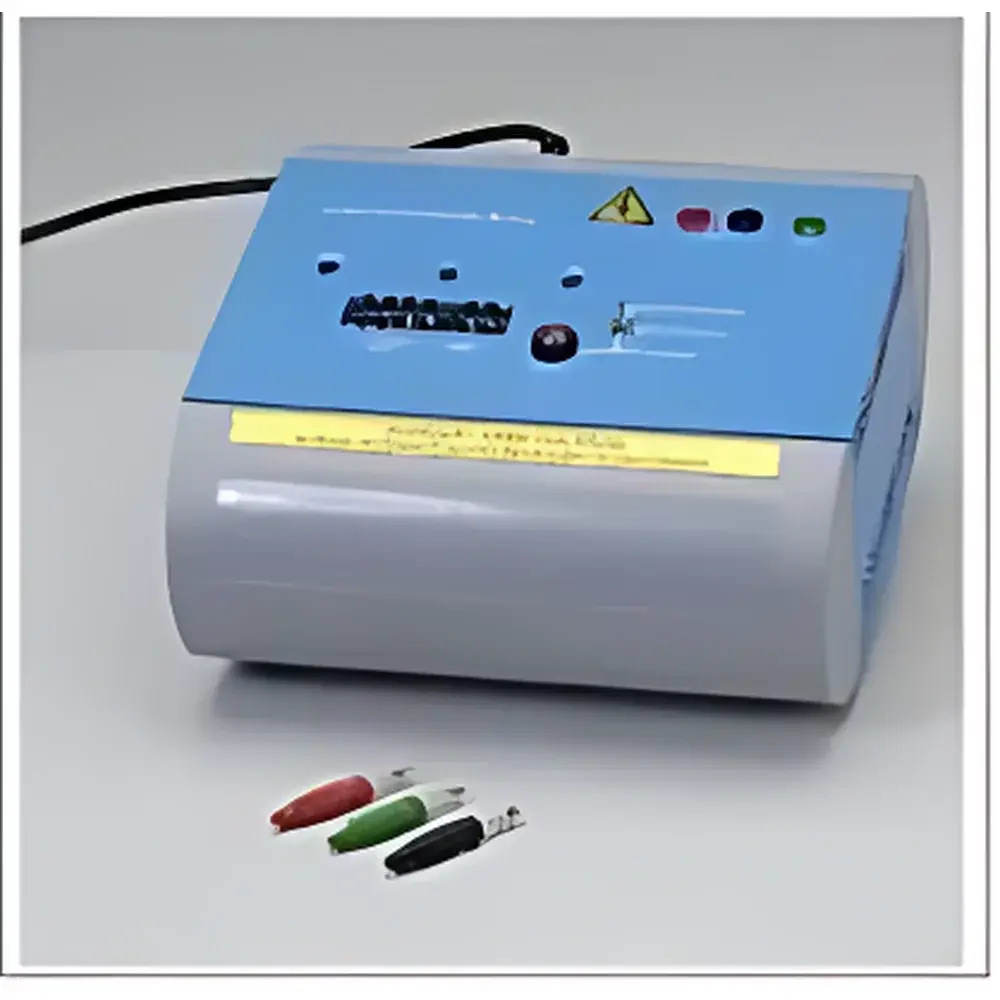
Ugo Basile Model 53500 Electrocoagulation Lesion Generator
| Brand | Ugo Basile |
|---|---|
| Origin | USA |
| Manufacturer Type | Authorized Distributor |
| Origin Category | Imported Instrument |
| Model | 53500 |
| Quotation | Upon Request |
| Output | Constant DC Current |
| Current Range | 10–99 mA |
| Timing Range | 1–99 s |
| Operating Temperature | 0–30 °C |
| Acoustic Noise Level | <45 dB(A) |
| Max. Load Impedance | 20 MΩ @ 10 µA / 2 kΩ @ 100 mA |
| Short-Circuit Protection | Active Electronic Monitoring |
| Visual Indicators | Yellow LED (Error), Red LED (Power Status) |
| Power Supply | 115 V or 230 V AC, 50/60 Hz, 20 W |
| Dimensions (W×D×H) | 25 × 15 × 11 cm |
| Net Weight | 1.5 kg |
| Gross Weight | ~2.8 kg |
| Packaging Dimensions | 49 × 29 × 24 cm |
Overview
The Ugo Basile Model 53500 Electrocoagulation Lesion Generator is a precision-engineered instrument designed for the controlled induction of focal electrothermal lesions in preclinical rodent models. It operates on the principle of resistive Joule heating: when a constant direct current (DC) passes through biological tissue between two electrodes, localized thermal energy is generated at the anode–tissue interface, resulting in reproducible coagulative necrosis. Unlike pulsed or RF-based systems, the Model 53500 delivers uninterrupted DC output—eliminating waveform artifacts and enabling precise correlation between applied current, exposure duration, and lesion geometry. Its design adheres to fundamental electrophysiological safety criteria for in vivo neuroscience and behavioral pharmacology studies, where spatial specificity, inter-animal consistency, and procedural repeatability are critical for histological validation and functional outcome assessment.
Key Features
- True constant-current DC generator with real-time electronic short-circuit detection—automatically halts current delivery if electrode contact resistance drops below threshold (e.g., inadvertent probe-to-probe contact), preventing unintended tissue damage or equipment stress.
- Adjustable current output (10–99 mA) and timer (1–99 s), both independently programmable via front-panel controls; supports both manual single-pulse operation and preset protocol recall.
- Galvanically isolated output circuitry with reinforced insulation between high-voltage path and chassis ground—minimizes stray current dispersion, ensures field confinement within target coordinates, and complies with IEC 61010-1 safety requirements for laboratory medical devices.
- Dual-status LED indicators: red LED confirms stable mains power and internal regulation; yellow LED illuminates during fault conditions (e.g., open circuit, over-impedance, timing overrun), providing immediate visual feedback without requiring software interface.
- Low-noise (<45 dB[A]) linear power conversion architecture—eliminates electromagnetic interference (EMI) that could disrupt concurrent electrophysiological recordings (e.g., LFP, single-unit activity) or behavioral tracking systems.
- Compact benchtop form factor (25 × 15 × 11 cm) with integrated cable management and non-slip base—optimized for integration into stereotaxic workstations and shared vivarium instrumentation racks.
Sample Compatibility & Compliance
The Model 53500 is validated for use with standard stainless-steel or tungsten stereotrodes (diameters 0.1–0.3 mm), bipolar lesioning probes, and insulated monopolar needles. It maintains stable current delivery across physiological impedance ranges encountered in murine brain (1–5 kΩ), spinal cord (3–10 kΩ), and peripheral nerve tissue (0.5–2 kΩ). The instrument conforms to ISO 14971:2019 (risk management for medical devices) and meets essential requirements of the EU Medical Device Regulation (MDR 2017/745) for Class I non-invasive ancillary equipment used in animal research. While not intended for human use, its electrical safety profile aligns with UL 61010-1 and CSA C22.2 No. 61010-1 for laboratory instrumentation. Documentation includes traceable calibration records and a Declaration of Conformity supporting GLP-compliant study reporting.
Software & Data Management
The Model 53500 operates as a stand-alone hardware module with no embedded firmware or proprietary software dependency. All parameter settings (current, duration, mode) are stored in non-volatile memory and retained after power cycling. For audit-trail compliance in regulated preclinical studies, users may log configuration data manually or integrate timestamped operation records into existing Laboratory Information Management Systems (LIMS) or electronic lab notebooks (ELN) via external event triggers (e.g., TTL pulse output upon completion). The device supports 21 CFR Part 11–aligned workflows when paired with validated third-party documentation platforms—no digital signature or user authentication is performed internally, preserving simplicity and regulatory flexibility.
Applications
- Stereotaxic ablation of discrete nuclei (e.g., ventral tegmental area, locus coeruleus, basolateral amygdala) for neuroanatomical tract-tracing or behavioral phenotype characterization.
- Controlled spinal cord lesion modeling in mice/rats to investigate axonal regeneration mechanisms and therapeutic intervention efficacy.
- Peripheral nerve injury studies—e.g., sciatic nerve electrocoagulation to induce Wallerian degeneration with defined distal stump boundaries.
- Validation of lesion accuracy via post-hoc Nissl staining, Fluoro-Jade C, or immunohistochemical markers (e.g., cleaved caspase-3, GFAP).
- Combined protocols with in vivo electrophysiology: simultaneous DC lesioning and local field potential (LFP) monitoring to assess acute network disruption dynamics.
FAQ
What type of current does the Model 53500 deliver?
It generates a stable, ripple-free direct current (DC) with adjustable magnitude (10–99 mA) and duration (1–99 s). No alternating or pulsed components are present.
Can it be used with insulated electrodes?
Yes—the instrument’s high-output impedance tolerance (up to 20 MΩ at microamp levels) ensures reliable current delivery even with partially insulated probes, provided the active tip surface area remains consistent across experiments.
Is temperature control built into the unit?
No. The device does not regulate tissue temperature; rather, it controls current and time—two primary determinants of thermal dose (Q = I²·R·t). Users must account for ambient and tissue-specific thermal conductivity in experimental design.
Does it support remote triggering or TTL synchronization?
Not natively. However, the end-of-timing cycle activates a passive open-collector signal usable for external event logging or hardware synchronization with DAQ systems.
How often does the unit require recalibration?
Ugo Basile recommends annual verification against a certified current standard (e.g., Fluke 5720A) per ISO/IEC 17025 guidelines. No user-serviceable calibration potentiometers are accessible.





