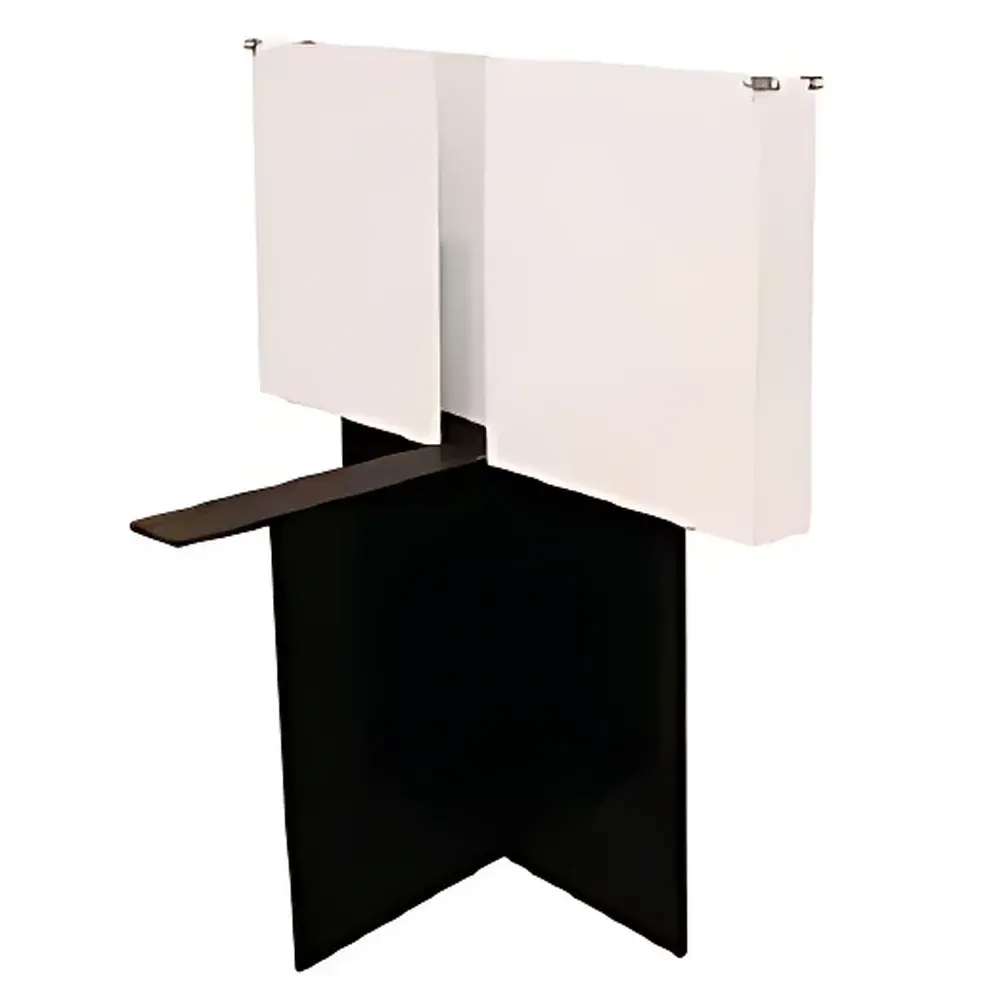
Panlab Elevated Plus Maze and Circular Maze (O-Maze) System
| Brand | Harvard Apparatus |
|---|---|
| Origin | USA |
| Manufacturer Type | Authorized Distributor |
| Import Status | Imported |
| Model | LE840 (Rat), LE842 (Mouse), H10-35-EPM (Universal) |
| Dimensions | LE840 — Enclosed Arms: 1000 × 1000 × 500 mm (gray walls) |
| Open Arms | 100 × 450 mm |
| LE842 — Enclosed Arms | 650 × 650 × 150 mm (gray walls) |
| Open Arms | 60 × 295 mm |
| H10-35-EPM — Arm Width | 250 px (≈63.5 mm), Arm Length: 1250 px (≈317.5 mm), Wall Height: 750 px (≈190.5 mm), Platform Height: 1375 px (≈349.3 mm) |
| Material | Cast Methyl Methacrylate (PMMA), Anodized Aluminum Frame |
| Transparent Wall Height | 30 mm (rat), 18 mm (mouse) |
| Tracking Compatibility | Manual Scoring or Video-Based Analysis with SMART 3.0 Software Suite (sold separately) |
| Output Metrics | Position Coordinates, Time Spent per Zone, Total Path Length, Instantaneous & Average Velocity, Arm Entries, Latency to First Entry |
Overview
The Panlab Elevated Plus Maze (EPM) and Circular Maze (O-Maze) system is a rigorously validated, ethologically grounded behavioral assay platform designed for preclinical assessment of anxiety-like behavior in rodents. Based on the natural conflict between exploratory drive and innate aversion to elevated, open spaces, the EPM exploits unconditioned behavioral responses—specifically, reduced open-arm exploration under baseline conditions and increased open-arm time following anxiolytic pharmacological intervention. The O-Maze variant eliminates the central square intersection zone present in traditional plus mazes, thereby removing ambiguity in zone assignment and enabling unambiguous spatial binning for high-fidelity trajectory analysis. Both configurations are engineered for precision, reproducibility, and compliance with standardized behavioral testing protocols widely adopted in academic neuroscience, pharmaceutical discovery, and regulatory toxicology studies.
Key Features
- Modular, tool-free assembly/disassembly architecture minimizes footprint and facilitates storage, transport, and cross-laboratory validation.
- Structurally rigid construction using optically clear, UV-stable cast methyl methacrylate (PMMA) ensures dimensional stability across repeated cleaning cycles and thermal fluctuations.
- Non-reflective matte-gray enclosed arms reduce visual distraction while maintaining consistent contrast for automated video tracking.
- Aluminum support frame with precision-machined mounting interfaces guarantees long-term alignment integrity and vibration damping during recording.
- Two dedicated rodent-scale configurations: LE840 (optimized for rats, 30 mm wall height) and LE842 (optimized for mice, 18 mm wall height), plus the H10-35-EPM universal platform accommodating both species without hardware modification.
- Calibration-ready geometry supports pixel-to-millimeter mapping required for accurate velocity and distance computation in SMART 3.0 and compatible third-party tracking engines.
Sample Compatibility & Compliance
The system is validated for use with Sprague-Dawley and Wistar rats (200–500 g), C57BL/6, BALB/c, and CD-1 mice (20–40 g). All structural dimensions adhere to published consensus guidelines from the American College of Laboratory Animal Medicine (ACLAM) and the European Directive 2010/63/EU on the protection of animals used for scientific purposes. Surface finish and material composition meet ISO 10993-5 biocompatibility requirements for non-invasive contact. The absence of sharp edges, solvent leachables, or static charge accumulation ensures animal welfare compliance during standard 5-minute test sessions. Data acquisition workflows integrating SMART 3.0 software support audit trails, user authentication, and electronic signature capabilities aligned with GLP and FDA 21 CFR Part 11 principles when configured with appropriate IT infrastructure.
Software & Data Management
While the maze hardware operates independently of software, quantitative behavioral phenotyping requires integration with SMART 3.0 (v3.0 or later), a validated, ISO/IEC 17025-aligned video-tracking platform developed by Panlab/Harvard Apparatus. SMART 3.0 computes over 30 primary endpoints—including time in open vs. closed zones, latency to first open-arm entry, total arm entries, path efficiency ratio, and velocity histograms—with sub-pixel spatial resolution. Raw video and metadata are stored in vendor-neutral AVI + XML formats, enabling downstream analysis in MATLAB, Python (via OpenCV or DeepLabCut), or R. Export modules support CSV, Excel, and HDF5 formats for statistical pipelines compliant with JMP, SPSS, or GraphPad Prism. All configuration files, calibration logs, and operator annotations are version-controlled within the SMART database schema.
Applications
- Pharmacological screening of novel anxiolytics and anxiogenic compounds in dose-response and time-course paradigms.
- Genetic characterization of anxiety-related endophenotypes in transgenic, knockout, and CRISPR-edited rodent models.
- Neurodevelopmental studies assessing early-life stress effects on adult anxiety circuitry.
- Validation of optogenetic or chemogenetic manipulations targeting amygdala–prefrontal–hippocampal networks.
- Environmental enrichment and chronic social defeat modeling in longitudinal behavioral phenotyping cohorts.
- Method validation for multi-assay batteries including open field, light-dark box, and novelty-suppressed feeding tests.
FAQ
Is the maze compatible with infrared (IR) backlighting for low-light video acquisition?
Yes—the PMMA construction exhibits >92% transmission across 700–1000 nm, making it fully compatible with IR LED arrays and monochrome CMOS cameras equipped with 850 nm bandpass filters.
Can SMART 3.0 track multiple animals simultaneously in one maze session?
No—SMART 3.0 is optimized for single-animal tracking per arena to ensure robust centroid discrimination and prevent occlusion artifacts; parallel testing requires separate arenas and synchronized camera channels.
What cleaning agents are recommended between subjects to avoid olfactory cue carryover?
70% ethanol followed by distilled water wipe-down is validated; avoid quaternary ammonium compounds or bleach, which may degrade PMMA surface integrity over repeated use.
Does the system include calibration tools for spatial scaling in SMART 3.0?
Yes—a precision-machined calibration grid (100 mm × 100 mm) is included with each unit to establish pixel-to-mm conversion prior to behavioral recording.
Is technical support available for protocol optimization and statistical interpretation?
Harvard Apparatus provides application engineering support for experimental design, SMART configuration, and endpoint selection—available via registered distributor channels and documented in the Panlab Behavioral Protocols Handbook v4.2.
Related Products