
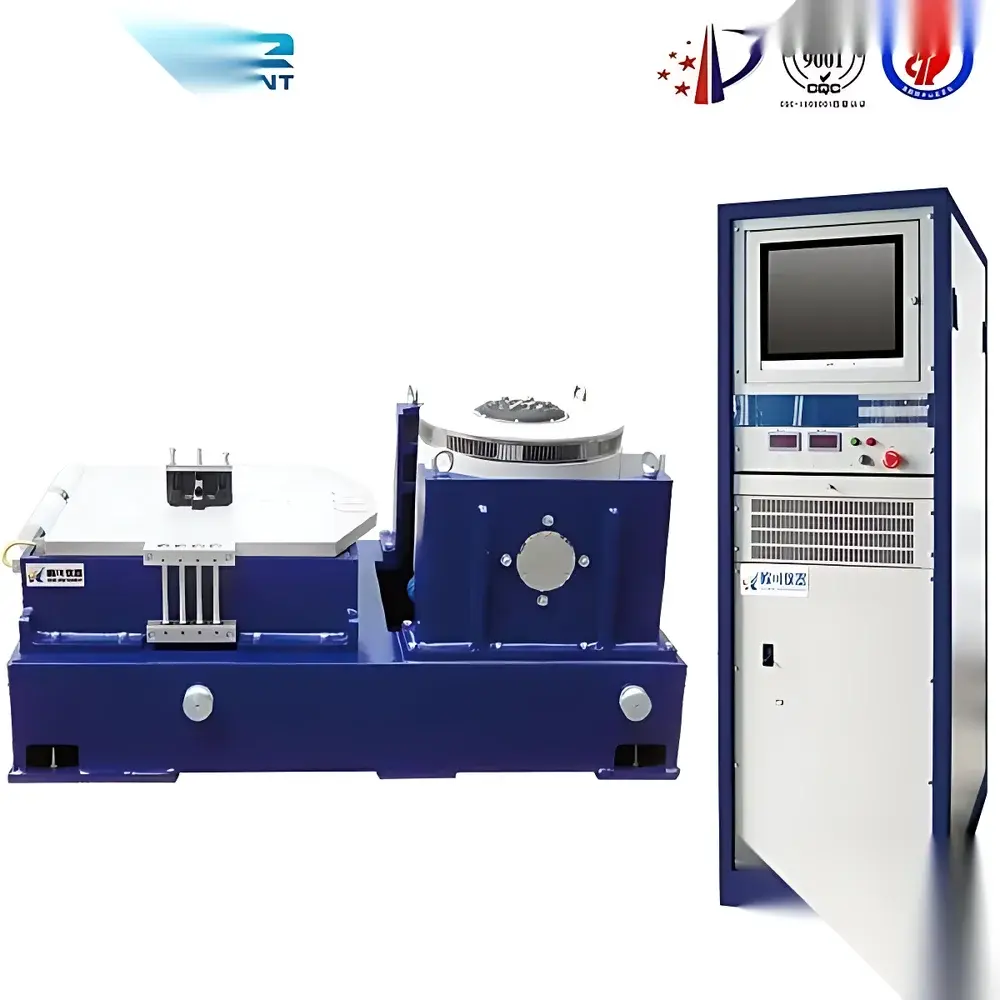
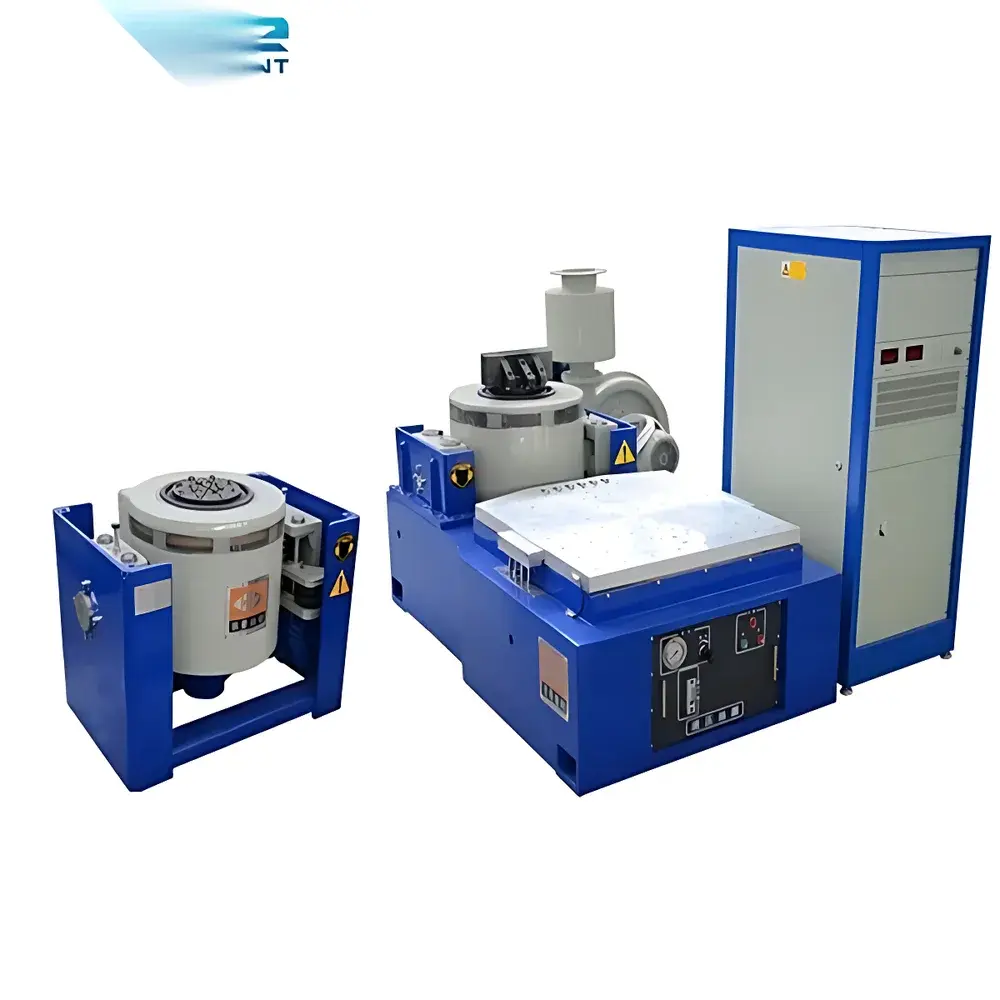
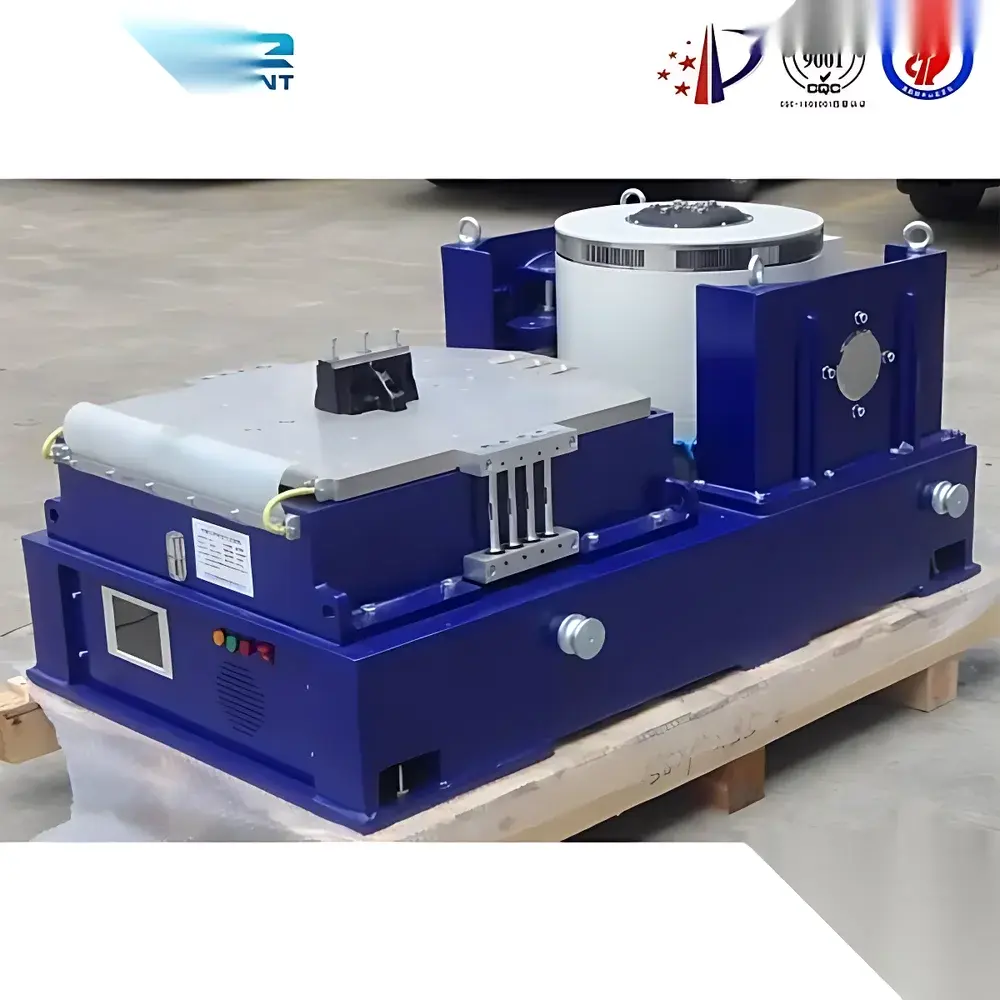
Electromagnetic Vibration Shaker OK-ES-10
| Key | Brand: Other Brands |
|---|---|
| Origin | Imported |
| Manufacturer Type | Authorized Distributor |
| Frequency Range | 0.1–100 Hz (equivalent to 6–6000 rpm) |
| Max Acceleration | 20 g (peak) |
| Max Displacement (p-p) | 5 mm |
| Nominal Displacement (p-p) | 25.4 mm @ low frequency (≤10 Hz) |
| Load Capacity | 50 kg (standard), up to 100 kg with structural reinforcement |
| Effective Table Size | 1000 × 1000 mm |
| Drive System | DC-controlled electromagnetic shaker with dual-magnetic-circuit design |
| Suspension | Pneumatic suspension with linear bearings and roller guides |
| Mounting Isolation | Cardanic gimbal (ear-axis) isolation |
| Timer Range | 0 s – 99 h 99 min |
| Speed Display Resolution | 0.1 rpm |
| Compliance Standards | EN 60068-2-6, EN 60068-2-27, ANSI S2.18, ASTM D999, ISTA 3A/3B/3E, UL 1286, MIL-STD-810H Method 514.8 & 516.8 |
Overview
The OK-ES-10 Electromagnetic Vibration Shaker is a precision-engineered electrodynamic vibration test system designed for laboratory-grade mechanical stress evaluation of components and assemblies under controlled sinusoidal, random, shock, and multi-axis excitation profiles. Operating on the principle of Lorentz force actuation—where a current-carrying coil interacts with a static magnetic field to generate controllable inertial motion—the shaker delivers high-fidelity dynamic excitation across a broad frequency spectrum (0.1–100 Hz, equivalent to 6–6000 rpm). Its dual-magnetic-circuit architecture enhances magnetic flux density and thermal efficiency, while the self-supporting voice-coil armature eliminates traditional bobbin mass penalties, enabling superior transient response and acceleration linearity. The system supports both single-axis and triaxial sequential testing configurations, and integrates seamlessly with environmental chambers for combined vibration–temperature–humidity (VTH) testing per MIL-STD-810H and IEC 60068-2-64.
Key Features
- Dual-magnetic-circuit electromagnetic drive delivering consistent 20 gpk peak acceleration capability (calculated as a = 0.002 × f² × D, where f is in Hz and D is peak-to-peak displacement in mm)
- Self-generating skeleton-type moving coil structure for enhanced thermal dissipation and reduced moving mass inertia
- Pneumatic suspension with precision linear bearings and dual-roller guidance ensures minimal lateral drift and high axial stiffness (>1.2 × 10⁶ N/m)
- Cardanic ear-axis isolation system decouples base reaction forces, minimizing floor transmission and improving test repeatability
- DC servo-controlled speed regulation with 0.1 rpm resolution and closed-loop feedback for stable amplitude tracking across frequency sweeps
- Configurable test modes: sine sweep, resonance dwell, broadband random (PSD up to 0.04 g²/Hz), classical shock pulses (half-sine, trapezoidal, terminal sawtooth), and Shock Response Spectrum (SRS) synthesis
- Robust 1000 × 1000 mm stainless steel test table with M10 threaded mounting grid (100 mm pitch), rated for 50 kg standard load (100 kg optional with reinforced support frame)
Sample Compatibility & Compliance
The OK-ES-10 accommodates a wide range of sample geometries—from PCB subassemblies and automotive ECUs to consumer electronics enclosures and aerospace avionics modules—via customizable fixture plates and inertial mass adapters. Its mechanical architecture conforms to international qualification standards including EN 60068-2-6 (vibration), EN 60068-2-27 (shock), ASTM D999 (shipping container simulation), ISTA 3-series protocols (e.g., 3A for parcel delivery, 3E for unitized loads), and MIL-STD-810H Methods 514.8 (vibration) and 516.8 (shock). All control firmware supports audit-ready data logging compliant with GLP and GMP requirements, including timestamped event markers, operator ID tagging, and unalterable calibration history records.
Software & Data Management
Control and analysis are executed via a Windows-based real-time test executive supporting IEEE 1588 Precision Time Protocol (PTP) synchronization. The software suite includes built-in FFT analyzers, PSD estimators, SRS synthesizers, and automated pass/fail threshold mapping against user-defined reference spectra. Raw time-history data is stored in ASAM MDF 4.1 format for traceability, with optional export to MATLAB (.mat), CSV, or UFF 58 formats. Full compliance with FDA 21 CFR Part 11 is achieved through electronic signature enforcement, role-based access control, and immutable audit trails covering all parameter changes, test executions, and report generations.
Applications
- Qualification of military-grade connectors and ruggedized displays per MIL-DTL-38999 and MIL-STD-461G
- Resonance screening of printed circuit board assemblies (PCBAs) prior to HALT/HASS
- Transport simulation for medical device packaging per ISO 11607-1 and ASTM D4169
- Vibration fatigue life assessment of lithium-ion battery modules under EV drivetrain spectral profiles
- Structural integrity validation of 5G base station RF front-end modules subjected to wind-induced oscillations
- Shock survivability testing of MEMS accelerometers and IMUs used in UAV navigation systems
FAQ
What is the maximum allowable displacement at 100 Hz?
At 100 Hz, the theoretical maximum peak-to-peak displacement is limited to 1 mm to maintain the 20 g acceleration ceiling, per the relationship D = 20 / (0.002 × f²).
Can this shaker perform simultaneous multi-axis vibration?
The OK-ES-10 is configured for sequential triaxial testing; simultaneous multi-axis operation requires integration with auxiliary shakers and a multi-channel controller (e.g., LDS SCADAS or Vibration Research VR9500).
Is climate chamber integration supported?
Yes—standard flange interfaces (DN200) enable direct coupling with walk-in or reach-in environmental chambers for combined vibration–temperature–humidity testing per MIL-STD-810H Figure 514.8C-1.
What power supply is required?
The system operates on three-phase 380 V AC, 50 Hz, with a dedicated 16 A circuit breaker and grounding resistance ≤5 Ω.
Does the system include calibration certification?
Each unit ships with a NIST-traceable factory calibration certificate covering acceleration sensitivity (mV/g), displacement linearity (±1.5% FS), and frequency response flatness (±1.0 dB from 5–80 Hz).



