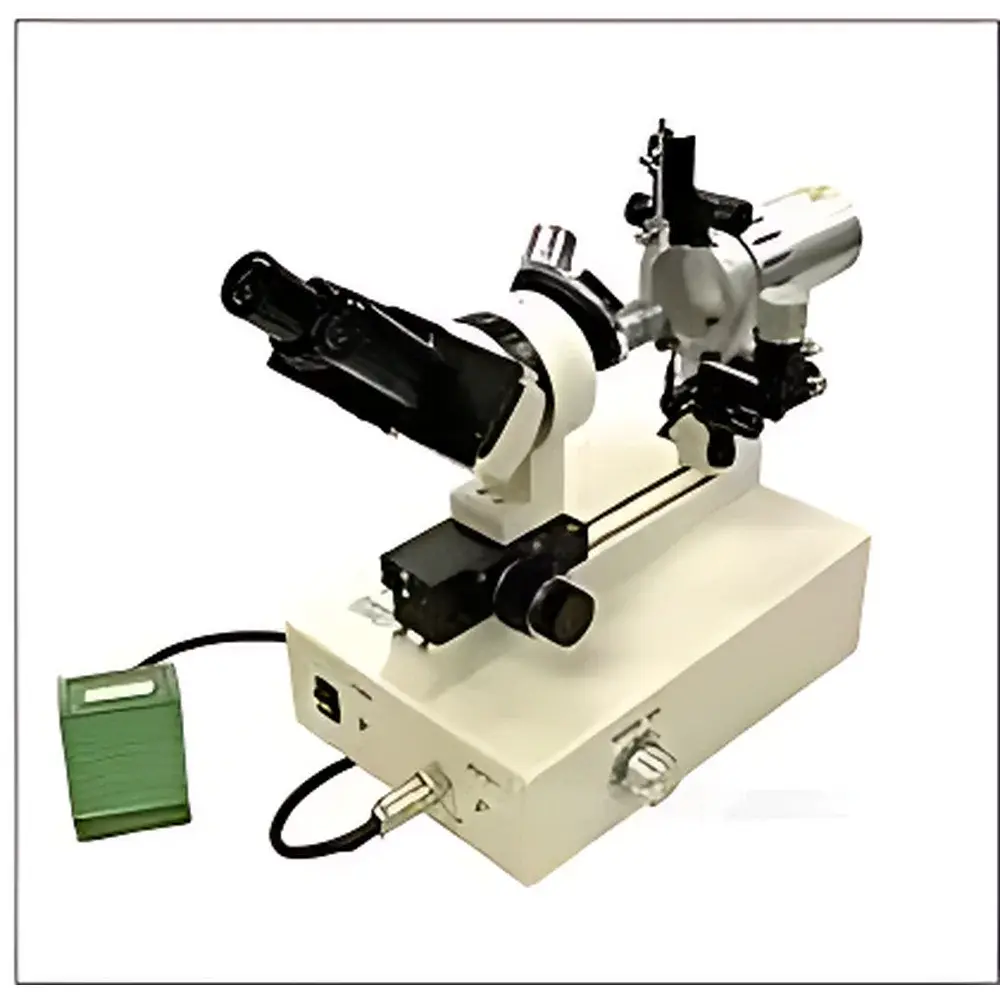
MF-830 Microelectrode Polishing System
| Origin | USA |
|---|---|
| Manufacturer Type | Authorized Distributor |
| Origin Category | Imported |
| Model | MF-830 |
| Pricing | Available Upon Request |
Overview
The MF-830 Microelectrode Polishing System is a precision-engineered instrument designed for post-pull refinement of glass micropipettes used in patch-clamp electrophysiology, single-channel recording, and intracellular microinjection. Unlike standard microforge systems that produce tapered electrodes with irregular or fractured tips, the MF-830 enables controlled thermal polishing under high-magnification optical guidance to yield smooth, symmetric, and contamination-free electrode apertures. The system operates on the principle of localized resistive heating—applying calibrated current through a fine tungsten filament positioned adjacent to the pipette tip—to induce gentle, sub-micron-level glass reflow without structural deformation. This process significantly reduces tip surface roughness and eliminates micro-fractures, thereby enabling gigaseal formation (≥1 GΩ) with improved reproducibility and longevity during whole-cell or cell-attached configurations.
Key Features
- Optical observation system with 15× wide-field eyepiece and dual magnification zoom objective (5×–35×), delivering continuous total magnification from 75× to 525× for real-time tip assessment
- Three-axis heated micromanipulator (X/Y/Z) with 14 mm travel range per axis, enabling precise spatial alignment between filament and electrode tip under visual feedback
- Dedicated electrode manipulator with independent Y-axis (12 mm) and Z-axis (28 mm) translation, optimized for fine-tuning pipette orientation relative to the heating zone
- Adjustable working distance: 0–30 mm, accommodating varied pipette lengths and holder geometries while maintaining optimal focus and thermal coupling
- Ergonomic mechanical design with tactile controls, low-drift stage mechanics, and vibration-damped base—engineered for stability during extended polishing cycles
Sample Compatibility & Compliance
The MF-830 accommodates standard borosilicate (e.g., BF150-86-10) and quartz capillaries (1.0–1.5 mm OD) pulled using horizontal or vertical pullers (e.g., Sutter P-1000, Narishige PC-10). It supports both uncoated and Sylgard 184™-coated electrodes; protocol guidance recommends coating prior to polishing to ensure uniform hydrophobic layer integrity and minimize capacitive noise in high-gain recordings. The system conforms to general laboratory safety standards for low-voltage resistive heating devices (IEC 61010-1) and is compatible with ISO 13485-aligned workflows when integrated into GLP-compliant electrophysiology laboratories. No regulatory submission (e.g., FDA 510(k)) applies, as the MF-830 is classified as a research-use-only (RUO) laboratory accessory.
Software & Data Management
The MF-830 is a fully manual, analog-controlled instrument with no embedded firmware or digital interface. All operational parameters—including filament current intensity, dwell time, and positional coordinates—are set via calibrated mechanical dials and verified visually through the optical path. This architecture ensures deterministic repeatability, eliminates software-related validation overhead, and facilitates straightforward audit-trail documentation per FDA 21 CFR Part 11 requirements when paired with laboratory notebooks or LIMS entries. Calibration records for manipulator linearity and magnification fidelity are maintained per institutional SOPs.
Applications
- Gigaseal optimization in whole-cell and perforated-patch configurations
- Tip smoothing for high-resistance (>5 MΩ) sharp microelectrodes used in intracellular potential recording
- Preparation of low-noise electrodes for single-channel analysis requiring minimal transmural capacitance
- Refinement of coated electrodes (Sylgard, Sigmacote®) where surface homogeneity directly impacts seal stability
- Quality assurance step in core electrophysiology facilities supporting neuroscience, cardiac pharmacology, and ion channel screening platforms
FAQ
Is the MF-830 compatible with quartz micropipettes?
Yes—the heating filament and optical geometry support both borosilicate and fused quartz capillaries within standard outer diameter ranges.
Can I polish electrodes after Sylgard coating?
Yes; the recommended workflow is coating first, then polishing at reduced filament power to avoid polymer degradation while achieving tip smoothness.
Does the system include calibration documentation?
A traceable mechanical calibration certificate for manipulator travel accuracy and magnification verification is provided with each unit.
What maintenance is required?
Annual inspection of filament integrity, optical lens cleaning, and mechanical play assessment—no consumables beyond replacement tungsten filaments.
Is technical support available internationally?
Yes—authorized distributors provide installation assistance, application training, and service coordination through regional service centers.