
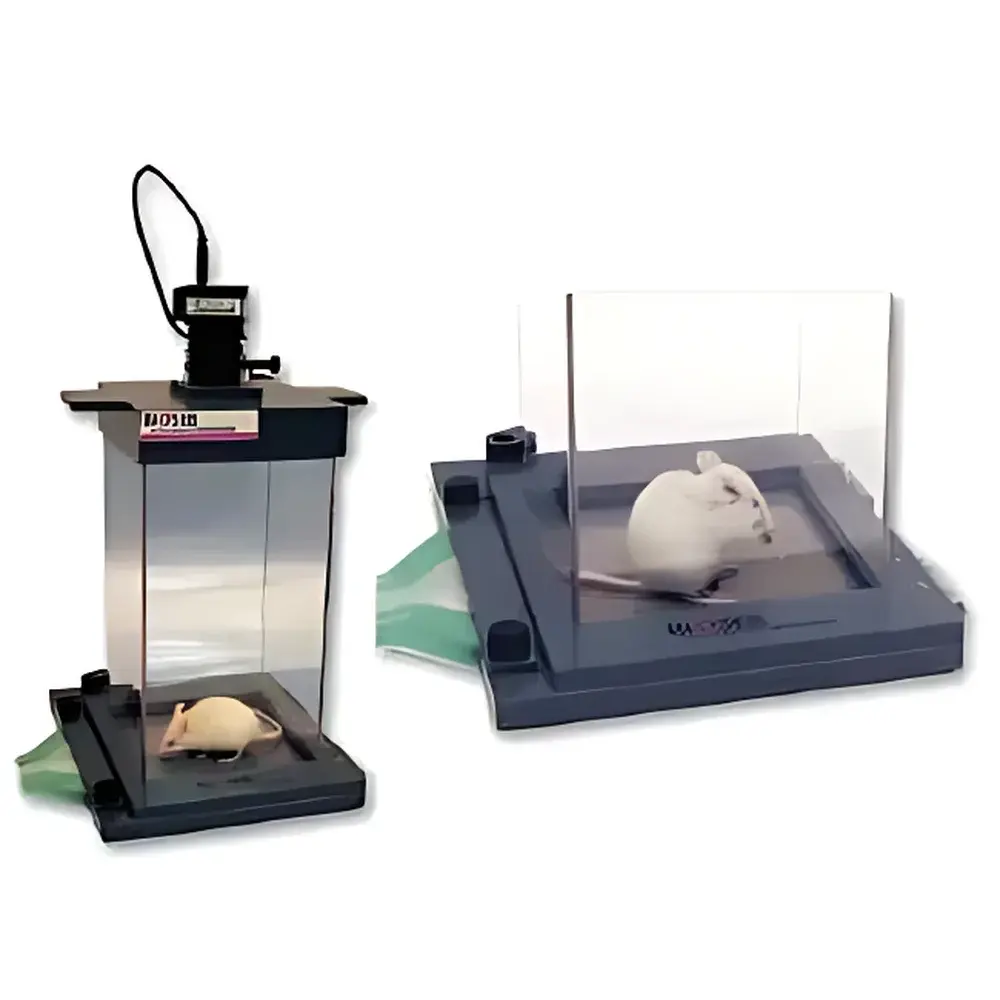
Bioseb BIO-DWB Quadruped Dynamic Weight Bearing System
| Brand | Harvard Apparatus |
|---|---|
| Origin | USA |
| Manufacturer Type | Authorized Distributor |
| Import Status | Imported |
| Model | BIO-DWB |
| Price Range | USD 1,400 – 7,000 |
| Sensor Accuracy (Mouse) | ±1 g |
| Sensor Resolution (Mouse) | 0.2 g |
| Sensor Range (Mouse) | 15–50 g |
| Sensor Range (Rat) | 150–500 g |
| Sensor Resolution (Rat) | 0.8 g |
| Chamber Dimensions (Mouse) | 11.5 × 11.5 × 22 cm (L×W×H) |
| Chamber Dimensions (Rat) | 22 × 22 × 30 cm (L×W×H) |
| External Dimensions (Mouse) | 17 × 17 × 22 cm |
| External Dimensions (Rat) | 30 × 30 × 35 cm |
| Weight (Mouse Unit) | 1 kg |
| Weight (Rat Unit) | 2.5 kg |
| Floor Material | Gray Polypropylene Copolymer (PPC) |
| Wall Material | Transparent PPC |
| Interface | USB 2.0 |
| OS Compatibility | Windows 7 or later |
| Minimum CPU | Intel Core i3 or i5 |
| Minimum RAM | 3 GB |
Overview
The Bioseb BIO-DWB Quadruped Dynamic Weight Bearing System is a precision-engineered behavioral phenotyping instrument designed for objective, non-invasive quantification of weight distribution across all four paws of freely moving rodents. Unlike reflex-based nociception assays, the BIO-DWB operates on a principle of continuous, real-time biomechanical load measurement using high-resolution capacitive force sensors embedded within the floor substrate—enabling detection of subtle asymmetries in dynamic weight bearing without external stimulation, restraint, or pharmacological provocation. This makes it particularly suited for longitudinal assessment of sensorimotor deficits in preclinical models of neuropathic pain, spinal cord injury (SCI), Parkinson’s disease, hemiparetic stroke, and peripheral nerve disorders. The system integrates synchronized high-frame-rate video tracking with spatially resolved force transduction to generate time-stamped, paw-specific load profiles—capturing not only peak force but also temporal parameters such as stance duration, inter-limb coordination, and weight transfer dynamics.
Key Features
- Simultaneous, independent real-time recording of vertical ground reaction forces (GRF) from all four paws with sub-gram resolution (0.2 g for mice; 0.8 g for rats)
- Automated paw localization and footprint segmentation via synchronized video + sensor fusion algorithm, eliminating manual frame-by-frame annotation
- Integrated validation workflow: side-by-side playback of raw video footage and corresponding force heatmaps with frame-accurate temporal alignment
- Manual correction module for misclassified paw contacts—supporting post-acquisition data curation under GLP-compliant audit trails
- Dual-chamber configurations optimized for murine (11.5 × 11.5 × 22 cm internal) and rat (22 × 22 × 30 cm internal) subjects, housed within low-profile, optically transparent polypropylene copolymer enclosures
- USB-powered operation compatible with standard Windows-based workstations; no external power supply or signal conditioning hardware required
- Export-ready output formats including CSV (time-series force vectors), XML (metadata-rich experiment logs), and AVI (synchronized video-force overlays)
Sample Compatibility & Compliance
The BIO-DWB accommodates both C57BL/6, BALB/c, and CD-1 mice (15–50 g body mass range) and Sprague-Dawley or Wistar rats (150–500 g). Its non-restrictive open-field design supports spontaneous locomotion over extended observation windows (up to 30 min/session), minimizing stress-induced confounds. All sensor calibration protocols follow ISO/IEC 17025 traceable procedures, and firmware timestamps are synchronized to system clock with <10 ms jitter. Data integrity meets FDA 21 CFR Part 11 requirements for electronic records—including user authentication, version-controlled analysis scripts, and immutable audit logs for every export or correction event. The device complies with ASTM E2509-22 standards for behavioral instrumentation validation in neuropharmacology studies.
Software & Data Management
The proprietary Bioseb DWB Analysis Suite (v4.2+) provides a modular GUI for acquisition, visualization, and statistical modeling. It includes built-in modules for calculating asymmetry indices (e.g., % weight shift, inter-limb ratio deviation), gait cycle segmentation (stance/swing phase identification), and cross-correlation analysis between limb loading patterns. Raw datasets are stored in HDF5 format to ensure scalability across multi-animal, multi-session experiments. The software supports batch processing with customizable QC filters (e.g., minimum contact duration, force thresholding) and exports compliant with MIAME and MIAPE reporting guidelines. Integration with MATLAB and Python (via documented REST API) enables custom algorithm development for machine learning–based gait classification.
Applications
- Quantitative evaluation of mechanical allodynia and spontaneous pain behavior in chronic constriction injury (CCI), spared nerve injury (SNI), or chemotherapy-induced peripheral neuropathy (CIPN) models
- Functional recovery monitoring after thoracic or lumbar SCI—tracking restoration of bilateral weight-bearing symmetry over weeks
- Phenotypic characterization of transgenic Parkinson’s models (e.g., A53T α-synuclein mice) through progressive hindlimb loading deficits
- Assessment of dopaminergic therapeutics by measuring dose-dependent normalization of forelimb bias in 6-OHDA lesioned rats
- Validation endpoint in preclinical trials of neuroregenerative scaffolds or stem cell grafts targeting motor circuit repair
FAQ
What species and weight ranges does the BIO-DWB support?
The system is validated for mice (15–50 g) and rats (150–500 g); two physically distinct chamber variants prevent cross-species calibration drift.
Is anesthesia or restraint required during testing?
No—subjects are tested in fully awake, unrestrained conditions, enabling naturalistic locomotor behavior without sedation artifacts.
How is data synchronization between video and force sensors achieved?
Hardware-level genlock synchronization ensures sub-millisecond alignment between camera frame triggers and sensor sampling clocks.
Can the system be used for longitudinal studies across multiple timepoints?
Yes—the software maintains persistent animal ID profiles with versioned analysis pipelines, supporting automated reprocessing of legacy datasets with updated algorithms.
Does the BIO-DWB meet regulatory requirements for IND-enabling toxicology studies?
It conforms to ICH S7B and FDA guidance for functional CNS endpoints; full validation documentation (IQ/OQ/PQ) is available upon request for GMP-aligned labs.



