
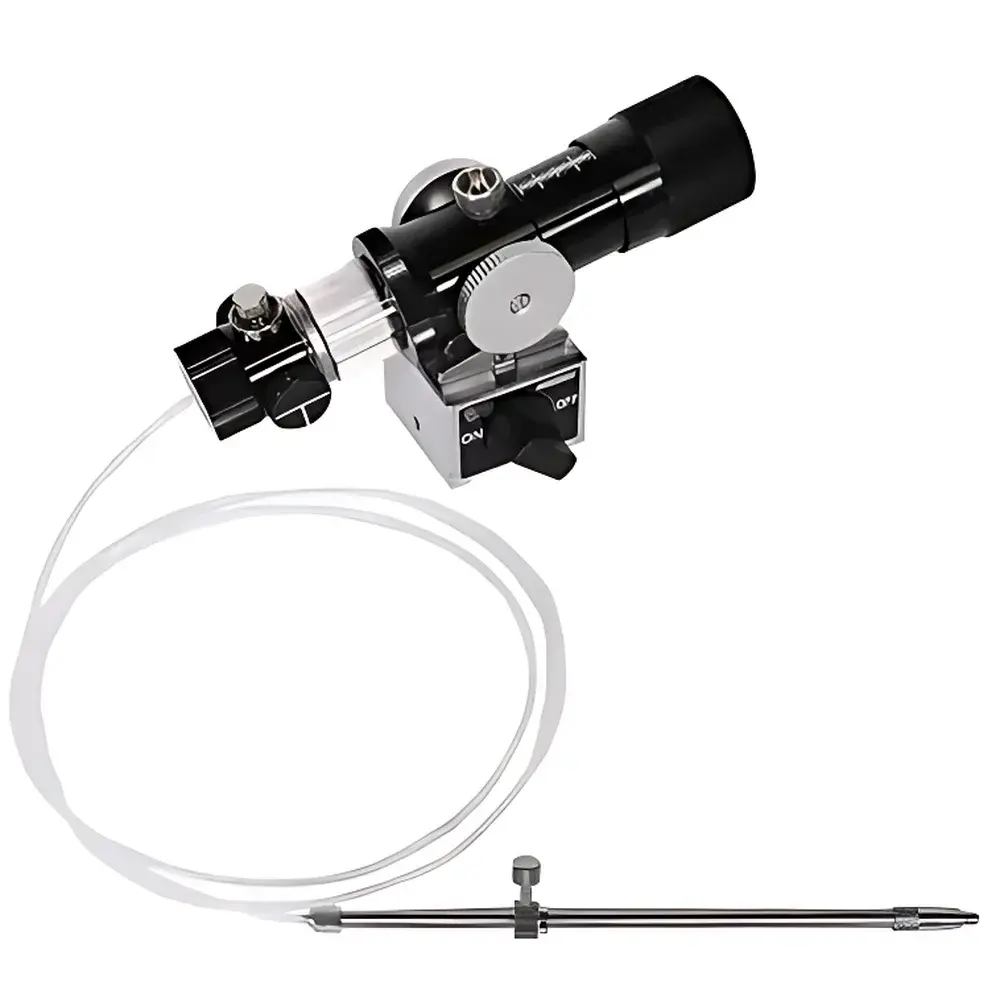
Narishige IM-21 Manual Microinjector
| Brand | Narishige |
|---|---|
| Origin | Japan |
| Model | IM-21 |
| Plunger Travel | 20 mm |
| Full-Rotation Volume Displacement | ~10 µL |
| Micrometer Resolution | 0.5 µm per division (500 µm per full knob rotation) |
| Dimensions | W127–147 × D55 × H78 mm |
| Weight | 620 g |
| Tubing Length | 1 m |
| Accessories | IM-H3 Holder, HI01PK01 Silicone Pad, IMO4 O-Ring, Grease Kit |
Overview
The Narishige IM-21 Manual Microinjector is a precision-engineered mechanical microinjection device designed for reproducible, low-volume fluid delivery in demanding biological and embryological applications. Operating on a calibrated micrometer-driven plunger mechanism, the IM-21 translates fine rotational motion into precise linear displacement—enabling controlled, stepwise injection without reliance on external power sources or electronic feedback loops. Its robust all-metal construction, combined with high-tolerance machining and silicone-based sealing components, ensures long-term dimensional stability and minimal hysteresis during repeated use. The instrument is optimized for intracellular and subcellular delivery tasks where real-time tactile control, zero electrical noise, and compatibility with inverted microscopy setups are critical—particularly in electrophysiology rigs, micromanipulation workstations, and cleanroom-based assisted reproductive technology (ART) labs.
Key Features
- Micrometer-Actuated Plunger System: A dual-scale micrometer knob provides coarse and fine adjustment; one full 360° rotation advances the plunger by 500 µm, corresponding to approximately 10 µL volume displacement depending on syringe inner diameter—enabling predictable, repeatable dosing across multiple experimental sessions.
- 20 mm Total Plunger Stroke: Sufficient travel range to accommodate standard glass capillaries (e.g., 10–100 µL volume capacity) and support multi-step injection protocols such as sequential cytoplasmic and nuclear targeting.
- Modular Mechanical Design: Integrates seamlessly with Narishige’s IM-H3 universal holder for stable mounting on micromanipulators (e.g., MO-202, MN-4); compatible with both vertical and angled orientation on inverted or upright microscopes.
- Chemically Resistant Sealing System: Includes OEM-specified silicone rubber pads (HI01PK01), fluorocarbon O-rings (IMO4), and medical-grade silicone grease to ensure leak-free operation with aqueous buffers, ethanol-washed reagents, and viscous nucleic acid solutions (e.g., CRISPR RNP complexes).
- Zero-Electromagnetic-Interference Operation: Fully manual actuation eliminates signal artifacts in simultaneous patch-clamp recordings or fluorescence imaging—critical for correlative functional assays in live-cell physiology.
Sample Compatibility & Compliance
The IM-21 supports a broad spectrum of biological samples requiring nanoliter-to-microliter scale delivery under visual guidance. It is routinely employed in murine and bovine oocyte microinjection (ICSI, pronuclear injection), zebrafish and Xenopus embryo manipulation, stem cell line transfection (ES/iPS), and somatic cell nuclear transfer (SCNT). All wetted materials comply with ISO 10993-5 (cytotoxicity) and USP Class VI biocompatibility standards. While the device itself carries no CE/UKCA marking as a standalone mechanical tool, its use within GLP- and GMP-regulated workflows (e.g., preclinical gene therapy vector production) is supported by full traceability of component lot numbers and documented cleaning validation procedures using 70% ethanol and autoclavable accessories.
Software & Data Management
The IM-21 operates independently of software control and does not generate digital output. However, it is fully interoperable with third-party documentation systems: injection timing, plunger position, and syringe calibration data can be manually logged in electronic lab notebooks (ELNs) compliant with 21 CFR Part 11 requirements when paired with audit-trail-enabled platforms (e.g., LabArchives, Benchling). For standardized reporting, users may reference ASTM F2942–14 (“Standard Practice for Calibration of Microinjection Systems”) to validate volumetric accuracy prior to critical experiments.
Applications
- Intracytoplasmic sperm injection (ICSI) in human and animal ART laboratories
- Genome editing delivery: CRISPR-Cas9 ribonucleoprotein (RNP), sgRNA, and donor DNA into zygotes or blastomeres
- Lineage tracing via fluorescent dextran or mRNA co-injection in early embryos
- Cytoplasmic transfer and mitochondrial replacement therapy (MRT) research
- Single-cell electroporation adjunct—used to preload electrodes or deliver adjuvants prior to pulse application
- Microinjection of tracer molecules (e.g., Lucifer Yellow) into neurons or epithelial monolayers for connectivity mapping
FAQ
Is the IM-21 compatible with oil-filled hydraulic micromanipulators?
Yes—the IM-21’s mechanical interface and sealed plunger assembly prevent cross-contamination with mineral oil used in Narishige MO-series manipulators.
What syringe types are recommended for optimal performance?
Standard borosilicate glass capillaries (e.g., Drummond NanoFil®, World Precision Instruments Femtotips®) with outer diameters of 1.0–1.2 mm and inner diameters of 10–50 µm are verified for consistent flow behavior.
How often should the O-rings and silicone pads be replaced?
Under routine use (≤5 injections/day), replace IMO4 O-rings every 6 months and HI01PK01 pads annually—or immediately after exposure to chloroform, acetone, or high-concentration DMSO.
Can the IM-21 be sterilized?
The main body is not autoclavable; however, detachable components (holder, cleaning rod, syringe adapter) may undergo dry-heat sterilization at 160°C for 2 hours per ISO 15883-1 guidelines.
Does Narishige provide calibration certificates for the IM-21?
No factory-issued calibration certificate is supplied, but users may perform in-house verification using gravimetric methods per ISO/IEC 17025-accredited protocols, referencing NIST-traceable analytical balances and certified pipette calibrators.





