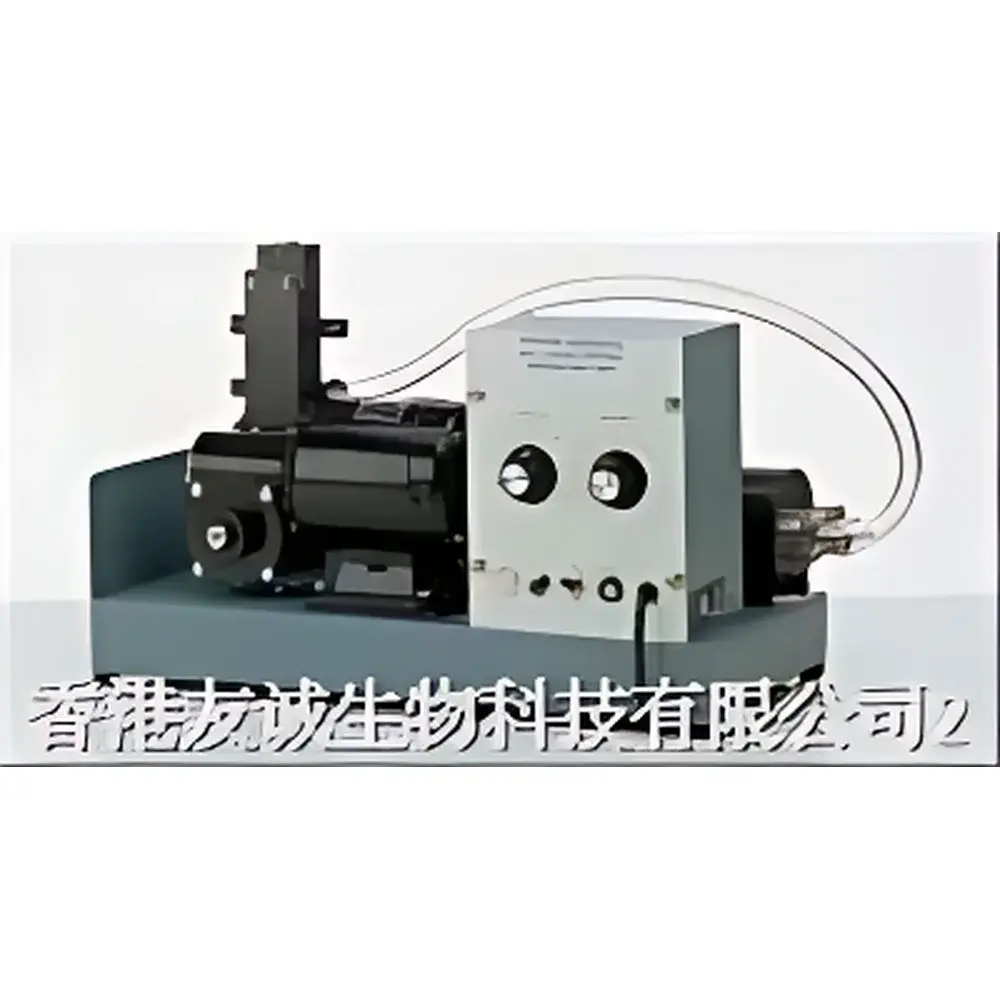
Harvard Apparatus Model 613 Large Animal Ventilator
| Brand | Harvard Apparatus |
|---|---|
| Origin | USA |
| Model | 613 |
| Tidal Volume Range | 30–750 mL |
| Respiratory Rate | 7–50 breaths/min |
| I | E Ratio: 25–50% |
| Dimensions (H×W×D) | 30 × 50 × 22.5 cm |
| Weight | 21 kg |
| Inlet/Outlet ID | 12.7 mm |
| Inlet/Outlet OD | 14.4 mm |
| Power Options | 115 VAC or 230 VAC |
| Animal Weight Range | 1.5–50 kg |
| PEEP Capability | Yes (via water column) |
| Compliance | CE-marked |
| Gas Supply | Medical air or non-flammable gases |
Overview
The Harvard Apparatus Model 613 Large Animal Ventilator is a robust, piston-driven, volume-controlled ventilator engineered for precision and reliability in preclinical large animal research. Designed specifically for use with animals weighing between 1.5 kg and 50 kg—including dogs, pigs, cats, rabbits, and large rodents—the Model 613 delivers consistent tidal volumes across its full operating range (30–750 mL per stroke) using a mechanically actuated piston mechanism. Unlike pressure-controlled or flow-controlled systems, this ventilator operates on a fixed-displacement principle: each full stroke of the piston delivers a predetermined volume, ensuring high reproducibility under stable experimental conditions. Its mechanical architecture eliminates electronic feedback loops during ventilation, making it particularly suitable for electrophysiology, MRI-compatible setups, or environments where electromagnetic interference must be minimized. The device integrates seamlessly into GLP-compliant and IACUC-approved animal surgery suites, supporting long-term physiological monitoring and acute intervention studies.
Key Features
- Piston-based volume control ensures deterministic tidal delivery without reliance on real-time pressure or flow sensors.
- Adjustable respiratory rate (7–50 breaths/min) and inspiratory-to-expiratory (I:E) ratio (25–50%)—both modifiable during active ventilation.
- Dedicated four-port gas manifold: inlet (for medical air or non-flammable gases), animal outlet (to tracheal tube), animal return (from circuit), and exhaust port connected to a calibrated water column for precise PEEP generation (typically 0–20 cm H₂O).
- CE-marked design compliant with EU Medical Device Directive 93/42/EEC (Class IIa), meeting essential safety and performance requirements for laboratory-use ventilators.
- Two standard power configurations available: 115 VAC (Model 550715) and 230 VAC (Model 550723), both equipped with fused line filters and grounded chassis for electrical safety.
- Modular service design: All critical wear components—including O-rings, valve springs, and lubricants—are field-replaceable via part number 550731, enabling extended operational lifetime and reducing downtime.
Sample Compatibility & Compliance
The Model 613 supports intubated or tracheostomized subjects across a broad weight spectrum (1.5–50 kg), with tubing interface specifications (ID 12.7 mm / OD 14.4 mm) compatible with standard large-animal breathing circuits and CO₂ absorbers. It is routinely deployed in studies requiring adherence to NIH OLAW, AAALAC International, and European Directive 2010/63/EU standards for humane animal experimentation. While not intended for human clinical use, its mechanical simplicity and traceable calibration history support audit readiness under GLP frameworks. The absence of digital displays or software interfaces simplifies validation protocols and avoids regulatory complications associated with computerized system qualification (e.g., FDA 21 CFR Part 11). All units ship with CE documentation, RoHS compliance statements, and manufacturer’s declaration of conformity.
Software & Data Management
The Model 613 operates as a standalone electromechanical instrument with no embedded firmware, touchscreen, or data logging capability. This analog architecture eliminates the need for software validation, cybersecurity hardening, or electronic audit trail implementation—critical advantages in regulated academic and contract research organizations (CROs) managing multiple concurrent studies. Respiratory parameters are set manually via calibrated dials and mechanical stops; all adjustments are physically indexed and repeatable. Integration with external data acquisition systems (e.g., ADInstruments PowerLab, BIOPAC MP160) is achieved via analog TTL triggers or pressure transducer outputs (available through optional accessory ports), allowing synchronized recording of ventilator timing signals alongside physiological waveforms (ECG, BP, SpO₂).
Applications
- Acute surgical physiology: Thoracotomy, craniotomy, and cardiovascular interventions in canine, porcine, and feline models.
- Pharmacological challenge studies requiring stable, repeatable ventilation during drug infusion or toxin exposure.
- Respiratory mechanics investigations—including resistance and compliance measurements—when paired with pneumotachographs and differential pressure transducers.
- Neurophysiology experiments where EMI-free operation is mandatory (e.g., intraoperative cortical mapping or deep-brain stimulation).
- Training platforms for veterinary anesthesiology and comparative medicine curricula.
- Long-term ventilator support in recovery studies up to 72 hours, supported by validated thermal management and low-vibration motor design.
FAQ
Can tidal volume be adjusted while the ventilator is running?
No. Tidal volume is set mechanically via piston stroke length and must be configured only when the unit is powered off and depressurized.
Does the Model 613 support pressure-controlled ventilation modes?
No. It is exclusively a volume-controlled, time-cycled ventilator with no pressure-limiting or adaptive targeting algorithms.
Is PEEP adjustable, and how is it implemented?
Yes. PEEP is generated passively via a user-filled water column attached to the exhaust port; height determines backpressure (e.g., 10 cm H₂O = 10 cm water column height).
What gases are compatible with the Model 613?
Medical-grade air, nitrogen, helium, or any non-flammable, non-corrosive gas; oxygen enrichment requires external blending upstream of the inlet port.
Is the device suitable for use inside MRI scanners?
Yes—its fully non-magnetic construction (no ferrous components, brushed DC motor, and mechanical controls) enables safe operation within MRI suite environments (up to 3T), subject to local RF shielding verification.
What maintenance intervals are recommended?
Harvard Apparatus recommends quarterly inspection of O-rings and valve springs, annual recalibration of stroke displacement, and biannual lubrication of the piston assembly using specified silicone-based lubricant (part #550731-04).