
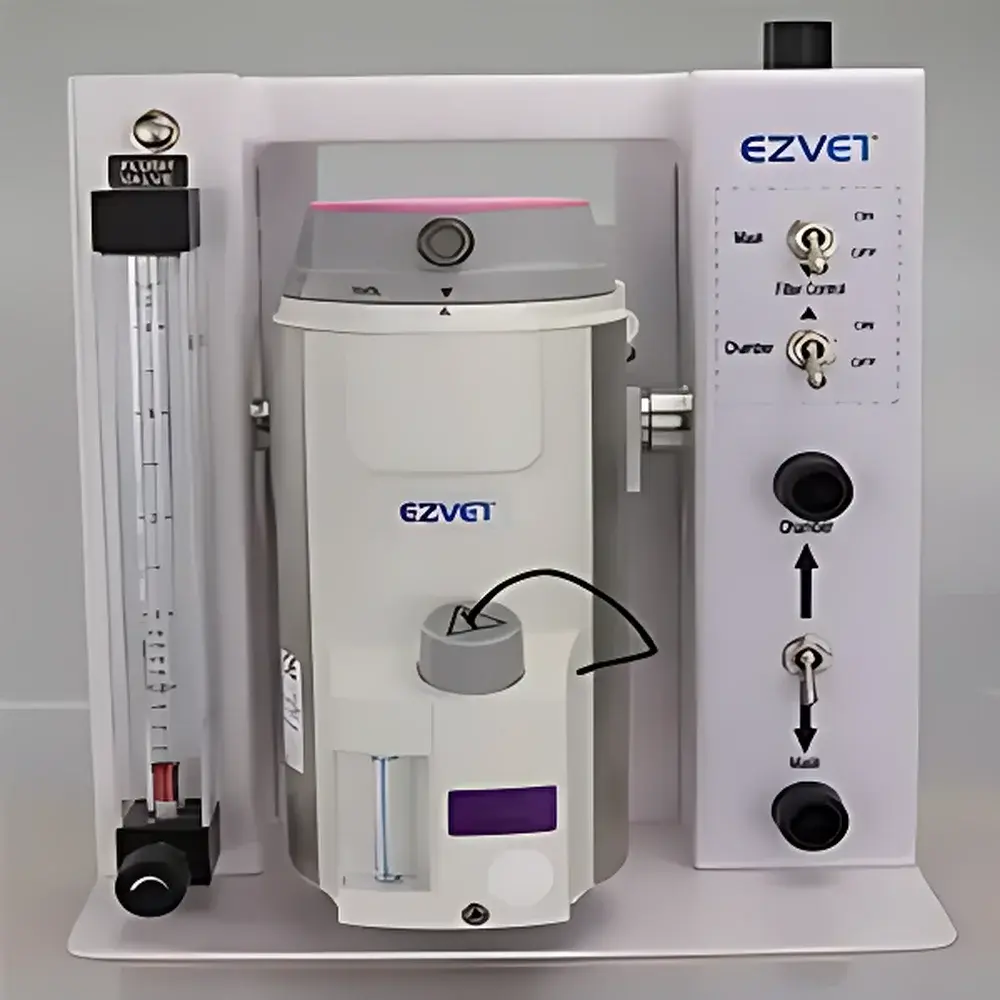
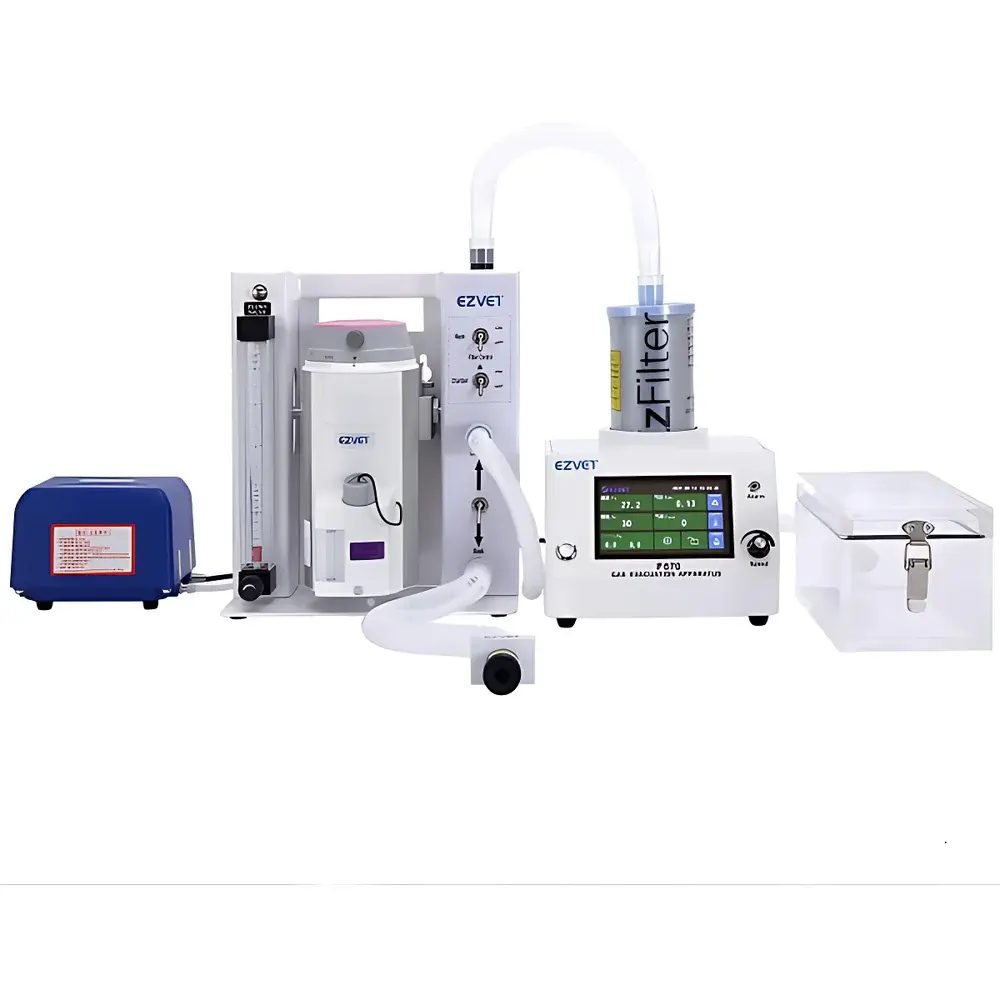
EZ Vet F500 Small Animal Anesthesia Machine
| Brand | EZ Vet |
|---|---|
| Model | F500 |
| Animal Weight Capacity | ≤ 7.0 kg |
| Anesthetic Agents | Isoflurane and Sevoflurane compatible |
| Vaporizer Type | Precision calibrated, interchangeable dual-agent vaporizer |
| Safety Features | Agent lockout mechanism, large-view sapphire-reinforced glass gauge, coaxial scavenging-integrated breathing circuit |
| Form Factor | Benchtop (upgradable to mobile cart configuration) |
| Compliance | Designed per ISO 8536-4 (gas anesthesia equipment), meets GLP-aligned operational safety requirements for preclinical research environments |
| Price Range | USD 700 – 1,400 (FOB Beijing) |
Overview
The EZ Vet F500 Small Animal Anesthesia Machine is a benchtop, precision-engineered inhalation anesthesia delivery system designed exclusively for laboratory animals weighing up to 7.0 kg. It operates on the principle of calibrated volatile anesthetic vaporization—utilizing temperature- and flow-compensated vaporizers to deliver consistent, traceable concentrations of isoflurane or sevoflurane in medical-grade oxygen or oxygen–air mixtures. The system adheres to fundamental gas dynamics principles governing carrier gas flow rate (typically 0.5–2.0 L/min), vapor pressure differentials, and saturated vapor output stability. Its architecture supports both spontaneous breathing and controlled ventilation modes when interfaced with external small-animal ventilators. Intended for use in academic research laboratories, preclinical CROs, veterinary teaching facilities, and GLP-compliant pharmacology units, the F500 provides reproducible anesthetic depth control without reliance on injectable agents—reducing metabolic interference in longitudinal physiological or pharmacokinetic studies.
Key Features
- Interchangeable, agent-specific vaporizers for isoflurane and sevoflurane—each factory-calibrated and independently verified for ±0.1% vol accuracy across standard flow and temperature ranges.
- Coaxial integrated breathing circuit with built-in active scavenging port—minimizes ambient anesthetic leakage and complies with occupational exposure limits (NIOSH REL: 2 ppm isoflurane; ACGIH TLV: 50 ppm sevoflurane).
- One-touch circuit purge function enabling rapid washout of residual anesthetic between procedures—critical for minimizing carryover in sequential multi-animal studies.
- Large-diameter, scratch-resistant sapphire-reinforced glass vaporizer level window—enabling real-time visual monitoring of agent volume without opening the vaporizer housing.
- Mechanical safety lockout prevents accidental vaporizer activation during transport or maintenance—meeting ISO 80601-2-13 requirements for unintended agent release prevention.
- Benchtop footprint (320 × 240 × 180 mm) with optional castor-mounted mobile cart integration—facilitating reconfiguration across surgical suites, imaging rooms, and teaching labs.
Sample Compatibility & Compliance
The F500 is validated for use with mice, rats, guinea pigs, rabbits, and domestic cats—covering >92% of common rodent and companion animal models in biomedical research. It supports mask induction, nose-cone delivery, and intubation-based administration via standard 15/22 mm tapered connectors. All wetted materials comply with USP Class VI biocompatibility standards. Device documentation includes traceable calibration certificates for vaporizer output, airflow sensor linearity verification (±2% FS), and leak-test protocols aligned with ASTM F1850-22 (Standard Practice for Leak Testing Anesthesia Machines). While not FDA-cleared as a human medical device, its design incorporates fail-safes referenced in ISO 8536-4 Annex B for veterinary and preclinical applications—including downstream O2 monitoring readiness and pressure-limiting pop-off valves.
Software & Data Management
The F500 operates as a standalone analog-controlled system with no embedded microprocessor or digital interface—ensuring electromagnetic compatibility in MRI, electrophysiology, and optical imaging environments where RF noise must be minimized. All adjustments (flow rate, vaporizer dial setting, O2 concentration) are manually actuated with tactile feedback and mechanical detents. For laboratories requiring audit trails, optional third-party analog-to-digital converters (e.g., National Instruments USB-6009) can log inlet O2 pressure, vaporizer dial position, and auxiliary flow meter outputs into LabChart or MATLAB-based acquisition platforms. Full service documentation—including maintenance logs, vaporizer recalibration records, and leak-test reports—is structured to support GLP audit readiness and institutional IACUC review cycles.
Applications
The F500 serves core functions across multiple preclinical workflows: intraoperative anesthesia during stereotaxic surgery or orthopedic implantation; stable sedation for longitudinal in vivo imaging (MRI, PET, bioluminescence); synchronized anesthesia delivery in optogenetics experiments requiring precise temporal coupling between light stimulation and neural state; and standardized endpoint anesthesia in toxicology or PK/PD studies. Its rapid induction/recovery profile supports high-throughput procedures such as retro-orbital bleeds, subcutaneous tumor cell injection, or tail vein cannulation in rats. In educational settings, it enables hands-on training in ASA-recommended anesthetic monitoring—pulse oximetry integration, capnography readiness, and manual respiration rate assessment—without introducing software abstraction layers that obscure first-principles understanding.
FAQ
Is the F500 suitable for use with non-rodent species such as ferrets or young dogs?
Yes—provided total body weight remains ≤7.0 kg and appropriate endotracheal tube size and breathing circuit resistance are selected. Flow rates and vaporizer settings must be adjusted per species-specific MAC values.
Can the F500 be connected to a ventilator for controlled mechanical ventilation?
Yes—its 15 mm male/female breathing circuit ports conform to ISO 5356-1, enabling direct coupling to small-animal ventilators (e.g., Harvard Apparatus Rodent Ventilator, Kent Scientific SAR-830/AP). Back-pressure tolerance is rated to 30 cm H2O.
Does the system include oxygen supply regulation?
The F500 requires external O2 source (tank or pipeline) regulated to 40–50 psi input pressure. Integrated needle valve allows fine-tuning of fresh gas flow from 0.1 to 3.0 L/min.
What maintenance intervals are recommended for the vaporizer?
Vaporizer output verification is required every 6 months per ISO 8536-4; full recalibration annually or after physical impact. Internal wick replacement is recommended every 24 months under continuous-use conditions.
Is training provided for IACUC compliance documentation?
EZ Vet supplies a standardized SOP template (aligned with OLAW Guidance Appendix A) covering daily leak checks, vaporizer log entries, and animal monitoring checklists—adaptable to institutional animal care program requirements.
Related Products




