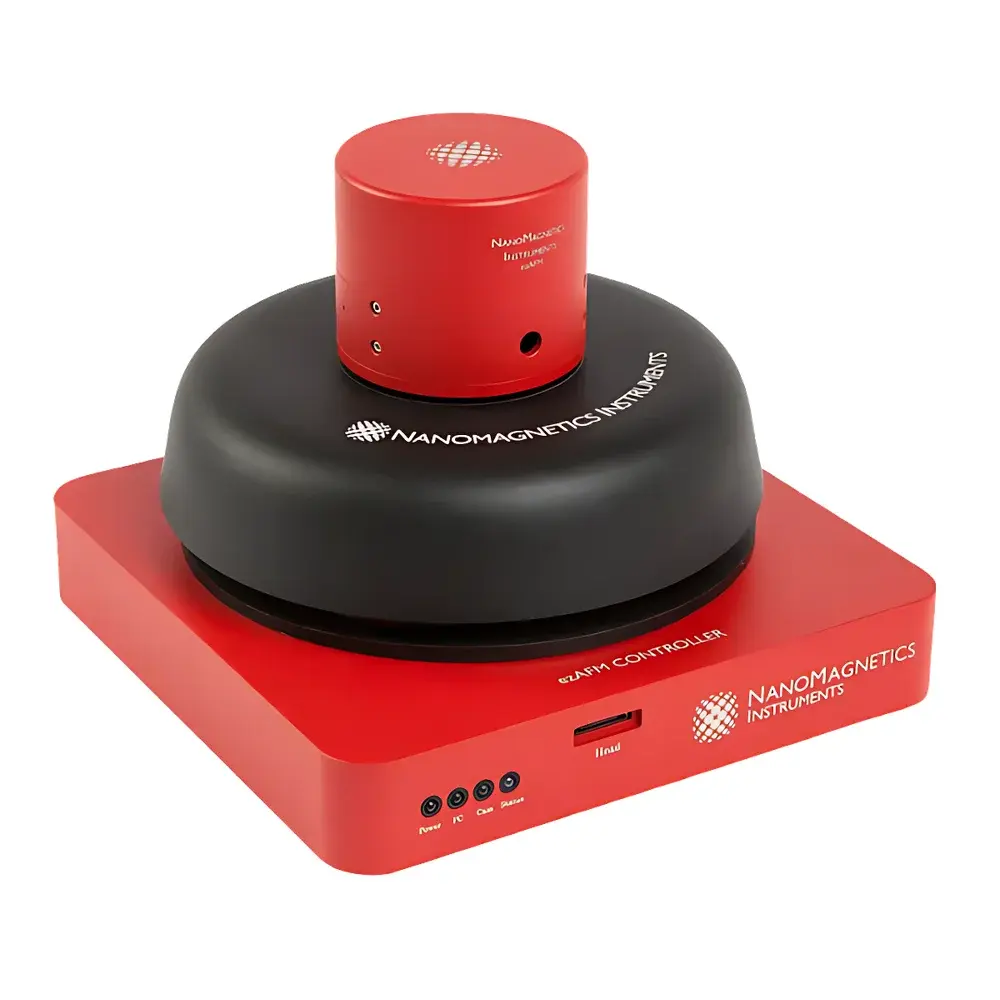
NanoMagnetics ezAFM Portable Atomic Force Microscope
| Brand | NanoMagnetics |
|---|---|
| Origin | United Kingdom |
| Model | ezAFM |
| Instrument Type | Material-Grade AFM |
| Position Detection Noise | 75 fm/√Hz |
| Maximum Sample Dimensions | 10 × 10 × 5 mm |
| XY Stage Travel Range | 38 × 38 mm |
| Scan Areas | 120 × 120 × 40 µm (Z resolution: 0.2 nm) or 40 × 40 × 4 µm (Z resolution: 0.02 nm) |
| Lateral Resolution | 16 nm (large scan) / 5 nm (high-res scan) |
| Optical View System | Full HD CCD, 2 µm resolution, 390 × 230 µm FOV, 2516 × 1960 pixels, 30 fps |
| Controller | 24-bit ADC/DAC, FPGA/DSP-based digital feedback |
| Standard Imaging Modes | Contact, Tapping, Phase, LFM, MFM |
| Extended Modes (ezAFM+) | EFM, KPFM, C-AFM, SSRM, PRFM, FMM, nanomechanical mapping, liquid-phase, vacuum-compatible configurations |
Overview
The NanoMagnetics ezAFM is a compact, high-stability portable atomic force microscope engineered for precision nanoscale surface characterization in constrained laboratory environments. Operating on the principle of piezoelectrically driven probe-sample interaction and optical beam deflection detection, the ezAFM delivers quantitative topographic, mechanical, electrical, and magnetic data across ambient, liquid, and vacuum conditions. Its modular architecture supports rapid reconfiguration between standard and advanced operational modes—making it uniquely suited for academic teaching labs, undergraduate and graduate nanoscience curricula, and early-stage materials research where footprint, ease of integration, and long-term software maintainability are critical constraints. Unlike conventional benchtop AFMs requiring dedicated vibration-isolated tables and complex alignment procedures, the ezAFM integrates a self-aligning cantilever mount and built-in top-view optical microscope (2 µm resolution), eliminating manual laser spot optimization and reducing setup time to under 15 minutes.
Key Features
- Alignment-free cantilever mounting system: eliminates iterative laser alignment; ensures consistent optical lever sensitivity across users and sessions.
- Dual-range scanning capability: configurable 120 × 120 × 40 µm (standard) or 40 × 40 × 4 µm (high-resolution) scan volumes, with Z-axis resolution down to 0.02 nm in the latter mode.
- Integrated full-HD optical viewing system: 2516 × 1960 pixel CCD camera, 30 fps frame rate, 390 × 230 µm field of view—enabling real-time probe positioning and sample navigation without external optics.
- FPGA/DSP-based digital feedback controller with 24-bit ADC/DAC: enables sub-nanometer closed-loop stability, adaptive gain tuning, and low-latency response for dynamic mode imaging and force spectroscopy.
- Modular environmental compatibility: base ezAFM supports ambient operation; optional ezAFM AQUA (liquid cell), ezAFM-Vacuum (UHV-ready), and ezSTM (scanning tunneling microscopy) configurations extend functionality to electrochemical, ultra-high vacuum, and quantum tunneling applications.
- Lifetime free software updates: delivered via secure HTTPS; installation completed in ≤60 minutes with automated dependency validation and configuration migration.
Sample Compatibility & Compliance
The ezAFM accommodates rigid and semi-rigid samples up to 10 × 10 × 5 mm in dimension; custom stage adapters support larger substrates—including silicon wafers, TEM grids, biochips, and polymer films—without compromising Z-range or lateral linearity. All mechanical and electronic subsystems comply with IEC 61000-6-3 (EMC emission limits) and IEC 61010-1 (safety requirements for laboratory equipment). Data acquisition workflows meet GLP traceability standards: timestamped metadata (including PID parameters, setpoints, and environmental logs) are embedded in every image file (HDF5 format). Optional FDA 21 CFR Part 11-compliant audit trail module provides electronic signature enforcement, user access tiering, and immutable session logs for regulated QC/QA environments.
Software & Data Management
Acquisition and analysis are performed using NanoMagnetics’ proprietary Gwyddion-based platform—extended with domain-specific modules for quantitative nanomechanics (e.g., Hertzian and Sneddon contact modeling), Kelvin probe force microscopy (KPFM) spectral deconvolution, and multi-frequency EFM phase demodulation. Raw force-distance curves, time-series deflection traces, and spectral FFT outputs are exportable in ASCII, CSV, and MATLAB .mat formats. Batch processing pipelines support automated grain size distribution analysis (per ISO 13322-2), roughness parameter extraction (Sa, Sq, Sz per ISO 25178), and cross-sectional profile quantification. All software binaries undergo annual penetration testing and static code analysis per OWASP ASVS Level 2 requirements.
Applications
The ezAFM serves as a pedagogical and research-grade instrument across multiple domains: nanomaterial morphology assessment (e.g., AAO templates, CdSe quantum dots, polymer nanocomposites); biomolecular structure mapping (DNA conformation, protein fibril assembly); thin-film dielectric characterization (ferroelectric hysteresis, surface potential gradients); and nanomechanical property profiling (elastic modulus, adhesion hysteresis, viscoelastic relaxation). In teaching contexts, its intuitive GUI and preloaded experiment templates (e.g., “Intro to Tapping Mode,” “KPFM Calibration Workflow”) reduce cognitive load while preserving full parameter transparency—enabling students to modify loop gains, drive frequencies, and setpoint ratios without compromising system safety.
FAQ
Does the ezAFM require external vibration isolation?
No. Its monolithic flexure-guided scanner and passive damping design achieve <10 pm RMS thermal drift over 1 hour at room temperature, permitting stable operation on standard optical tables.
Can the ezAFM perform quantitative nanomechanical mapping?
Yes. Force-volume and PeakForce QNM modes are supported via ezAFM+ firmware; elastic modulus, deformation, and dissipation maps are computed in real time using calibrated cantilever spring constants and tip geometry models.
Is liquid-phase imaging compatible with biological samples?
Yes. The ezAFM AQUA configuration includes a sealed fluid cell with integrated temperature control (±0.1°C), inert gas purging ports, and biocompatible O-rings compliant with ISO 10993-5 cytotoxicity standards.
What data formats are natively supported for third-party analysis?
All acquired datasets are stored in HDF5 with embedded metadata schemas conforming to the Open Microscopy Environment (OME) model; direct import is supported in ImageJ/Fiji, Gwyddion, MATLAB, and Python (via h5py and PyAFM libraries).
How is calibration traceability maintained?
NIST-traceable grating standards (e.g., NIST SRM 2461) are used during factory calibration; users receive a certificate listing lateral scale uncertainty (k=2, ≤0.5%), Z-scale linearity deviation (<0.2% over full range), and photodiode responsivity tolerance (±1.2%).