
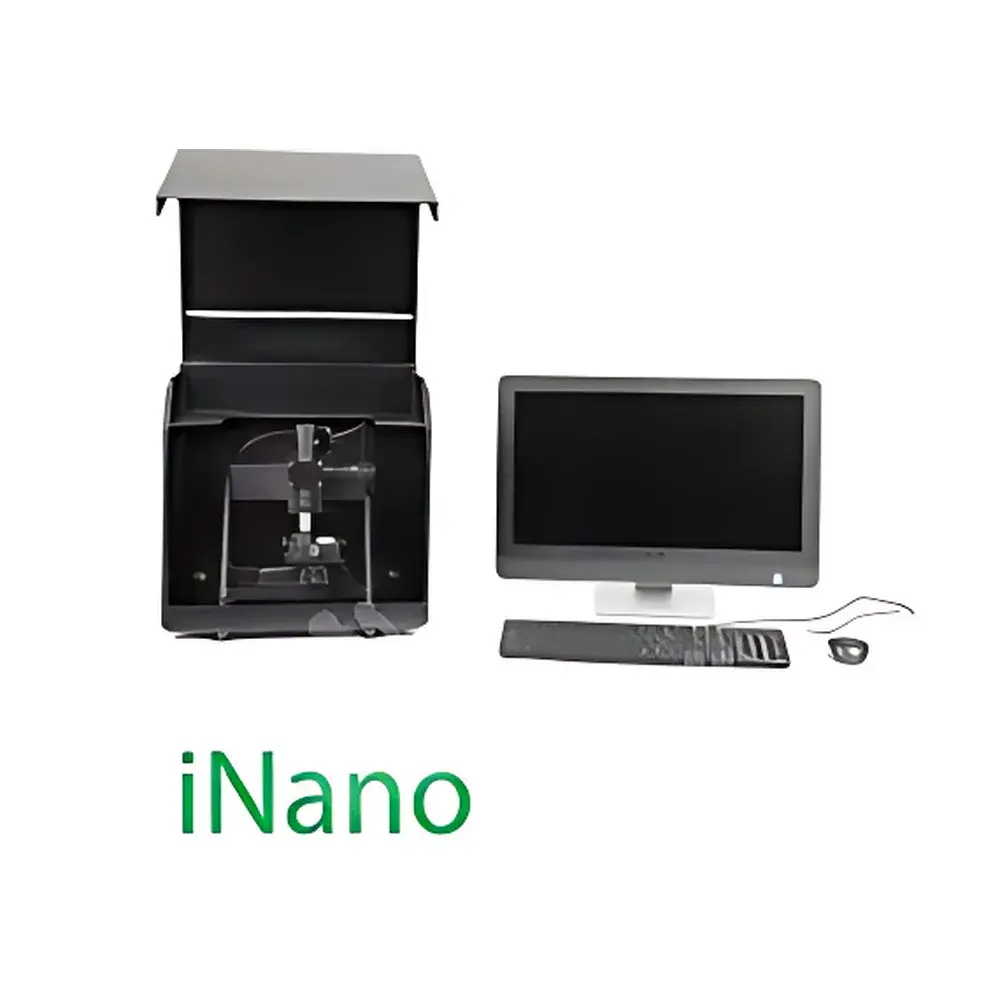
KLA iNano Desktop Nanoindentation and In-situ Mechanical Testing System
| Brand | KLA |
|---|---|
| Origin | USA |
| Model | iNano |
| Maximum Force | 50 mN |
| Force Resolution | 3 nN |
| Force Noise | <200 nN (RMS) |
| Time Constant | 20 µs |
| Maximum Indentation Depth | 50 µm |
| Displacement Noise | <0.1 nm |
| Digital Displacement Resolution | 0.02 nm |
| Drift Rate | <0.05 nm/s |
| Dynamic Frequency Range | 0.1 Hz – 1 kHz |
| Z-Stage Travel | 25 mm |
| X-Stage Travel | 100 mm |
| Y-Stage Travel | 150 mm |
| Load Frame Stiffness | >1,000,000 N/m |
| Scratch Max Normal Load | 50 mN |
| Scratch Max Distance | 2.5 mm |
| Scratch Max Speed | 500 µm/s |
Overview
The KLA iNano Desktop Nanoindentation and In-situ Mechanical Testing System is a high-performance, benchtop-scale instrument engineered for quantitative nanomechanical characterization of advanced materials. Based on the established principles of quasi-static and dynamic depth-sensing indentation—rooted in the Oliver–Pharr method—the iNano delivers traceable, reproducible measurements of hardness, elastic modulus, storage and loss moduli, creep compliance, and strain-rate-dependent mechanical response. Its electromagnetic actuator architecture provides intrinsic decoupling of force and displacement signals, eliminating cross-talk artifacts common in piezoelectric or voice-coil-based systems. With a time constant of just 20 µs, the iNano achieves the fastest closed-loop response among commercially available nanoindenters, enabling high-fidelity capture of transient mechanical events—including viscoelastic relaxation and rate-sensitive yielding—without signal aliasing or phase lag. Designed for integration into university research labs, industrial R&D centers, and quality control environments, the system meets stringent requirements for GLP-compliant data acquisition and audit-ready documentation.
Key Features
- Electromagnetic transducer with 50 mN maximum force, 3 nN force resolution, and sub-200 nN RMS noise floor—ensuring high signal-to-noise ratio across low-load regimes.
- Sub-nanometer displacement metrology: <0.1 nm displacement noise, 0.02 nm digital resolution, and drift rate <0.05 nm/s—critical for long-duration creep or thermal drift compensation experiments.
- Dynamic mechanical analysis (DMA) capability from 0.1 Hz to 1 kHz, supporting harmonic force modulation, continuous stiffness measurement (CSM), and frequency-domain viscoelastic mapping.
- Motorized XYZ stage with 100 mm (X) × 150 mm (Y) × 25 mm (Z) travel range—enabling large-area mapping and multi-location testing on heterogeneous or macroscopic samples.
- Integrated tip calibration routine embedded in the Nanomechanics TestWorks™ software suite—automating area function verification using reference materials per ISO 14577-1 and ASTM E2546 standards.
- Modular design supports optional scratch testing (up to 50 mN normal load, 2.5 mm scan length, 500 µm/s velocity) and in-chamber dual-angle USB video monitoring for real-time feature tracking and alignment.
Sample Compatibility & Compliance
The iNano accommodates a broad spectrum of sample geometries and material classes—including thin films (<10 nm), bulk polymers, metallic coatings, ceramic composites, hydrogels, and biological tissues—without requiring vacuum or cryogenic environments. Its open-stage architecture permits direct mounting of standard SEM stubs, wafer fragments, or custom fixtures. All mechanical test protocols adhere to internationally recognized standards: ISO 14577 (Metallic and non-metallic materials — Instrumented indentation test), ASTM E2546 (Standard Guide for Instrumented Indentation Testing), and USP (Mechanical Testing of Pharmaceutical Dosage Forms). Data integrity is maintained via built-in audit trail functionality compliant with FDA 21 CFR Part 11 requirements, including electronic signatures, user access controls, and immutable raw-data archiving.
Software & Data Management
Controlled exclusively through Nanomechanics’ TestWorks™ v6.x platform, the iNano provides a unified interface for experiment design, real-time visualization, post-processing, and reporting. The software implements automated tip calibration, thermal drift correction algorithms, and CSM parameter optimization. Advanced modules include NanoBlitz™ 3D/4D property mapping—enabling spatially resolved modulus/hardness tomography across cross-sections or surfaces—and statistical outlier detection for batch analysis. Export formats include ASCII, CSV, HDF5, and MATLAB-compatible binaries; all datasets retain full metadata (test parameters, environmental logs, calibration history) required for regulatory submissions or inter-laboratory comparison studies.
Applications
- Thin-film adhesion and interfacial toughness quantification via controlled delamination assays.
- Depth-profiling of graded coatings (e.g., DLC, TiN, ALD oxides) to assess compositional–mechanical correlations.
- Mechanical aging studies of polymer electrolytes and battery separator membranes under thermal or electrochemical stress.
- Nanoscale viscoelasticity mapping of hydrogel scaffolds for tissue engineering applications.
- Hardness and modulus gradients in additive-manufactured metal parts to evaluate process-induced microstructural heterogeneity.
- Scratch resistance and wear initiation thresholds in optical coatings and display substrates.
FAQ
Is the iNano compatible with third-party environmental chambers?
Yes—the system’s modular electronics and open communication protocol (TCP/IP-based API) support integration with temperature-controlled stages, humidity chambers, and electrochemical cells.
Does the iNano meet ISO/IEC 17025 accreditation requirements for testing laboratories?
When operated under documented SOPs—including daily tip calibration, reference material verification, and uncertainty budgeting—the iNano satisfies key technical requirements for ISO/IEC 17025 Clause 6.4 (Equipment) and Clause 7.7 (Uncertainty of Measurement).
Can NanoBlitz™ be used for cross-sectional analysis of embedded interfaces?
Yes—when coupled with focused ion beam (FIB) sample preparation, NanoBlitz™ enables quantitative 3D modulus reconstruction across buried interfaces, provided surface topography is optically accessible or reconstructed via AFM co-registration.
What level of operator training is required to achieve ISO 14577-compliant results?
Nanomechanics provides certified instructor-led training covering instrument fundamentals, uncertainty estimation per GUM (JCGM 100:2008), and report generation aligned with ISO/IEC 17025 documentation standards.
Is remote diagnostics and software update support included?
Yes—KLA offers secure remote maintenance via encrypted VNC sessions, with quarterly software updates delivering new test methods, compliance patches, and performance enhancements.



