
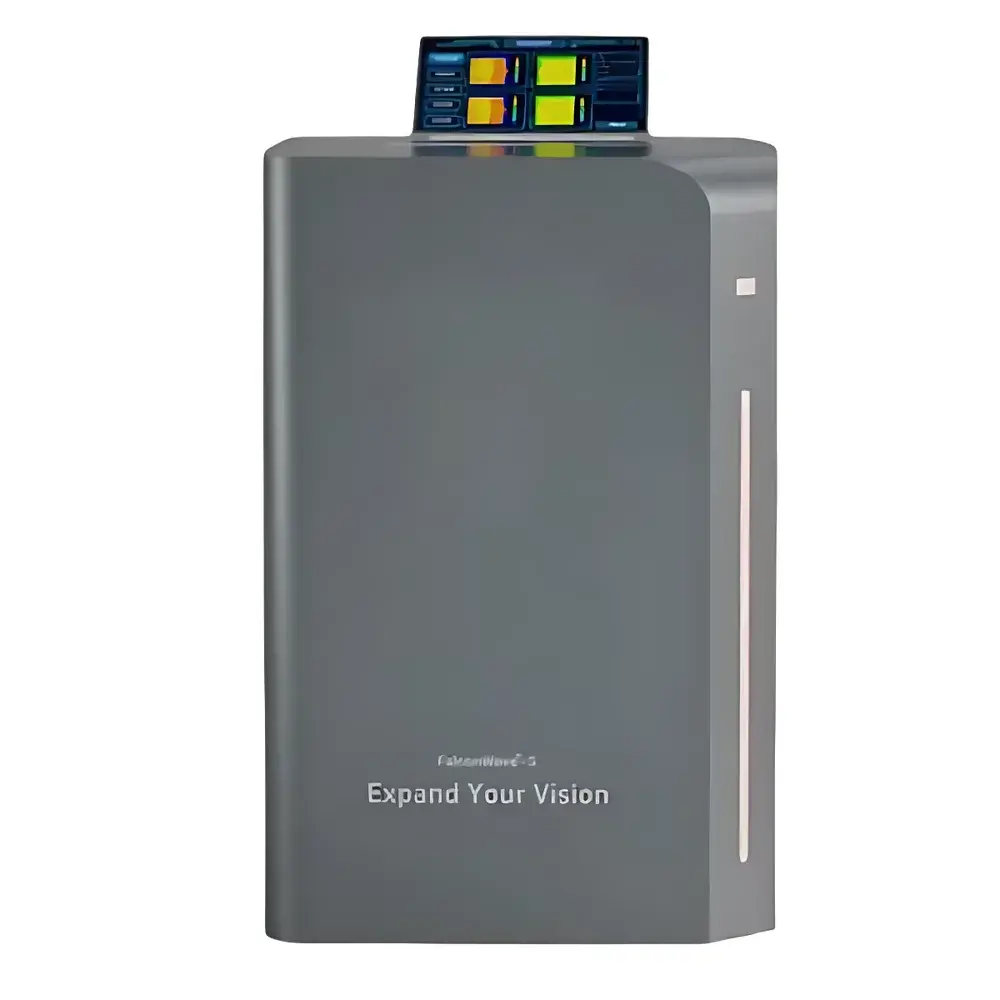
FalconWave®-S Series High-Precision Terahertz Imaging Analyzer
| Brand | SHNTI (Shanghai Naten Instruments) |
|---|---|
| Origin | Shanghai, China |
| Model | FalconWave®-S Series |
| Detection Frequency Range | 60–800 GHz |
| Spatial Resolution | 1 mm per pixel |
| Scan Speed | ~7 minutes per image (at 1 mm resolution) |
| Measurement Accuracy | <3% deviation (offline precise scanning) |
| Repeatability Error | <1% |
| Interface | Gigabit Ethernet (Plug-and-Play) |
| Power Consumption | Low (CMOS-based THz sensor architecture) |
| Compliance | CE-marked for laboratory use |
| Target Users | R&D laboratories, academic research groups, materials science institutes, QC/QA departments in advanced manufacturing |
Overview
The FalconWave®-S Series High-Precision Terahertz Imaging Analyzer is a benchtop, CMOS-based time-domain terahertz (THz) imaging system engineered for quantitative, non-destructive evaluation of dielectric and semi-conductive materials. Operating across a broad spectral band from 60 GHz to 800 GHz, it leverages coherent continuous-wave (CW) THz generation and heterodyne detection to deliver high-dynamic-range, phase-resolved 2D cross-sectional images without ionizing radiation or physical contact. Unlike optical or X-ray modalities, THz radiation penetrates non-metallic, non-polar materials—including polymers, ceramics, composites, pharmaceutical tablets, and layered packaging—while remaining sensitive to density variations, delamination, moisture content, and crystallinity. The system is optimized for controlled laboratory environments and supports both transmission and reflection-mode acquisition, enabling thickness mapping, defect localization (e.g., voids, inclusions, disbonds), and qualitative/quantitative material characterization through calibrated amplitude and phase contrast.
Key Features
- CMOS-integrated THz sensor architecture: Enables low-power operation (<5 W typical), silent scanning via integrated brushless stepper motor, and intrinsic immunity to ambient lighting and thermal drift.
- High spatial fidelity: Fixed 1 mm pixel pitch with sub-millimeter lateral resolution achievable via interpolation-assisted post-processing; absolute positioning accuracy maintained by closed-loop encoder feedback.
- Multi-frequency adaptability: Interchangeable waveguide-coupled probes support discrete frequency selection within the 60–800 GHz band, allowing spectral fingerprinting of material absorption features (e.g., phonon resonances in crystalline organics).
- Gigabit Ethernet interface: Ensures deterministic data streaming (>120 MB/s sustained throughput), synchronized trigger I/O for external instrumentation (e.g., environmental chambers, mechanical stages), and remote configuration via standard TCP/IP stack.
- Robust mechanical design: Aluminum alloy frame with vibration-damped optical baseplate; IP20-rated enclosure suitable for ISO Class 7 cleanroom-adjacent lab spaces.
Sample Compatibility & Compliance
The FalconWave®-S accommodates flat or gently curved samples up to 300 × 300 mm² and 50 mm thickness (standard stage). Compatible substrates include polyethylene, polyimide, silicon wafers, paperboard, epoxy laminates, and tablet coatings. It does not support metallic or highly conductive samples due to THz reflectivity constraints. From a regulatory standpoint, the instrument conforms to IEC 61000-6-3 (emission limits for industrial environments) and IEC 61000-6-1 (immunity to electrostatic discharge, RF fields, and voltage dips). As a non-ionizing device operating well below ICNIRP-recommended exposure thresholds (≤10 µW/cm² averaged over 6 minutes at 300 GHz), it requires no radiation safety licensing under national frameworks aligned with EU Directive 2013/35/EU. While not certified to GLP or GMP Annex 11, its audit-ready data logging (with timestamped metadata, user ID, and parameter history) supports internal validation protocols compliant with ISO/IEC 17025:2017 Clause 7.7.
Software & Data Management
The bundled FalconView™ v4.2 software provides full control of scan parameters (step size, dwell time, frequency selection, averaging cycles), real-time amplitude/phase visualization, and batch processing pipelines. All raw interferograms and reconstructed B-scan/C-scan datasets are stored in HDF5 format with embedded metadata (including instrument serial number, calibration date, environmental log). Export options include TIFF (8/16-bit), CSV (pixel-wise parameter tables), and MATLAB .mat files. Audit trails record operator actions, parameter changes, and file exports—supporting traceability per FDA 21 CFR Part 11 when deployed with network-authenticated login and electronic signature modules (optional add-on). Software updates are delivered via secure HTTPS repository with SHA-256 integrity verification.
Applications
- Pharmaceutical solid dosage analysis: Quantification of coating thickness uniformity, detection of blister pack seal integrity, and identification of API crystallinity shifts during stability testing.
- Advanced composite inspection: Mapping of fiber orientation, resin-rich zones, and interlaminar porosity in CFRP and GFRP aerospace components.
- Electronics packaging QA: Subsurface imaging of wire bond lift-off, die attach voids, and underfill delamination in QFN and BGA packages.
- Art conservation science: Stratigraphic analysis of paint layers, varnish degradation, and hidden underdrawings in historical panel paintings.
- Academic materials research: Time-resolved carrier dynamics in 2D semiconductors, hydration kinetics in hydrogels, and phonon dispersion studies in perovskite thin films.
FAQ
Is the FalconWave®-S suitable for in-line production monitoring?
No—it is designed exclusively for offline, high-fidelity laboratory analysis. Its 7-minute scan duration and precision mechanical stage are incompatible with high-throughput conveyor-based workflows.
Does the system require external cooling or vacuum?
No. The CMOS THz sensor operates at ambient temperature; no cryogenic or vacuum infrastructure is needed.
Can I integrate this instrument with my existing LIMS or MES platform?
Yes. FalconView™ supports OPC UA server mode and provides RESTful API endpoints for metadata query and job queue control, enabling bidirectional integration with LabVantage, Thermo Fisher SampleManager, or Siemens Opcenter.
What calibration standards are supplied with the instrument?
A NIST-traceable polyethylene step wedge (0.1–5.0 mm thickness increments) and a reference mirror for phase alignment are included. Annual factory recalibration is recommended and documented per ISO/IEC 17025.
Is training provided for operators and data analysts?
Yes. SHNTI offers a 2-day on-site technical workshop covering hardware operation, measurement protocol development, artifact mitigation (e.g., standing wave interference), and basic inverse modeling using built-in parameter extraction tools.
Related Products



