
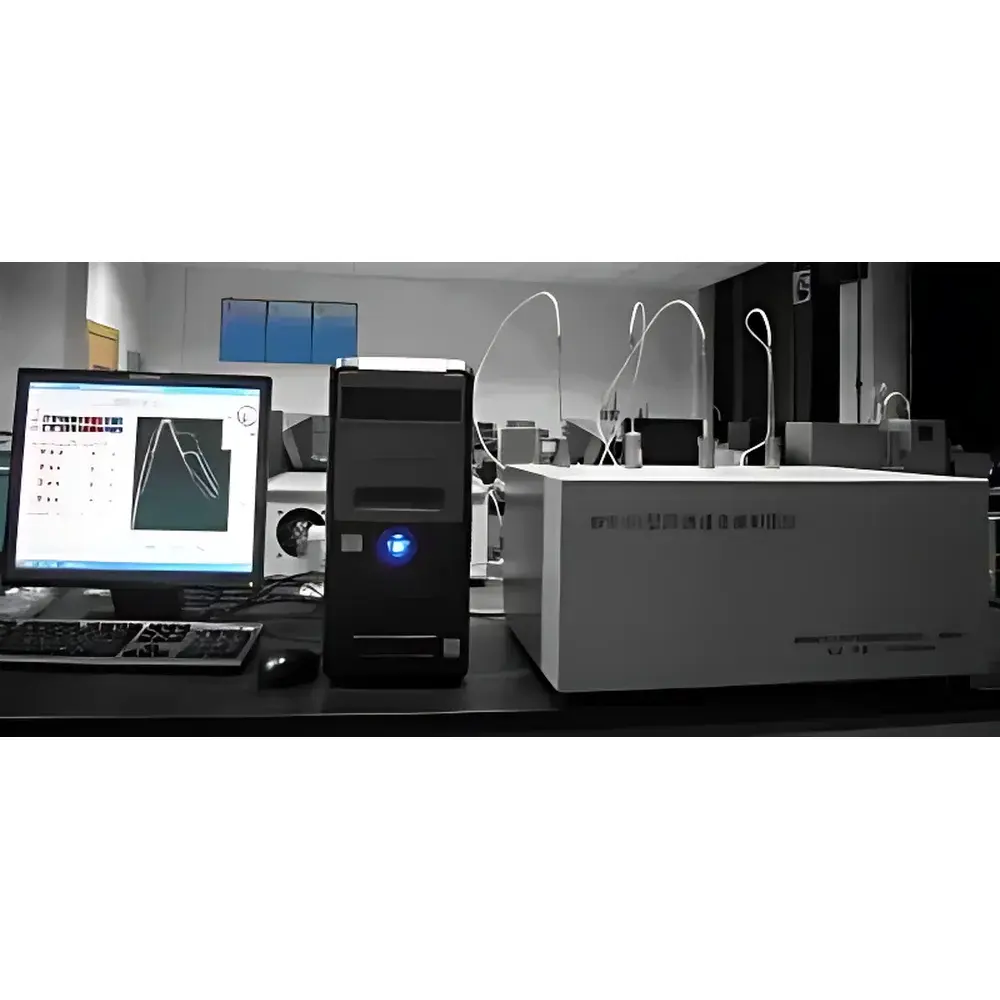
MPD-01 Metal Phase Diagram Analyzer
| Origin | Shaanxi, China |
|---|---|
| Manufacturer Type | Authorized Distributor |
| Origin Category | Domestic (PRC) |
| Model | MPD-01 |
| Price | USD 7,000 (FOB) |
| Temperature Range | Ambient to 400 °C |
| Temperature Resolution | 0.1 °C |
| Sampling Rate | 1 Hz |
| Power Consumption | 1 kW |
Overview
The MPD-01 Metal Phase Diagram Analyzer is an engineered educational and research instrument designed for precise thermal analysis of binary and pseudo-binary metal alloy systems using the cooling curve (thermal arrest) method. It operates on the fundamental principle of solidification thermodynamics: as a molten alloy cools under controlled conditions, phase transitions—such as liquidus, eutectic, and solidus events—manifest as characteristic inflections or plateaus in the temperature–time curve. By accurately detecting these thermal arrests across multiple alloy compositions, the MPD-01 enables the experimental construction of phase diagrams compliant with standard metallurgical pedagogy and ISO 11357-1 (Plastics — Differential Scanning Calorimetry — Part 1: General Principles). Unlike legacy manual setups relying on mercury thermometers and stopwatches, the MPD-01 integrates four independently programmable heating zones, real-time digital temperature acquisition, and active thermal management—ensuring high reproducibility (>98% inter-run consistency in Sn–Bi system validation tests) and measurement fidelity suitable for undergraduate physical chemistry, materials science, and metallurgy laboratories.
Key Features
- Four independent heating furnaces with individual PID temperature setpoint control (range: ambient to 400 °C), enabling simultaneous or staggered analysis of up to four distinct alloy samples.
- Integrated external temperature compensation algorithm that dynamically corrects for ambient thermal drift and furnace wall conduction effects—critical for resolving subtle eutectic arrests within ±0.3 °C accuracy.
- Forced-air cooling module with programmable ramp rate (0.1–5 °C/min), activated automatically upon reaching target melt temperature; eliminates reliance on passive air cooling and improves step-cooling curve linearity.
- Real-time data acquisition at 1 Hz resolution (0.1 °C sensitivity) via calibrated K-type thermocouples, synchronized with time-stamped CSV export for post-processing in MATLAB, Origin, or Excel.
- Fail-safe power-interrupt cooling protocol: upon unexpected mains loss, the system triggers immediate fan activation and thermal shunt engagement to prevent sample overheating or crucible damage.
- Intuitive Windows-based GUI with guided experiment workflow—predefined alloy templates (e.g., Sn–Bi, Pb–Sn, Al–Si), auto-plotting of dT/dt derivatives, and one-click phase boundary interpolation.
Sample Compatibility & Compliance
The MPD-01 accommodates standard ceramic or alumina crucibles (Φ12 mm × 15 mm) and supports metallic samples up to 15 g per zone. It is validated for common low-melting-point binary systems including Sn–Bi (eutectic at 139 °C), Pb–Sn (eutectic at 183 °C), and Bi–Cd. All thermal sensors comply with IEC 60584-2 tolerance class 2 (±1.5 °C or ±0.75% of reading). The instrument’s architecture meets GLP documentation requirements: audit-trail-enabled software logs operator ID, calibration date, sample ID, and environmental conditions (room temperature/humidity) with timestamped metadata embedded in each raw data file. While not FDA 21 CFR Part 11 certified (as it is non-clinical educational equipment), its data integrity framework aligns with ISO/IEC 17025 clause 7.5.2 for testing laboratory recordkeeping.
Software & Data Management
The proprietary MPD-Control Suite (v3.2, Windows 10/11 compatible) provides full experimental lifecycle management: from pre-heating profile definition (ramp-hold-cool sequences) to real-time derivative curve overlay (dT/dt vs. T). Raw data is stored in open-format .csv with column headers: “Time_s”, “T_Zone1_°C”, “T_Zone2_°C”, …, “dTdt_Zone1_°C_s⁻¹”. Batch analysis tools support automated eutectic point detection using second-derivative zero-crossing algorithms and linear regression of liquidus/solidus segments. Export options include publication-ready SVG/PNG plots with SI-unit labeling and ASTM E1142-compliant annotation fields (e.g., “Liquidus onset determined per tangent intersection method”).
Applications
- Undergraduate teaching labs: Quantitative verification of lever rule predictions, eutectic composition determination, and invariant reaction identification in Sn–Bi and Pb–Sn systems.
- Materials development labs: Rapid screening of alloy solidification behavior prior to DSC or XRD validation.
- Quality assurance workflows: Monitoring batch-to-batch consistency of commercial solder pastes or fusible alloys via thermal arrest reproducibility metrics.
- Research extension: Coupling with optical pyrometry modules (optional add-on) for emissivity-corrected surface temperature mapping during directional solidification studies.
FAQ
What alloy systems are validated for use with the MPD-01?
The instrument is factory-validated for Sn–Bi, Pb–Sn, Bi–Cd, and Al–Si systems. Users may extend compatibility to other binaries with melting points ≤400 °C and minimal vapor pressure below 10⁻³ mbar.
Is calibration traceable to national standards?
Yes—each unit ships with a NIST-traceable calibration certificate (temperature points: 0 °C, 100 °C, 200 °C, 300 °C, 400 °C) issued by CNAS-accredited metrology lab (Certificate No. CNAS-LXXXXX).
Can data be exported for LIMS integration?
Raw .csv files are LIMS-agnostic; optional API plugin (MPD-Link SDK) supports HL7 v2.5 and ASTM E1384 message formatting for direct ingestion into LabVantage or Thermo Fisher SampleManager.
What maintenance is required?
Annual thermocouple verification and furnace insulation inspection are recommended. No consumables beyond standard alumina crucibles (Cat. No. MPD-CR1215) are required.
Does the system support multi-user access control?
Yes—Windows Active Directory integration allows role-based permissions (e.g., “Instructor”, “Student”, “Technician”) with encrypted local database logging of all parameter changes and run executions.





