
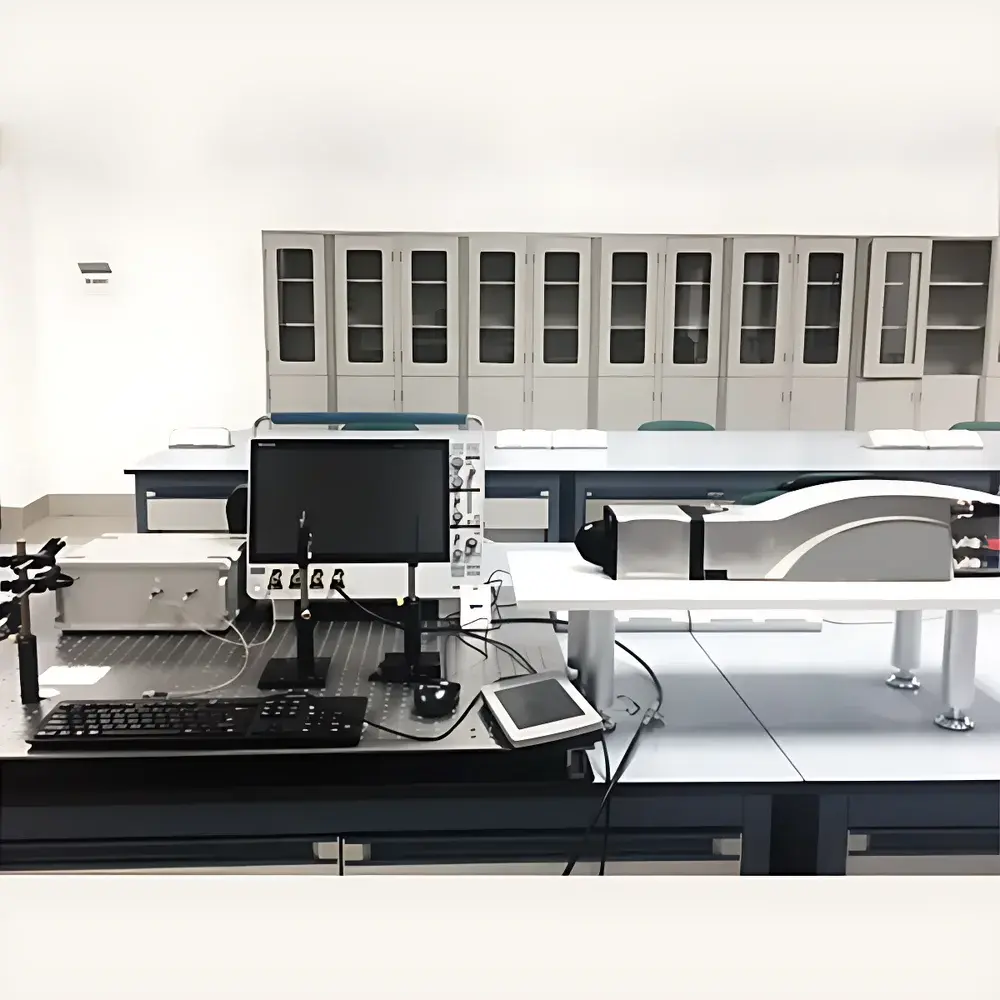
PL-TPV Transient Surface Photovoltage Spectrometer
| Brand | PerfectLight |
|---|---|
| Model | PL-TPV |
| Laser Source | Nd:YAG (1064/532/355 nm) |
| Pulse Width | 6–8 ns |
| Beam Spot Size | 4.5 mm |
| Max Pulse Energy | 330 mJ @ 1064 nm, 160 mJ @ 532 nm, 60 mJ @ 355 nm |
| Repetition Rate | ≤20 Hz |
| Preamplifier | 100 MΩ Input Impedance, 1 kΩ Output Impedance, 1 GHz Bandwidth |
| Digital Oscilloscope | 500 MHz Bandwidth, 4 Channels, 5 ns Rise Time |
| Energy Meter Range | 10 μJ – 150 mJ |
| Origin | Beijing, China |
| Compliance | Designed for GLP-compliant transient optoelectronic characterization |
Overview
The PL-TPV Transient Surface Photovoltage Spectrometer is a dedicated time-resolved optoelectronic characterization system engineered for quantitative investigation of photogenerated charge carrier dynamics at semiconductor surfaces and interfaces. Operating on the principle of surface photovoltage (SPV) transients induced by nanosecond laser pulses, the instrument measures voltage changes across a sample’s surface following photoexcitation—without electrical contact or physical modification. This non-invasive, non-destructive methodology enables direct probing of charge separation directionality, interfacial charge transfer efficiency, recombination kinetics, and carrier lifetime distributions in the 1 ns to 10 µs range. The system integrates a high-stability, wavelength-tunable Nd:YAG laser source with synchronized detection electronics—including low-noise preamplification, high-bandwidth digitization, and calibrated energy monitoring—to ensure reproducible, artifact-minimized transient waveforms under controlled experimental conditions.
Key Features
- Ultrafast nanosecond excitation: Nd:YAG laser with precisely controlled pulse width (6–8 ns), three harmonic wavelengths (1064 nm, 532 nm, 355 nm), and energy stability <±3% per pulse at ≤20 Hz repetition rate.
- High-fidelity signal acquisition: 500 MHz bandwidth digital oscilloscope with four synchronized channels, 5 ns rise time, and real-time waveform capture up to 1 GS/s sampling rate.
- Low-noise front-end electronics: Custom-designed preamplifier featuring 100 MΩ input impedance, 1 kΩ output impedance, and flat frequency response up to 1 GHz—optimized for weak surface photovoltage signals from insulating or high-impedance samples.
- Traceable optical energy calibration: Integrated thermopile-based energy meter (10 μJ–150 mJ range) with NIST-traceable calibration certificate for accurate photon flux normalization across all excitation wavelengths.
- Modular optical path design: Adjustable beam delivery optics support variable spot size (down to Ø1 mm via optional focusing), polarization control, and compatibility with cryostats, environmental chambers, and in situ electrochemical cells.
Sample Compatibility & Compliance
The PL-TPV spectrometer accommodates planar solid-state samples including thin-film photoelectrodes (e.g., BiVO₄, Fe₂O₃, g-C₃N₄), perovskite absorbers, organic semiconductors, quantum dot assemblies, and single-crystal wafers (Si, GaAs, TiO₂). No electrical contacts or electrode deposition are required—measurements rely solely on built-in surface band bending and capacitive coupling. The system architecture supports compliance with Good Laboratory Practice (GLP) documentation requirements, including audit-ready data logging timestamps, user-access control logs, and raw waveform file integrity verification. While not certified to ISO/IEC 17025, its core subsystems (laser, oscilloscope, energy meter) conform to manufacturer-specified metrological standards traceable to national measurement institutes.
Software & Data Management
Acquisition and analysis are performed using proprietary PerfectLight TPV Control Suite v3.2, a Windows-based application supporting automated parameter sweeps (wavelength, delay time, bias voltage), real-time averaging (up to 10,000 traces), baseline correction, exponential decay fitting (mono-/bi-exponential, stretched exponential models), and derivative analysis for inflection point identification. All raw binary waveform files (.bin) are stored with embedded metadata (laser energy, trigger delay, ambient temperature, operator ID). Export formats include CSV, MATLAB .mat, and HDF5 for third-party processing. The software adheres to FDA 21 CFR Part 11 principles through electronic signature capability, audit trail activation (user actions, parameter changes, file modifications), and password-protected configuration lockdown for regulated environments.
Applications
- Quantifying directional charge separation at heterojunctions (e.g., type-II vs. Z-scheme behavior in photocatalytic composites)
- Distinguishing drift-dominated versus diffusion-limited transport in nanostructured metal oxides
- Evaluating interfacial trap density and energetic distribution via temperature-dependent TPV decay analysis
- Correlating surface photovoltage transients with transient absorption (TA) or time-resolved photoluminescence (TRPL) datasets
- Screening co-catalyst loading effects on electron extraction kinetics in photoanodes
- Validating theoretical models of space-charge region dynamics under modulated illumination
FAQ
What is the minimum detectable surface photovoltage signal?
The system achieves a typical signal-to-noise ratio (SNR) >25 dB for 10 mV SPV transients at 1064 nm excitation, corresponding to ~300 µV RMS noise floor (10 MHz–1 GHz bandwidth, 1000-trace average).
Can the PL-TPV be coupled with an external bias source?
Yes—integrated BNC-triggered voltage bias interface supports DC and square-wave bias (±50 V, 100 kHz max) synchronized to laser firing for electric-field-dependent carrier dynamics studies.
Is spectral deconvolution supported for multi-wavelength TPV datasets?
The software includes a constrained linear least-squares solver for extracting wavelength-dependent lifetime components when collecting sequential spectra across ≥3 excitation wavelengths.
Does PerfectLight provide application support for data interpretation?
Technical collaboration with Prof. Dejun Wang’s group at Jilin University includes remote spectral deconvolution assistance, kinetic modeling guidance, and peer-reviewed publication support for TPV-derived mechanistic conclusions.
What maintenance intervals are recommended for long-term stability?
Laser optics alignment verification every 6 months; energy meter recalibration annually; oscilloscope self-calibration prior to critical experiments per manufacturer guidelines.
Related Products



