
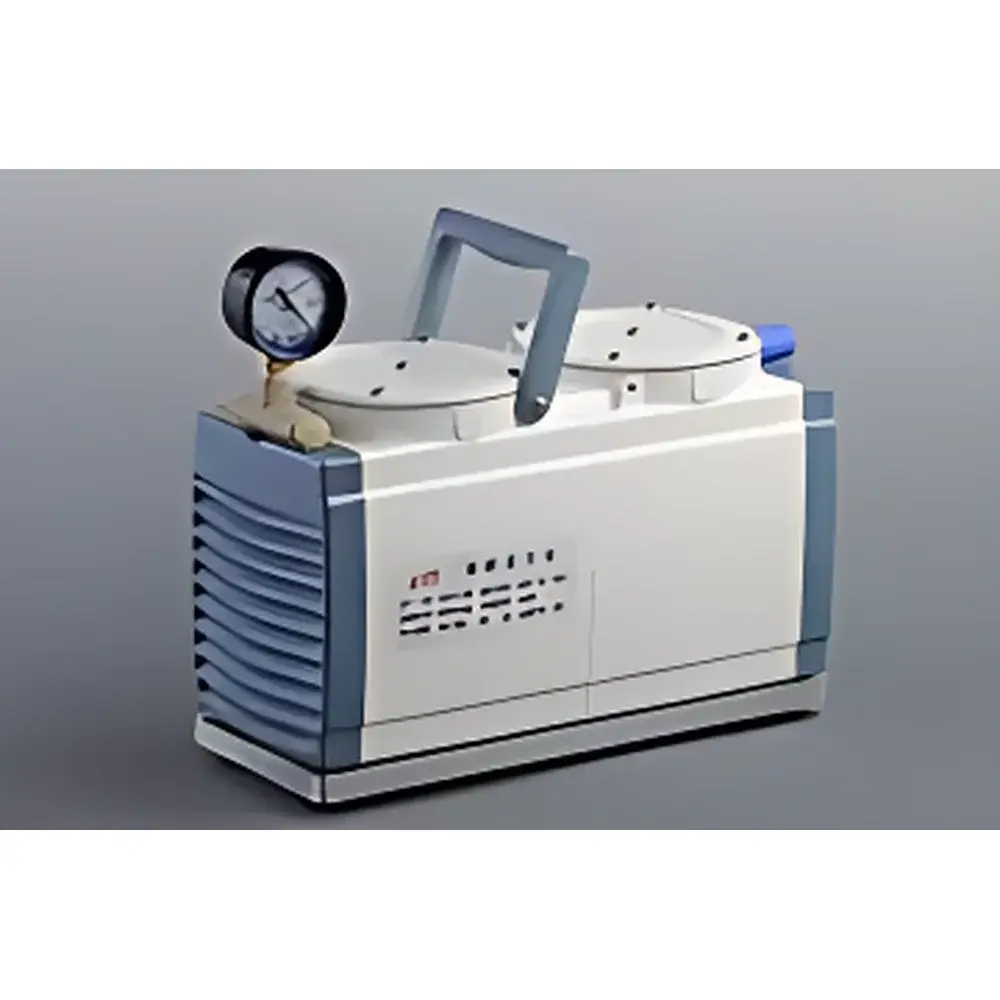
GM-0.33B Diaphragm Vacuum Pump
| Origin | Tianjin, China |
|---|---|
| Manufacturer Type | Distributor |
| Origin Category | Domestic (China) |
| Model | GM-0.33B |
| Quotation | Upon Request |
| Pumping Speed | 20 L/min |
| Operating Temperature (Pump Body) | <55 °C |
| Ultimate Vacuum Pressure | ≤50 mbar (≥0.095 MPa absolute) |
| Noise Level | <50 dB(A) |
| Inlet/Outlet Port Diameter | φ6 mm |
| Dimensions (L×W×H) | 300×120×235 mm |
| Motor Power | 160 W |
| Net Weight | 10 kg |
| Ambient Operating Temperature | 7–40 °C |
| Configuration | Dual-head negative-pressure diaphragm pump |
Overview
The GM-0.33B Diaphragm Vacuum Pump is a compact, oil-free, dual-head positive displacement vacuum generator engineered for reliable and contamination-free operation in analytical laboratories, chemical synthesis setups, and quality control environments. Utilizing a precision-machined PTFE-coated diaphragm and corrosion-resistant stainless steel valves, it achieves stable vacuum generation through reciprocating mechanical displacement—eliminating the need for lubricating oil and preventing sample or process contamination. Its ultimate vacuum capability of ≤50 mbar (≥0.095 MPa absolute) supports routine applications such as rotary evaporation, vacuum filtration, degassing of solvents, and inert gas purging of reaction vessels. Designed for continuous duty under ambient conditions ranging from 7 °C to 40 °C, the pump maintains thermal stability with a maximum housing temperature below 55 °C, ensuring safe integration into enclosed fume hoods or benchtop instrument clusters.
Key Features
- Dual-head configuration enhances pumping efficiency and extends service life by distributing mechanical load across two synchronized diaphragm assemblies.
- Oil-free operation ensures zero hydrocarbon backstreaming—critical for GC sample introduction, mass spectrometry prep, and pharmaceutical solvent recovery where trace organic contamination must be avoided.
- Low-noise design (<50 dB[A] at 1 m) enables quiet operation in shared laboratory spaces without acoustic shielding.
- Chemically resistant wetted materials—including fluoropolymer diaphragms, EPDM seals, and 316 stainless steel valve plates—provide compatibility with mild acids, bases, and polar organic solvents.
- Integrated thermal protection circuitry automatically interrupts power if motor winding temperature exceeds safe thresholds, complying with IEC 60335-1 safety requirements.
- Compact footprint (300 × 120 × 235 mm) and lightweight construction (10 kg) facilitate portability between workstations and integration beneath vacuum manifolds or evaporators.
Sample Compatibility & Compliance
The GM-0.33B is suitable for non-explosive, non-particulate, and non-condensable vapor streams. It is not rated for use with flammable solvents above their flash point, halogenated hydrocarbons, or highly corrosive gases (e.g., Cl₂, HF, NH₃ beyond trace levels). When operated within specified ambient and inlet conditions, it meets general-purpose laboratory vacuum requirements aligned with ISO 8573-1:2010 Class 4 for particulate and oil content (oil-free classification), and conforms to electromagnetic compatibility standards per EN 61326-1 for laboratory equipment. While not certified for medical or explosive atmospheres, its design supports GLP-compliant documentation protocols when paired with external vacuum gauges and loggers.
Software & Data Management
As a standalone mechanical vacuum source, the GM-0.33B does not incorporate embedded firmware, digital displays, or data output interfaces. However, it is fully compatible with third-party vacuum monitoring systems via standard analog pressure transducer inputs (0–5 V or 4–20 mA). Users may integrate it into centralized lab automation platforms using relay-based on/off control or PWM-compatible external controllers. For audit readiness, manual log entries—including operating duration, maintenance intervals, and observed noise/vibration anomalies—can be maintained in accordance with ISO/IEC 17025 clause 7.7 (equipment records) and FDA 21 CFR Part 11 principles when entered into validated electronic lab notebooks (ELNs).
Applications
- Rotary evaporation of heat-sensitive compounds under reduced pressure
- Vacuum-assisted filtration in HPLC mobile phase preparation and particulate analysis
- Desiccation of hygroscopic reagents in glove boxes or drying ovens
- Evacuation of Schlenk lines prior to inert gas purging cycles
- Support vacuum for cold traps in distillation and sublimation apparatuses
- Sample preparation workflows requiring consistent low-to-medium vacuum (50–500 mbar range)
FAQ
Can the GM-0.33B be used for vacuum drying ovens?
Yes—provided the oven’s maximum operating temperature remains below 40 °C during pump operation and condensable vapors are trapped upstream using a cold trap or desiccant filter.
Is this pump suitable for connection to a mass spectrometer inlet?
No—it lacks the ultimate vacuum performance (<10⁻³ mbar) and vibration isolation required for direct MS coupling; it is appropriate only for roughing pumps in hybrid vacuum systems.
What maintenance intervals are recommended?
Diaphragm and valve assembly inspection every 6 months under continuous operation; replacement recommended after 5,000 hours or upon audible loss of pumping efficiency.
Does it support continuous 24/7 operation?
Yes—within specified ambient temperature (7–40 °C) and non-condensing vapor conditions; ensure adequate ventilation around the motor housing to sustain thermal limits.
Can inlet pressure be regulated externally?
Yes—using a needle valve or vacuum regulator installed upstream of the inlet port; avoid throttling at the outlet, which may induce backpressure-induced diaphragm stress.



