
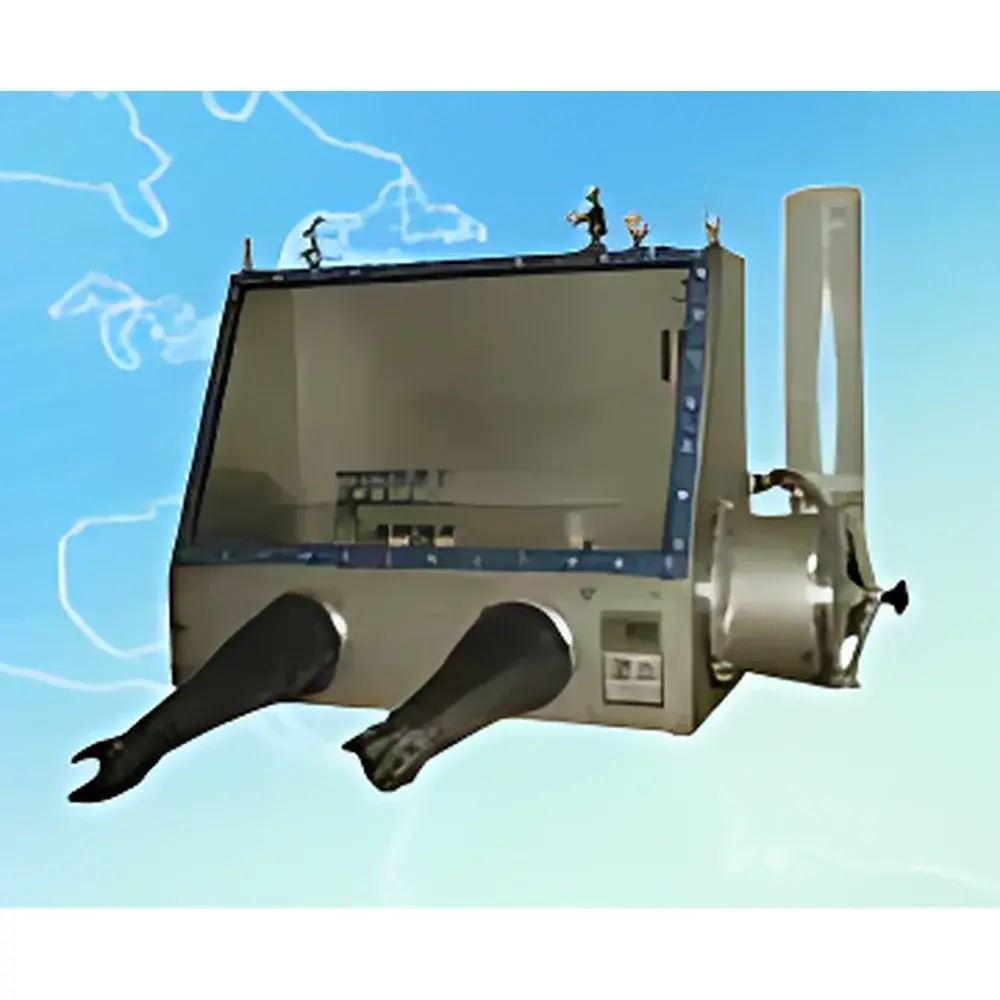
Glove Box GB12 – Inert Atmosphere Isolation System for Hazardous and Air-Sensitive Applications
| Origin | Germany |
|---|---|
| Manufacturer Type | Authorized Distributor |
| Origin Category | Imported |
| Model | GB12 |
| Pricing | Available Upon Request |
Overview
The Glove Box GB12 is an engineered inert-atmosphere isolation system designed for safe, controlled manipulation of air-sensitive, pyrophoric, toxic, radioactive, or biohazardous materials. Constructed as a fully sealed enclosure with optically transparent acrylic viewing panels and integrated 8-inch elastomeric gloves, it enables manual dexterity while maintaining strict environmental separation between operator and sample. The system operates on the principle of positive-pressure inert gas purging (typically argon or nitrogen) or vacuum-assisted atmosphere exchange, supported by continuous gas purification to maintain O₂ and H₂O levels below 1 ppm—critical for lithium battery electrode handling, organometallic synthesis, nuclear material processing, and high-containment biosafety protocols. Its robust 1.4301 (AISI 304) stainless steel chamber and modular interface architecture ensure long-term structural integrity, leak-tight performance (<0.05 vol% air ingress/hour), and compatibility with downstream analytical instrumentation.
Key Features
- Chamber volume: 630 L (1200 × 640 × 1000 mm external dimensions; net weight: 160 kg)
- Integrated transition chamber (airlock): Ø330 × 270 mm, 23 L volume, dual DN16 ports (A1/A2), enabling safe sample/material transfer without atmosphere breach
- Dual-stage gas purification system with real-time monitoring of O₂ and H₂O content—capable of achieving and sustaining ≤0.1 ppm residual oxygen and ≤0.1 ppm water vapor under steady-state operation
- Standard configuration includes two DN16 side ports (S1), two DN40 side ports (S4), two DN16 top ports (T1), and two DN40 top ports (T4) for integration with external vacuum lines, gas manifolds, or analytical tools (e.g., XRD, SEM feedthroughs)
- LED lighting system with uniform illumination and glare-reducing diffusers for extended visual inspection and precision manipulation
- Stainless steel base frame with leveling feet and optional seismic anchoring provisions compliant with DIN 4149 and IBC 2021 requirements
- Gas compensation unit (DN40, 12 L capacity) for stable internal pressure regulation during frequent glove movement or transition cycles
Sample Compatibility & Compliance
The GB12 accommodates a broad spectrum of sample forms—including powders, thin films, electrodes, biological cultures, radiopharmaceuticals, and nanomaterials—without risk of oxidation, hydrolysis, or cross-contamination. It conforms to ISO 14644-1 Class 5 cleanroom equivalency when operated with HEPA/ULPA filtration add-ons. For hazardous applications, the system supports containment verification per ASTM D6195 (glove integrity testing) and meets EN 12469:2000 requirements for microbiological safety cabinets when configured with appropriate filtration and negative-pressure options. All electrical components comply with CE/EMC Directive 2014/30/EU and low-voltage directive 2014/35/EU. Documentation packages include Factory Acceptance Test (FAT) reports, leak test certificates (helium mass spectrometry verified), and material traceability for 1.4301 SS components.
Software & Data Management
While the base GB12 operates via analog pneumatic controls and digital front-panel displays, optional upgrades include the GB-Link™ control module—a CE-certified embedded system supporting RS485/Modbus RTU and Ethernet/IP communication. This enables centralized logging of O₂/H₂O sensor outputs, pressure differentials, purge cycle timestamps, and glove pressure differentials. Audit trails comply with FDA 21 CFR Part 11 requirements when deployed with user authentication, electronic signatures, and immutable data storage. Integration with LIMS platforms (e.g., LabWare, STARLIMS) is supported via OPC UA drivers. All firmware updates are digitally signed and version-locked to prevent unauthorized modification.
Applications
- Lithium-ion and solid-state battery R&D: Electrode coating, cell assembly, and post-cycling disassembly under argon <1 ppm O₂
- Organometallic and main-group chemistry: Handling of alkyl-lithium reagents, white phosphorus, or aluminum hydrides
- Nuclear and radiochemistry labs: Manipulation of α-emitting isotopes (e.g., Pu-238, Am-241) behind lead-acrylic shielding
- Biosafety Level 3 (BSL-3) research: Culture of select agents (e.g., Francisella tularensis, Burkholderia pseudomallei) with redundant HEPA exhaust and negative-pressure interlocks
- Materials science: Thin-film deposition pre- and post-annealing, catalyst activation, and air-sensitive MOF synthesis
- Pharmaceutical development: Handling of highly potent active pharmaceutical ingredients (HPAPIs) under OEL ≤10 ng/m³ conditions
FAQ
What inert gases are compatible with the GB12 system?
Nitrogen, argon, and helium are fully supported; hydrogen-containing mixtures require optional explosion-proof certification and catalytic recombiner integration.
Can the GB12 be retrofitted with solvent-resistant gloves?
Yes—fluoroelastomer (FKM) and butyl rubber glove options are available as field-installable replacements, rated for resistance to THF, DMF, chlorinated solvents, and concentrated acids.
Is the transition chamber equipped with automatic door interlocking?
Standard configuration includes mechanical interlocks preventing simultaneous opening of inner and outer doors; programmable PLC-based sequencing is available as an upgrade.
Does the system support GMP documentation for pharmaceutical use?
Yes—IQ/OQ documentation templates, calibration records for all sensors, and 21 CFR Part 11–compliant electronic logbooks are provided upon request.
What maintenance intervals are recommended for the gas purification column?
Under typical argon-purged operation at 1 ppm target purity, the dual-bed purifier requires regeneration every 6–12 months depending on usage frequency and ambient humidity exposure; full replacement is recommended after 3 regeneration cycles.



