
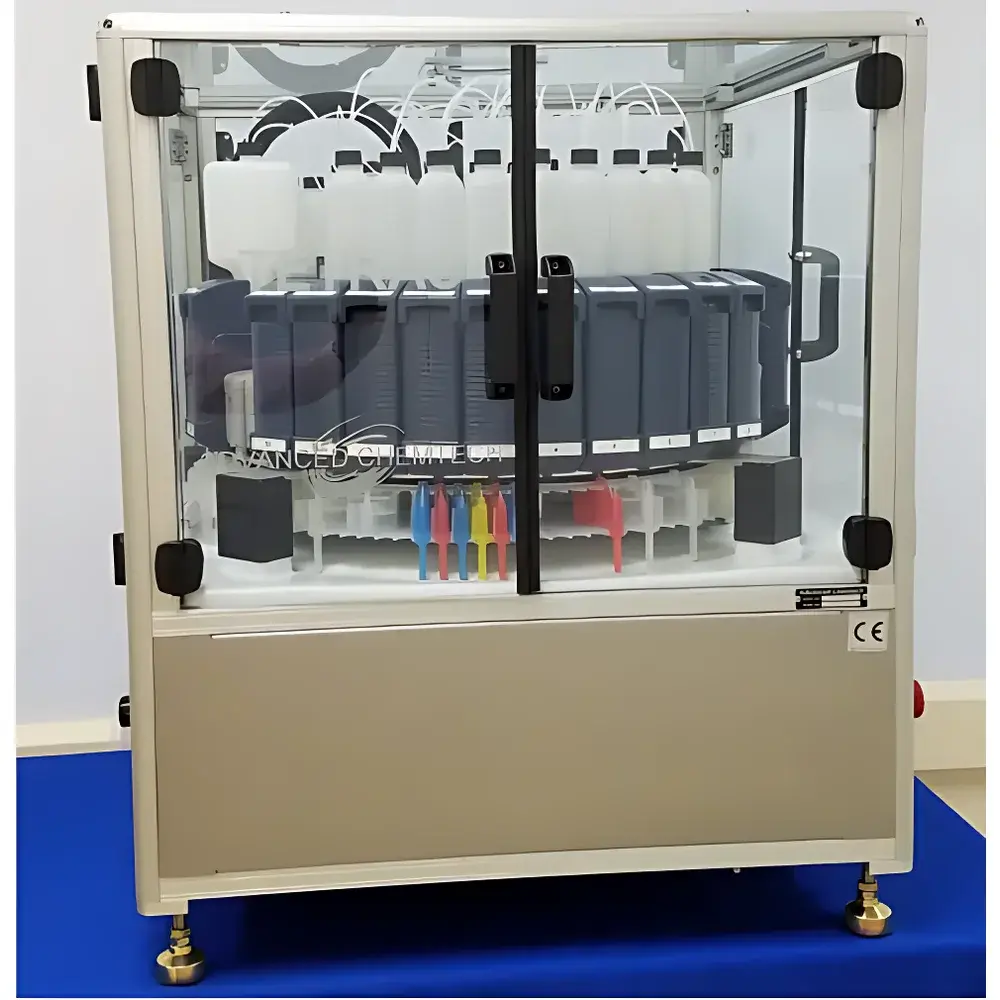
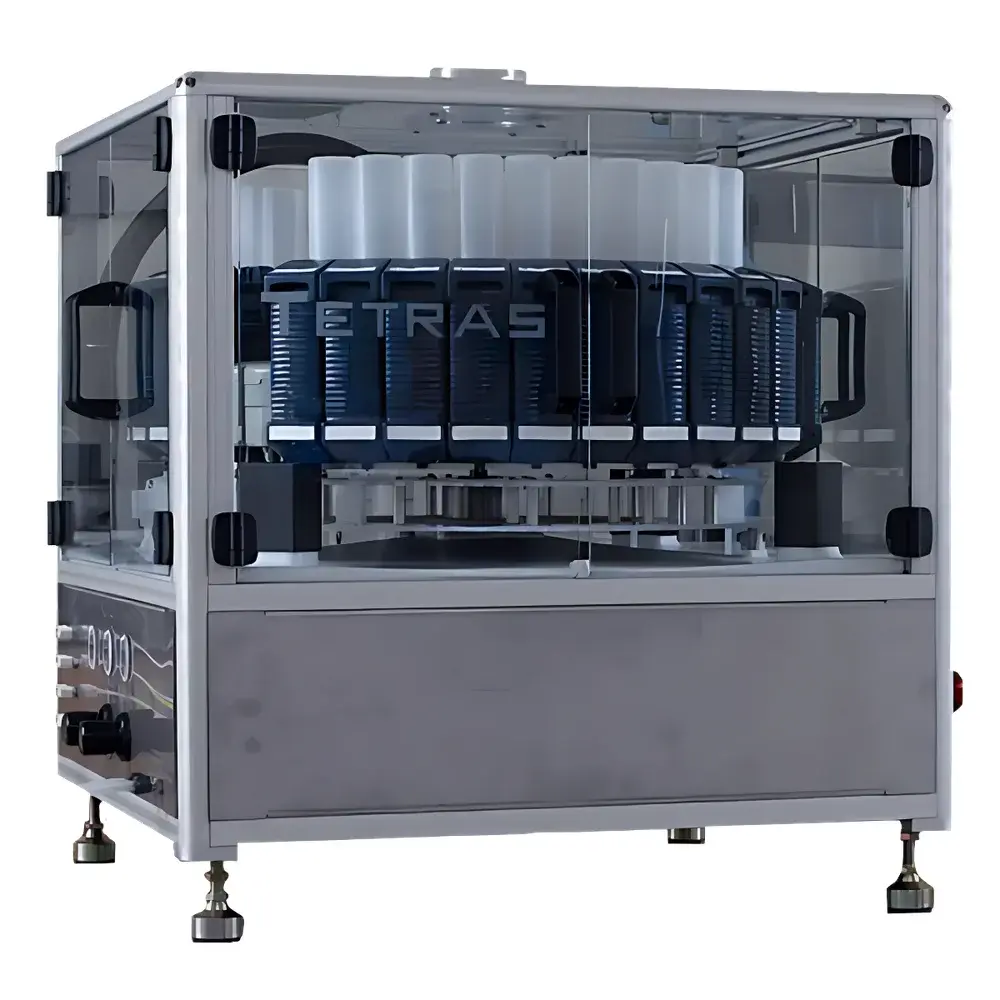
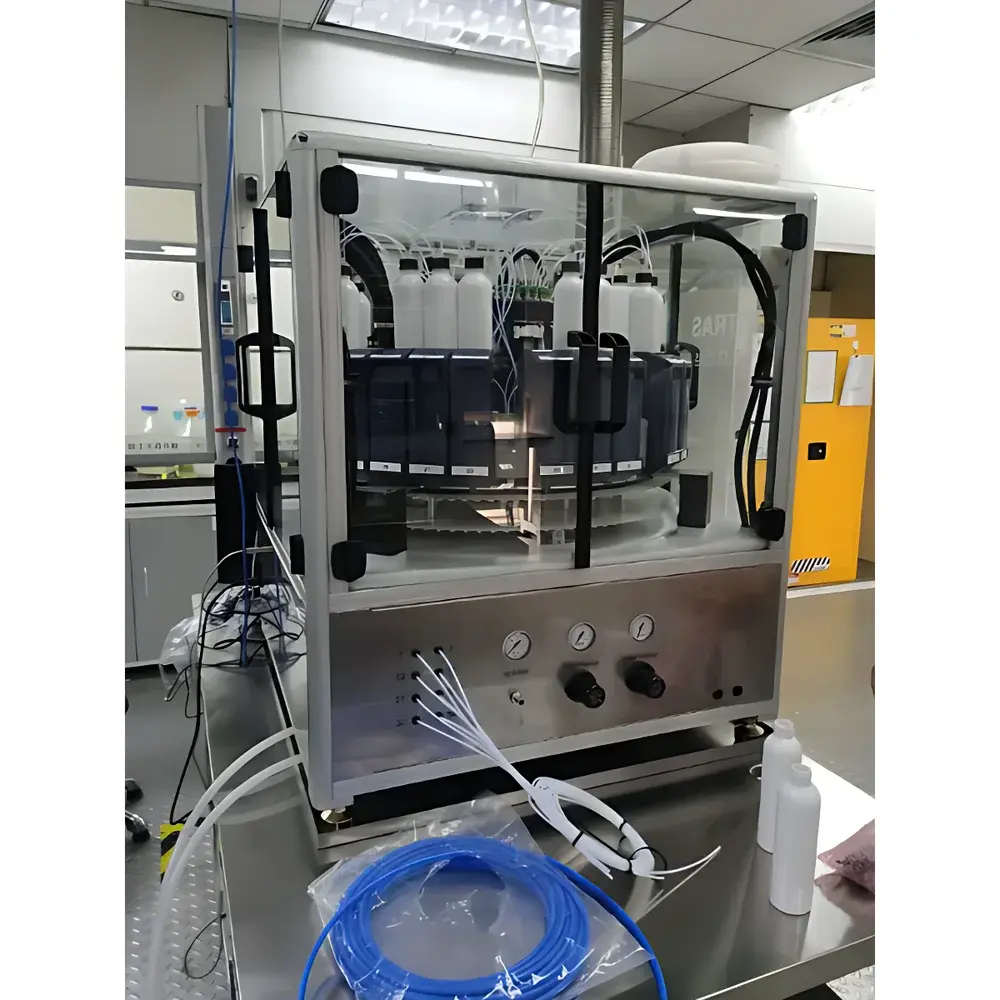
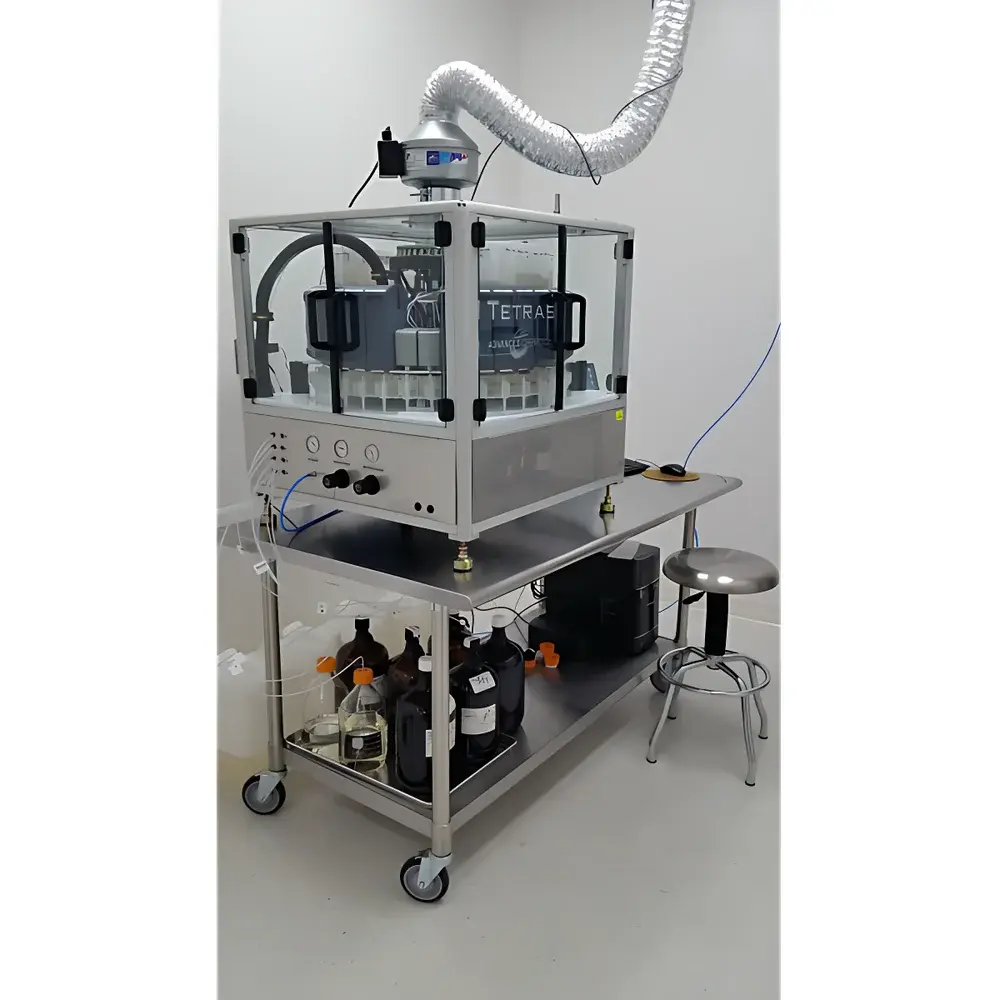
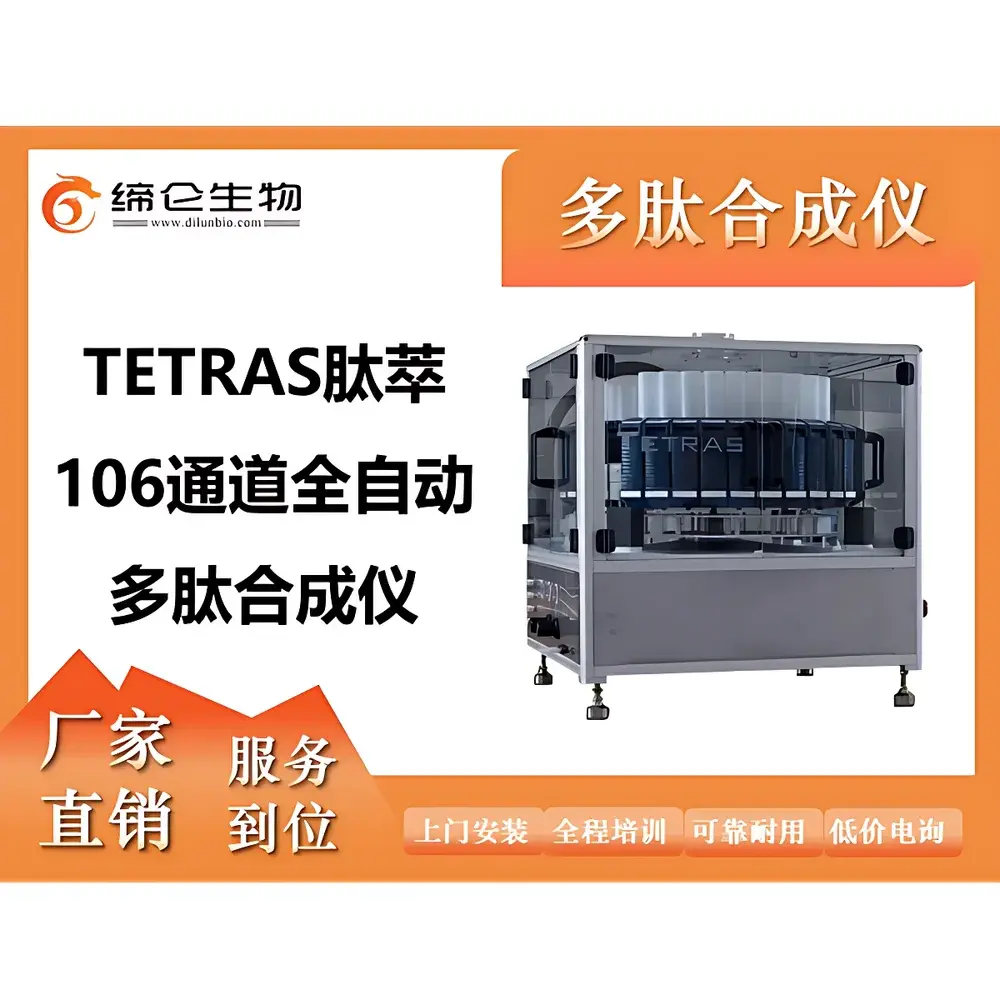
Tetras ACT/Tetras 106-Channel Fully Automated Asynchronous Peptide Synthesizer
| [Brand | ACT/Tetras |
|---|---|
| Origin | USA |
| Model | Tetras 106-Channel Peptide Synthesizer |
| Amino Acid Delivery | Automated |
| Reagent Delivery | Automated |
| Synthesis Scale per Reactor | 30–1000 µmol or 0.01–3 g resin |
| Max Reactor Count | ≤106 |
| Reactor Volumes | 6 mL, 25 mL, 40 mL, 60 mL |
| Syringe Pump Accuracy | <1% |
| Synthesis Purity | ≥99.5% |
| Flow Rate | 0.25–1 mL/s] |
Overview
The Tetras ACT/Tetras 106-Channel Fully Automated Asynchronous Peptide Synthesizer is an industrial-grade solid-phase peptide synthesis (SPPS) platform engineered for high-throughput, parallel, and methodologically independent synthesis of custom peptides. Unlike conventional synchronous multi-channel synthesizers—where all reactions initiate, couple, deprotect, and wash simultaneously—the Tetras architecture implements true asynchronous channel control: each of the up to 106 reaction vessels operates under independently programmable protocols, including variable coupling times, reagent stoichiometries, wash cycles, and solvent sequences. This capability is grounded in a modular fluidic architecture featuring digitally controlled syringe pumps, isolated linear flow paths, and rotation-assisted mixing, eliminating cross-contamination while enabling rigorous reproducibility across heterogeneous peptide sequences. Designed for GLP-compliant laboratories and GMP-aligned CRO/CDMO environments, the system supports both Fmoc- and Boc-based chemistries and integrates seamlessly into regulated workflows requiring audit trails, electronic signatures, and instrument qualification documentation.
Key Features
- Asynchronous multi-channel operation: Each reactor executes unique synthesis protocols—including sequence-specific coupling duration, activation chemistry, and deprotection conditions—without synchronization constraints.
- Modular injection and evacuation stations: Configurable with 24–32 digitally controlled syringe pumps; supports internal reagent reservoirs (125 mL, 230 mL, 500 mL) and external bulk solvent tanks.
- Zero-cross-contamination fluidics: Dedicated, non-intersecting liquid pathways from pump to reactor; minimal dead volume and short conduit lengths reduce carryover and solvent consumption by >40% versus manifold-based systems.
- Rotational mixing with sinusoidal agitation: Ensures uniform resin suspension and efficient mass transfer during coupling and deprotection steps—critical for high-yield synthesis of difficult sequences (e.g., hydrophobic, aggregation-prone, or sterically hindered peptides).
- Remote operation & diagnostics: Web-enabled interface supports real-time monitoring, email status alerts, and secure remote access (with user authorization) for troubleshooting, method deployment, and operator training.
- Regulatory-ready architecture: Compliant with FDA 21 CFR Part 11 requirements for electronic records and signatures when paired with validated software configuration; supports IQ/OQ/PQ documentation packages.
Sample Compatibility & Compliance
The Tetras synthesizer accommodates standard SPPS resins (e.g., Wang, Rink amide MBHA, 2-CTC) across a broad scale range—from microscale (30 µmol, ~0.01 g resin) for epitope screening to preparative-scale (1000 µmol, ~3 g resin) for antigen production. Reaction vessels are available in four standardized volumes (6 mL, 25 mL, 40 mL, 60 mL), all featuring arc-bottom geometry optimized for homogeneous resin dispersion and complete reagent penetration. The system complies with ISO 9001-certified manufacturing practices and meets electrical safety standards IEC 61010-1 (Laboratory Equipment). It is validated for use in environments adhering to USP , ASTM E2500, and EU Annex 11 guidelines for computerized system validation.
Software & Data Management
The embedded Tetras Control Suite provides a browser-based GUI supporting method creation, real-time reactor status visualization, reagent consumption forecasting, and automated low-reagent alerts. All synthesis logs—including timestamps, pump actuation events, pressure readings, and temperature profiles—are timestamped, digitally signed, and stored in encrypted SQLite databases with optional export to LIMS or enterprise SQL servers. Unlimited method storage enables lab-wide protocol libraries; pre-loaded templates cover common applications (e.g., phosphorylated peptides, disulfide-rich scaffolds, N-methylated analogs). Audit trail functionality records every user action, parameter change, and system event—fully traceable for regulatory inspections.
Applications
- High-throughput custom peptide synthesis for pharmaceutical discovery (epitope mapping, vaccine candidates, PROTAC linkers)
- Construction of focused and combinatorial peptide libraries (up to 106 sequences per run)
- Method optimization studies: Empirical determination of optimal coupling reagents, activators, and cycle durations per sequence
- Educational labs: Concurrent student projects using distinct protocols on shared hardware
- CRO/CDMO service operations: Flexible batch scheduling accommodating variable order sizes (e.g., 30 peptides one day, 50 the next) without reconfiguration overhead
- Antibody conjugation payload synthesis requiring strict purity and batch consistency (≥99.5% crude purity typical for 15–25mer sequences)
FAQ
What does “asynchronous synthesis” mean in practice?
It means each of the 106 reactors can be assigned a unique synthesis protocol—different amino acid addition order, coupling time, reagent concentration, or wash volume—without affecting other channels.
Can the system support both Fmoc and Boc chemistry?
Yes; solvent compatibility includes DMF, DCM, TFA, and piperidine solutions; hardware materials (e.g., PTFE tubing, Hastelloy valves) resist corrosion from strong acids and bases.
Is remote maintenance supported under regulatory environments?
Remote diagnostics and software updates are permitted only when conducted via authenticated, encrypted sessions compliant with your organization’s IT security policy and 21 CFR Part 11 Annex A controls.
How is calibration and pump accuracy verified?
Syringe pump accuracy (<1% CV) is verified per ASTM E2872 using gravimetric dispensing tests at multiple flow rates (0.25–1 mL/s); calibration certificates are issued with each IQ/OQ package.
What resin formats are compatible with the 6 mL and 60 mL reactors?
Standard fritted polypropylene reaction vessels accept 100–200 mesh resin slurries; custom adapters are available for specialty resins (e.g., ChemMatrix®, PEG-based supports).




