
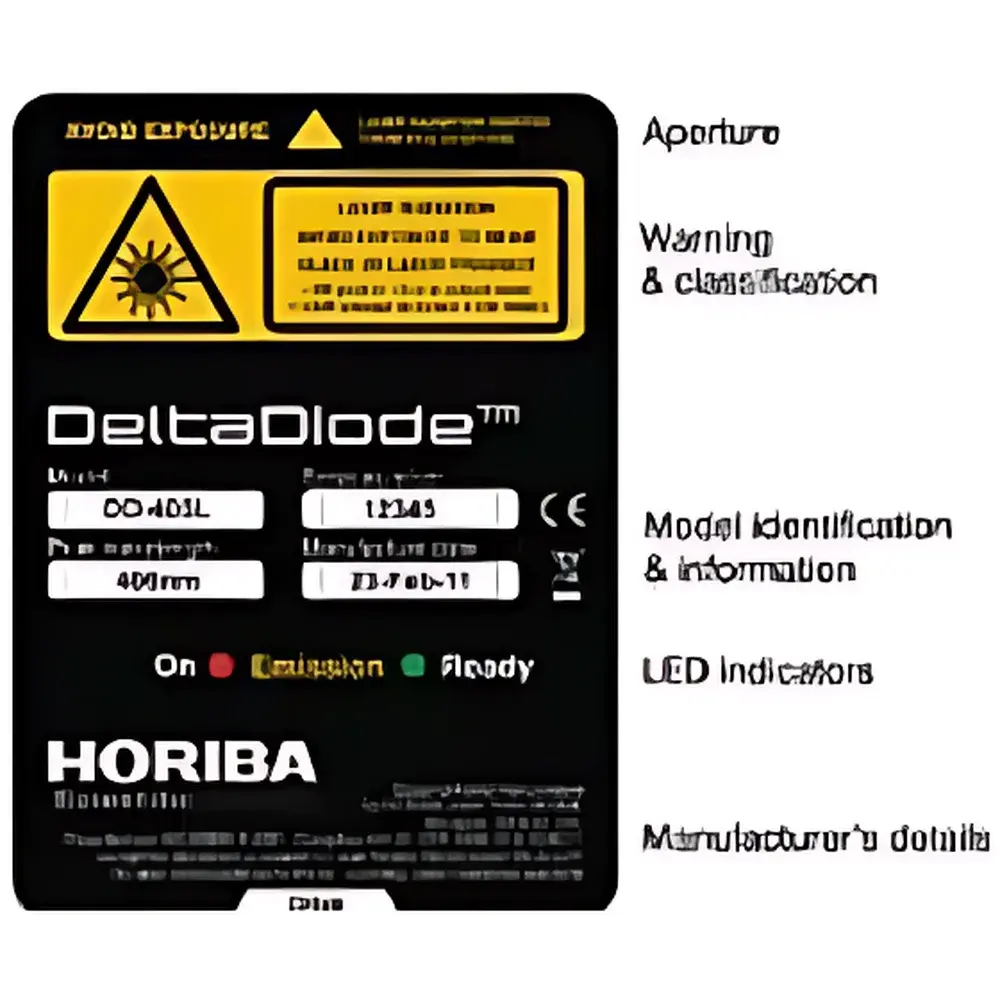
HORIBA DeltaDiode 100 MHz Picosecond Pulsed Laser Source
| Brand | HORIBA |
|---|---|
| Origin | United Kingdom |
| Manufacturer Type | Authorized Distributor |
| Origin Category | Imported |
| Model | DeltaDiode |
| Component Category | Pulsed Light Source |
| Wavelength Range | 250–980 nm |
| Pulse Width | <70 ps (typ.) |
| Repetition Rate | Up to 100 MHz (laser) |
| Output Modes | Pulsed (TCSPC-optimized), CW (select wavelengths) |
| Synchronization | NIM/TTL output with adjustable nanosecond delay |
| Triggering | External TTL/NIM trigger input |
| Gating | Fast/slow gate inputs |
| Control Interface | LCD front panel + USB (PC) |
| Adjustable Parameters | Output power, repetition rate, cooling temperature, pulse frequency |
| Compliance | Designed for GLP/GMP-aligned fluorescence lifetime instrumentation |
Overview
The HORIBA DeltaDiode 100 MHz Picosecond Pulsed Laser Source is a modular, laboratory-grade excitation platform engineered for high-temporal-resolution photonic measurements. Based on gain-switched semiconductor laser diode technology and high-efficiency pulsed LED architecture, the system delivers sub-70 ps optical pulses with exceptional timing jitter (<5 ps RMS) and amplitude stability (<0.5% RMS over 8 hours). Its core design principle centers on deterministic, low-jitter photon generation synchronized to external instrumentation—making it fundamentally suited for Time-Correlated Single Photon Counting (TCSPC), time-domain fluorescence lifetime spectroscopy, and Fluorescence Lifetime Imaging Microscopy (FLIM). Unlike broadband or mode-locked sources, the DeltaDiode achieves picosecond performance without complex cavity alignment or water cooling, leveraging thermoelectric stabilization and integrated driver electronics for long-term operational consistency in ambient-lab environments.
Key Features
- Modular source-controller architecture: One controller supports interchangeable laser diode or LED modules across 250–980 nm, enabling rapid reconfiguration for multi-wavelength lifetime studies.
- Precision pulse control: Factory-calibrated repetition rates from 10 kHz to 100 MHz (laser) or 20 MHz (LED), with fine-tuning via USB or front-panel LCD interface.
- Low-jitter synchronization: NIM and TTL outputs with digitally adjustable delay (0–1000 ns, 10 ps resolution) for precise alignment with detectors, time-to-digital converters (TDCs), or gated cameras.
- Dual-mode operation: Selectable pulsed or continuous-wave (CW) output on compatible wavelengths—facilitating instrument calibration, background subtraction, and intensity reference protocols.
- Robust thermal management: Closed-loop thermoelectric cooler (TEC) maintains diode junction temperature within ±0.1 °C, ensuring wavelength stability (<0.02 nm/°C) and pulse energy reproducibility.
- External triggering capability: Accepts TTL/NIM logic-level triggers with <2 ns rise time and programmable hold-off, supporting pump-probe, gated detection, and event-driven acquisition schemes.
- Flexible gating interface: Dedicated fast-gate (≤2 ns rise/fall) and slow-gate (microsecond-scale) inputs enable time-resolved signal rejection and background suppression in heterogeneous samples.
Sample Compatibility & Compliance
The DeltaDiode integrates seamlessly into regulated analytical workflows. Its stable pulse parameters, traceable calibration history (per module serial number), and deterministic timing behavior support compliance with ISO/IEC 17025 requirements for measurement uncertainty estimation in fluorescence lifetime assays. When deployed in pharmaceutical QC labs or academic core facilities, the system aligns with FDA 21 CFR Part 11 expectations through optional audit-trail-enabled software (e.g., DAS6 or SymPhoTime 64), where user actions, parameter changes, and hardware events are timestamped and non-erasable. All optical modules meet IEC 60825-1:2014 Class 3B laser safety standards; LED variants comply with IEC 62471 for photobiological safety. No hazardous substances are used in manufacturing per RoHS Directive 2011/65/EU.
Software & Data Management
Native control is provided via HORIBA’s DeltaHub USB driver suite (Windows/Linux), offering SCPI-compatible command set for integration into LabVIEW, Python (PyVISA), or MATLAB environments. Third-party TCSPC platforms—including Becker & Hickl SPC-150NX, PicoQuant HydraHarp 400, and ID Quantique ID120—recognize DeltaDiode as a standard sync source via NIM/TTL handshake. Firmware updates preserve backward compatibility across generations (including legacy PicoBrite-branded units, fully interoperable with current DeltaDiode controllers). All configuration states—including wavelength selection, repetition rate, power level, and gate settings—are stored in non-volatile memory and can be recalled via preset profiles. Exportable log files include timestamps, thermal sensor readings, and pulse energy monitoring data—critical for GLP documentation and method validation reports.
Applications
- TCSPC-based fluorescence lifetime decay analysis in solution-phase kinetics, protein folding studies, and FRET efficiency quantification.
- Confocal and multiphoton FLIM systems requiring spatially resolved lifetime maps with sub-nanosecond temporal binning.
- Time-resolved photoluminescence (TRPL) of quantum dots, perovskites, and organic semiconductors under controlled excitation fluence.
- Calibration of ultrafast streak cameras, single-photon avalanche diodes (SPADs), and superconducting nanowire single-photon detectors (SNSPDs).
- Gated Raman spectroscopy and time-resolved diffuse reflectance in turbid media (e.g., biological tissue phantoms).
- Development of time-of-flight (ToF) optical sensors and LiDAR test benches requiring stable, high-repetition-rate picosecond triggers.
FAQ
Is the DeltaDiode compatible with non-HORIBA TCSPC hardware?
Yes—the system provides industry-standard NIM and TTL synchronization outputs and accepts external triggers, ensuring full interoperability with Becker & Hickl, PicoQuant, and Swabian Instruments timing electronics.
Can I operate multiple DeltaDiode modules from one controller simultaneously?
No—each controller drives only one optical module at a time; however, modules can be physically swapped in seconds without recalibration due to precision mechanical and electrical interlocks.
What is the typical pulse energy stability over an 8-hour measurement session?
Under constant-temperature conditions and fixed drive current, pulse energy drift remains ≤0.8% (peak-to-peak) for wavelengths ≥405 nm; UV LEDs (250–300 nm) exhibit ≤2.5% drift due to inherent semiconductor aging effects.
Does the system support custom firmware development?
HORIBA provides documented USB HID protocol specifications and C/C++ SDKs under NDA for OEM integration and automated test system development.
Are service manuals and calibration certificates available for regulatory audits?
Yes—factory calibration reports (including pulse width, jitter, and wavelength verification) and full technical service documentation are supplied with each unit and archived for 10 years post-manufacture.





