
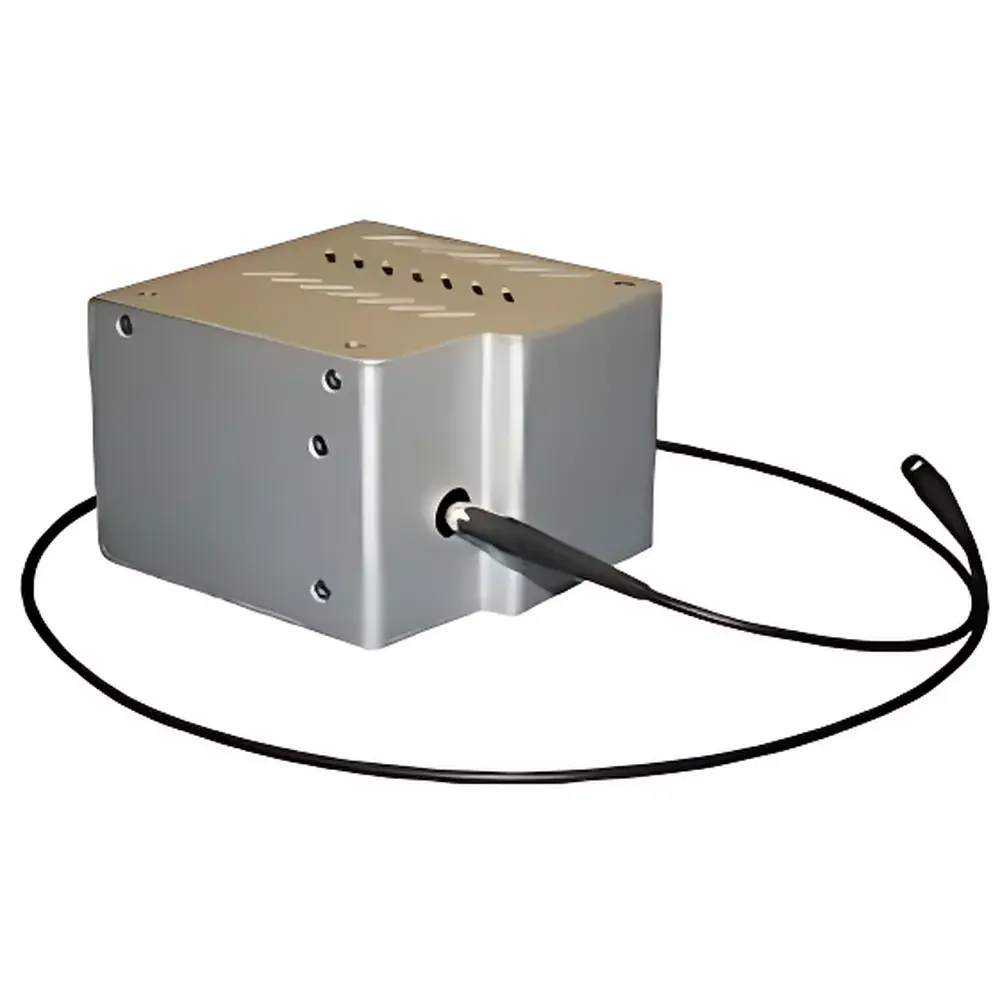
HORIBA Jobin Yvon VS7000+ OEM Grating Spectrometer Monochromator
| Brand | HORIBA |
|---|---|
| Origin | France |
| Manufacturer Type | Authorized Distributor |
| Product Category | Imported Instrument |
| Model | VS7000+ |
| Application System | Fluorescence Spectroscopy |
| Grating Mount | Motorized or Fixed Grating Turret (OEM Configurable) |
| Spectral Resolution | 0.33 nm/pixel (at 75 µm slit, 2048-pixel CCD, UV-VIS configuration) |
| Dispersion | ~1.6 nm/mm (typical, dependent on grating and focal length) |
| Wavelength Range | 200–1050 nm (configurable via grating & filter options) |
| F/# | f/2.8 |
| Wavelength Accuracy | ±0.2 nm (calibrated, traceable to NIST standards) |
| Stray Light | <0.04% (typical), <0.08% (max), measured with 300 µm UV-VIS CCD, 510 nm bandpass filter, 75 µm slit |
Overview
The HORIBA Jobin Yvon VS7000+ is a purpose-engineered OEM grating spectrometer monochromator designed for integration into analytical instrumentation platforms by original equipment manufacturers (OEMs). It employs a modified Czerny-Turner optical architecture with a single-element, aberration-corrected, flat-field concave holographic grating (Jobin Yvon Type IV), eliminating moving parts and ensuring long-term mechanical and spectral stability. Unlike modular benchtop spectrometers, the VS7000+ prioritizes compactness (L × W × H ≈ 145 × 110 × 75 mm), high optical throughput (f/2.8), and intrinsic stray-light suppression—critical for low-signal applications such as fluorescence emission, weak Raman scattering, and absorbance measurements in microvolume cuvettes or flow cells. Its core functionality is rooted in dispersive spectroscopy: incident light is collimated, diffracted by the fixed grating, and focused onto a linear back-illuminated CCD array with pixel-level spatial registration to wavelength. This enables direct, non-scanning spectral acquisition across the full UV-VIS-NIR range—without mechanical wavelength scanning or slit translation—supporting real-time kinetics, multichannel detection, and synchronization with external triggers.
Key Features
- Single-element, monolithic Type IV aberration-corrected concave grating: eliminates alignment drift and guarantees consistent flat-field focusing across the detector array
- Back-illuminated linear CCD detector with peak quantum efficiency >75% at 650 nm; >63% at 250 nm; >55% at 850 nm—optimized for low-photon-flux applications including fluorescence and weak-emission spectroscopy
- Configurable spectral coverage: three standard optical paths—UV-VIS (200–860 nm), VIS-only (380–750 nm), and UV-VIS-NIR (200–1050 nm)—each matched with optimized grating blaze and integrated order-sorting filters to suppress second-order diffraction
- High optical throughput (f/2.8) and ultra-low stray light (<0.04% typical): achieved via precision-coated optics, blackened internal baffling, and proprietary grating groove geometry
- On-board linearization and dark-current compensation: factory-calibrated pixel-to-wavelength mapping, nonlinearity correction (<0.4% residual error), and real-time dark-frame subtraction reduce post-processing overhead
- USB 2.0 interface with deterministic timing: supports trigger-synchronized acquisition at up to 223 spectra/s (ultra-fast mode, 4.5 ms readout), with full 16-bit digitization and hardware-level data integrity checks
Sample Compatibility & Compliance
The VS7000+ is engineered for compatibility with standard fiber-optic interfaces (600 µm core, 1.5 m length; optional 1 mm-height detector for 800–1000 µm fibers) and common optical sampling accessories—including cuvette holders (10 mm pathlength), integrating spheres, flow cells, and microfluidic adapters. Its spectral performance meets key requirements for regulatory-compliant analytical systems: wavelength accuracy is traceable to NIST-certified emission lines (e.g., Hg and Ne lamps); photometric linearity is validated per ASTM E275 and ISO 17025 protocols using certified reference materials (e.g., caffeine in aqueous solution at 273 nm); stray-light levels comply with USP criteria for UV-Vis spectrophotometers (>2.4 AU suppression). While the instrument itself carries no standalone FDA 21 CFR Part 11 certification, its DLL/VIs and LabVIEW-compatible drivers support audit-trail-enabled software architectures compliant with GLP/GMP environments when implemented within validated host systems.
Software & Data Management
The VS7000+ ships with a comprehensive software development kit (SDK) including LabVIEW™ 2011-compatible VIs, C/C++ DLLs, and Python wrappers—enabling seamless integration into OEM control frameworks. All raw CCD frames (16-bit, uncorrected) and factory-linearized spectra are accessible programmatically. On-board processing includes real-time dark subtraction, pixel binning (boxcar averaging), and selectable gain modes (4 e⁻/count or 8 e⁻/count). Spectral calibration supports three native axes: pixel index, wavelength (nm), and wavenumber (cm⁻¹), with user-definable polynomial orders (up to 5th degree). Data export formats include ASCII (.txt), CSV, and Excel-compatible .xlsx. No LabVIEW runtime license is required to execute precompiled acquisition software; however, custom VI development necessitates a licensed LabVIEW 2011 environment. Firmware updates and calibration file management are handled via secure USB-based tools compliant with IEC 62304 Class B software lifecycle requirements.
Applications
- Fluorescence spectrometers: high-sensitivity detection of low-concentration biomarkers, quantum dots, and lanthanide complexes due to superior UV QE and low read noise (35 e⁻ RMS in sensitivity mode)
- Portable Raman analyzers: robust monolithic optical path resists vibration-induced misalignment; NIR-optimized configurations enable 785 nm excitation with minimal fluorescence interference
- HPLC/UV-Vis detectors: rapid multi-wavelength absorbance monitoring (223 spectra/s) supports gradient elution analysis and peak purity assessment
- LED and laser diode characterization: high dynamic range (7000:1) and sub-nanometer pixel resolution enable precise FWHM, centroid shift, and spectral stability tracking
- Water and gas quality sensors: field-deployable UV absorption (e.g., NO₂, SO₂, ozone) and NIR reflectance (e.g., organic carbon, chlorophyll-a) measurement using embedded firmware logic
- NIR food and agricultural analyzers: broadband spectral capture (200–1050 nm) facilitates PLS regression models for moisture, protein, and fat content prediction
FAQ
Is the VS7000+ suitable for regulated pharmaceutical QC environments?
Yes—when integrated into a validated host system with appropriate software controls (e.g., electronic signatures, audit trails, and calibration management), it meets foundational requirements for USP , EP 2.2.25, and ICH Q2(R2) method suitability.
Can I replace the grating or detector in the field?
No—the VS7000+ is a sealed OEM module. Grating and detector selections are finalized at order entry; all optical alignments are factory-performed and permanently fixed.
What is the thermal stability of spectral calibration?
Wavelength drift is <0.01 nm/°C over 15–35 °C ambient range; dark current doubles approximately every 6 °C—active cooling is not provided, but external thermoelectric stabilization is supported via mounting interface.
Does HORIBA provide application-specific firmware?
Standard firmware is generic; however, HORIBA offers co-development services for application-tuned firmware (e.g., real-time peak detection, ratio-metric absorbance, or fluorescence lifetime gating) under NDA and OEM agreement.
How is stray light quantified, and what test conditions apply?
Stray light is measured per ISO 9022-18 using a 510 nm bandpass filter and 75 µm slit width with a 300 µm-height UV-VIS CCD; reported values reflect worst-case second-order contribution under standardized geometry.




