
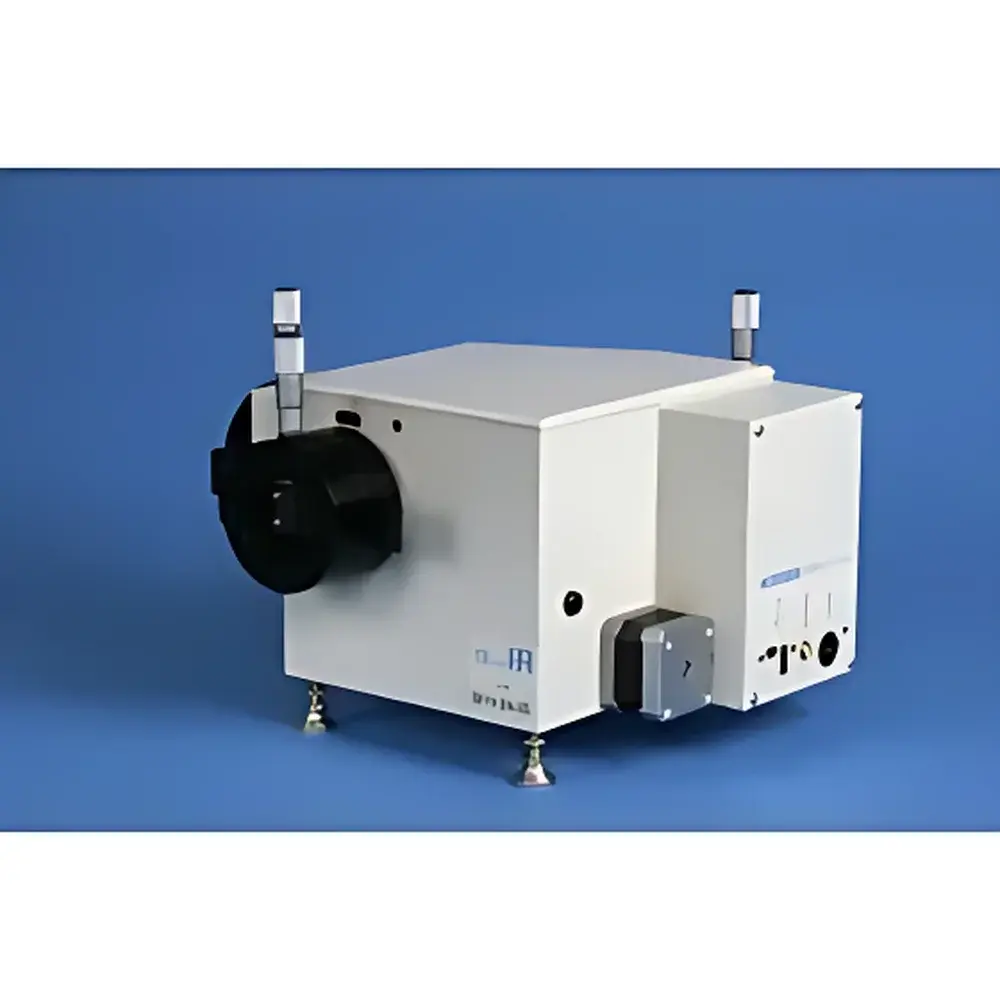
HORIBA JY MicroHR Compact Imaging Spectrometer
| Brand | HORIBA |
|---|---|
| Origin | USA |
| Model | MicroHR |
| Focal Length | 140 mm |
| f/# | f/3.88 |
| Linear Dispersion | 5.25 nm/mm |
| Grating Format | Dual-position motorized or manual turret (32 mm × 32 mm) |
| Spectral Range | 180 nm – 20 µm (dependent on grating and detector selection) |
| Detector Interface | Compatible with CCD, PMT, and other single-channel detectors |
| Application Modes | Transmission, Reflection, Fluorescence, Laser Spectroscopy, In-situ & Field Deployment |
Overview
The HORIBA JY MicroHR is a compact, high-performance imaging spectrometer engineered for precision spectral analysis across ultraviolet, visible, near-infrared, and mid-infrared domains. Based on Czerny–Turner optical architecture with an optimized toroidal mirror system, the MicroHR delivers superior image quality, minimal astigmatism, and high throughput — essential for low-light applications such as fluorescence spectroscopy and Raman signal acquisition. Its 140 mm focal length and f/3.88 aperture provide an optimal balance between resolution, light-gathering capability, and physical footprint. Designed for modularity and field adaptability, the MicroHR serves as both a benchtop laboratory workhorse and a rugged component in OEM integration or portable diagnostic systems.
Key Features
- Compact form factor (140 mm focal length) enables integration into space-constrained setups including vacuum chambers, cryostats, and mobile platforms.
- Dual-position grating turret — available in manual or motorized configurations — supports rapid interchange of up to two ruled or holographic gratings (32 mm × 32 mm), facilitating seamless transition between UV–VIS and IR spectral ranges.
- Toroidal focusing mirrors minimize optical aberrations and deliver diffraction-limited performance across broad wavelength bands, enhancing signal fidelity in multi-wavelength detection schemes.
- Standard C-mount and SMA fiber input options ensure compatibility with industry-standard light sources, optical fibers, and beam delivery systems.
- Optimized mechanical stability and thermal design support long-term measurement repeatability under variable ambient conditions, meeting requirements for GLP-compliant routine analysis.
Sample Compatibility & Compliance
The MicroHR accommodates diverse sample geometries and measurement modalities through flexible coupling options: free-space optics for reflection/transmission measurements; fiber-optic probes for remote or in-line monitoring; and direct mounting onto microscopes or laser excitation paths for confocal or time-resolved spectroscopy. When paired with calibrated detectors (e.g., back-illuminated CCDs for UV–VIS or MCT detectors for IR), the system supports quantitative spectral acquisition traceable to NIST standards. The instrument’s mechanical and electrical design complies with IEC 61000-6-3 (EMC emission) and IEC 61000-6-2 (immunity), and its software control architecture can be configured to meet FDA 21 CFR Part 11 requirements for electronic records and signatures when deployed in regulated QC/QA environments.
Software & Data Management
HORIBA’s Synergy software provides full instrument control, spectral acquisition, real-time processing, and export capabilities compliant with ASTM E131 and ISO/IEC 17025 data integrity guidelines. Features include wavelength calibration using Hg/Ar lamp references, intensity correction via flat-field normalization, and batch processing workflows for multi-sample comparative analysis. Raw spectral data is stored in vendor-neutral formats (e.g., ASCII, CSV, HDF5), enabling interoperability with third-party tools such as MATLAB, Python (NumPy/SciPy), and LabVIEW. Audit trails, user access logs, and version-controlled method files support GMP-aligned documentation practices.
Applications
- UV–VIS–NIR absorption and reflectance spectroscopy for thin-film characterization and semiconductor metrology.
- Laser-induced fluorescence (LIF) and time-resolved photoluminescence studies in materials science and life sciences.
- In-situ and process analytical technology (PAT) deployments for real-time reaction monitoring in chemical synthesis and pharmaceutical manufacturing.
- Plasma diagnostics and combustion analysis via atomic emission line profiling.
- Environmental sensing — including gas-phase pollutant identification using tunable diode laser absorption spectroscopy (TDLAS) coupled with MicroHR dispersion.
FAQ
What detector types are compatible with the MicroHR?
The MicroHR supports standard interfaces for scientific CCDs (USB 3.0 or Camera Link), photomultiplier tubes (PMTs) with HV power supplies, and single-element IR detectors (e.g., InGaAs, MCT) via custom adapter plates.
Can the MicroHR operate under vacuum or in controlled atmospheres?
Yes — the base housing is vacuum-compatible to 10⁻⁵ mbar when equipped with optional O-ring sealed ports and non-outgassing internal coatings.
Is wavelength calibration traceable to national standards?
Calibration routines support NIST-traceable Hg, Ar, Ne, and Xe emission lines; users may generate custom calibration polynomials with RMS residuals < 0.02 nm over 100 nm windows.
Does HORIBA offer OEM integration support?
Yes — mechanical drawings, API documentation (DLL and LabVIEW drivers), and firmware customization services are available under NDA for embedded system developers.
How is stray light performance characterized?
Stray light is minimized by optimized baffling, blackened internal surfaces, and grating blaze optimization; typical values range from 10⁻⁴ to 10⁻⁵ OD depending on grating choice and spectral order suppression configuration.



