
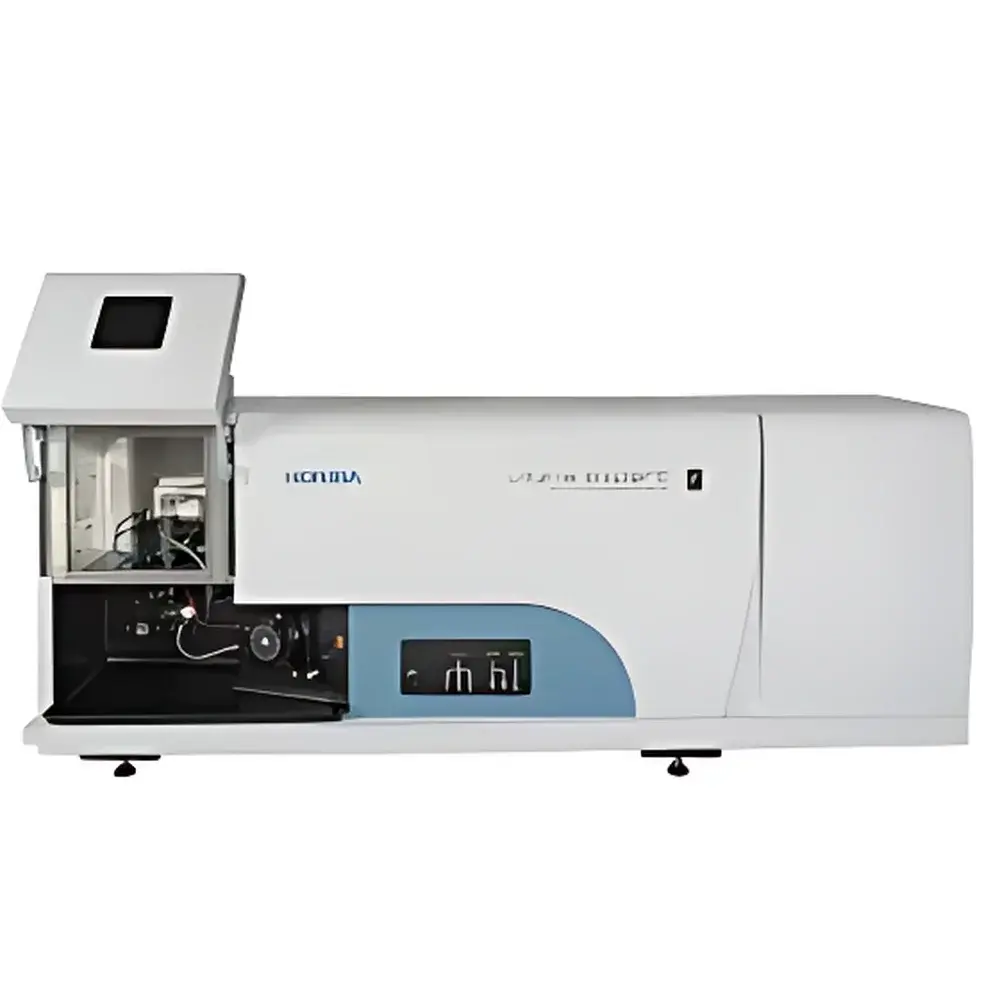
HORIBA Ultima Expert Inductively Coupled Plasma Optical Emission Spectrometer
| Brand | HORIBA |
|---|---|
| Origin | France |
| Model | Ultima Expert |
| Instrument Type | Sequential Scanning ICP-OES |
| Detection Limit | Not Specified |
| Repeatability | ≤1% RSD |
| Stability | ≤2% RSD |
| Wavelength Range | 160–800 nm |
| Optical Resolution | ≤0.005 nm (5 pm) |
| Detector | High-Density Diode (HDD) Array |
| Grating Options | 2400 g/mm holographic grating (≤5 pm @ 120–320 nm |
| Grating Size | 110 × 110 mm ion-etched holographic grating |
| Stray Light Level | <1 × 10⁻⁷ |
| Monochromator | Czerny-Turner with 1 m focal length |
| Plasma Observation | Vertical torch with side-on viewing geometry |
Overview
The HORIBA Ultima Expert is a high-performance, sequential-scanning inductively coupled plasma optical emission spectrometer (ICP-OES) engineered for precision elemental analysis across diverse sample matrices. Based on robust plasma excitation and high-fidelity optical detection, the system utilizes argon plasma at ~6,000–10,000 K to atomize, ionize, and electronically excite elements—emitting characteristic atomic/ionic line spectra detectable across the ultraviolet to near-visible range (160–800 nm). Its core architecture integrates Jobin Yvon’s legacy in high-throughput spectroscopy with modern hardware design: a 1-meter focal length Czerny-Turner monochromator, large-format ion-etched holographic gratings, and a high-density diode (HDD) array detector enabling full-spectrum acquisition without mechanical scanning limitations. The vertical torch with side-on observation ensures uniform plasma sampling across the entire emission zone—minimizing matrix-induced signal suppression and enhancing both sensitivity and long-term stability.
Key Features
- High-resolution optical system featuring a 110 × 110 mm ion-etched holographic grating delivering stray light suppression below 1 × 10⁻⁷—critical for accurate trace analysis in high-background matrices.
- Selectable grating configurations: standard 2400 g/mm grating (≤5 pm resolution at 120–320 nm; ≤10 pm at 320–800 nm) or optional dual-grating assembly (2400 + 4343 g/mm) extending high-resolution capability to 450 nm.
- 1-meter focal length Czerny-Turner monochromator—the longest in commercial ICP-OES—enabling superior dispersion and peak separation for complex spectral environments (e.g., Fe-, W-, or REE-rich geological samples).
- Vertical ICP torch with lateral viewing geometry ensures full-plasma integration, improving signal-to-noise ratio and reducing polyatomic interferences common in axial-view systems.
- HDD detector supports simultaneous multi-element acquisition across the full 160–800 nm range, facilitating rapid qualitative screening and method development without sacrificing quantitative accuracy.
- Thermally stabilized optical bench and active wavelength calibration ensure ≤2% signal drift over 4-hour operation—meeting routine QC requirements in regulated laboratories.
Sample Compatibility & Compliance
The Ultima Expert demonstrates broad compatibility with liquid samples—including high-salt brines, organic solvents (e.g., lubricating oils), acidic digests (aqua regia, HF-HNO₃), and suspended particulates following appropriate nebulization and spray chamber conditioning. Its robust plasma interface accommodates variable dissolved solids content (<25% w/v) and tolerates moderate levels of organic load via oxygen addition or cooled spray chamber operation. The system supports compliance with ASTM D1976 (metals in water), ISO 11885 (water quality), USP (elemental impurities in pharmaceuticals), and EPA Method 200.7/6010D for environmental monitoring. Data integrity features—including audit trail logging, user access control, and electronic signature support—are fully compatible with FDA 21 CFR Part 11 and GLP/GMP workflows when deployed with validated software configurations.
Software & Data Management
Ultima Expert is operated via HORIBA’s proprietary analytical software suite, designed for both routine operation and advanced method development. The platform supports automated wavelength selection, background correction using multi-point polynomial fitting, and internal standard normalization for drift compensation. The “Image” module enables full-spectrum visualization and semi-quantitative elemental mapping without prior calibration—ideal for unknown sample characterization or contamination forensics. Multi-task sequence programming allows concurrent execution of calibration, QC checks, and sample batches, optimizing instrument uptime. All raw spectral data, processing parameters, and audit logs are stored in a structured SQLite database compliant with LIMS integration standards (ODBC/JDBC). Software validation packages—including IQ/OQ documentation and performance qualification protocols—are available upon request for regulated environments.
Applications
- Metallurgy & Mining: Quantification of major, minor, and trace elements (e.g., Al, Cr, Ni, Co, V, Mo) in ferrous/non-ferrous alloys, slag, and rare-earth concentrates—even in presence of intense spectral overlaps from Fe II or Ce II lines.
- Geological & Environmental: Multi-element analysis of soil extracts, groundwater, and leachates per EPA 6010D, including As, Cd, Pb, Hg, Se, and U at sub-pptr levels with minimal interference correction.
- Precious Metals Refining: Direct determination of Au, Pt, Pd, Rh, and Ir in refinery feedstocks and anode slimes—leveraging high-resolution capability to resolve adjacent emission lines (e.g., Pt 265.945 nm / Ir 266.003 nm).
- Food & Agriculture: Monitoring of toxic elements (Cd, Pb, As) and essential nutrients (Ca, Mg, Zn, Mn) in fortified foods, plant tissues, and animal feeds per AOAC and ISO standards.
- Chemical & Materials Science: Catalyst composition profiling, polymer additive quantification, and high-purity reagent certification where detection of residual metals at ng/g levels is required.
FAQ
What plasma viewing configuration does the Ultima Expert use, and why is it advantageous?
It employs a vertically oriented torch with side-on (radial) observation, enabling full-height plasma integration and minimizing self-absorption and matrix-induced signal suppression—particularly beneficial for high-concentration analytes and complex matrices.
Is the system capable of analyzing samples with high total dissolved solids (TDS)?
Yes—the plasma interface and optimized nebulization system support stable operation with TDS up to 25% w/v; optional desolvation or microconcentric nebulizers further extend capability for saline or viscous samples.
Does the Ultima Expert comply with FDA 21 CFR Part 11 requirements?
When configured with validated software settings—including electronic signatures, audit trails, and role-based access control—the system meets core Part 11 expectations for electronic records and signatures in GxP environments.
Can the instrument perform both qualitative and quantitative analysis in a single run?
Yes—the HDD detector and full-spectrum acquisition allow real-time spectral imaging (via Image software) for element identification, followed by targeted quantitative measurement using pre-defined methods—all within one sample introduction cycle.
What maintenance intervals are recommended for optimal optical performance?
The ion-etched grating and sealed optical bench require no routine cleaning; annual verification of wavelength calibration and detector dark current is recommended, with full optical alignment every 24 months under typical usage conditions.




