
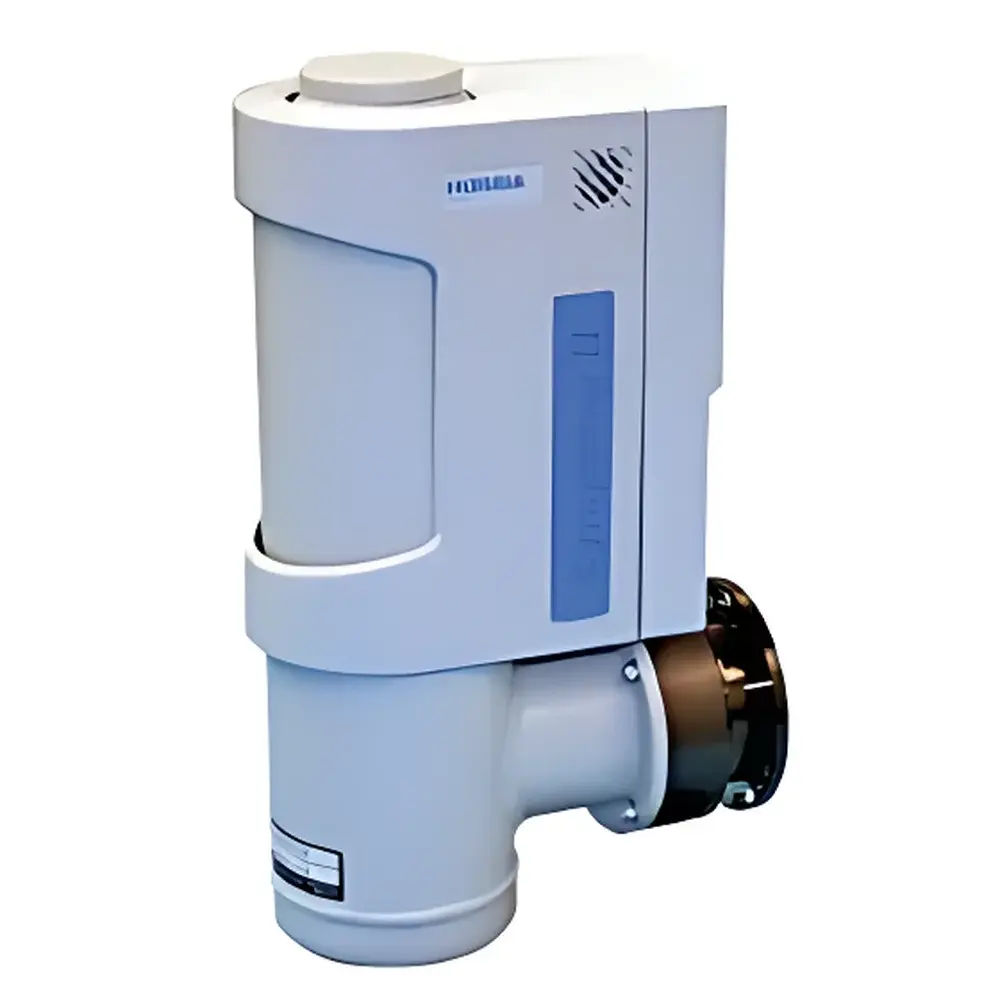
HORIBA Jobin Yvon Symphony CCD Detector
| Brand | HORIBA |
|---|---|
| Origin | USA |
| Model | Symphony CCD |
| Cooling | Liquid Nitrogen |
| Sensor Architecture | Front-Illuminated (FI) / Back-Illuminated (BI) / Deep-Depletion (DD) |
| Resolution Options | 1024×256, 2048×512 |
| Pixel Types | UV-Enhanced, Vis-Enhanced, Open Electrode |
| ADC | 16-bit, 20 kHz – 1 MHz readout |
| Interface | Gigabit Ethernet |
| Onboard Memory | Yes |
| Software Control | SynerJY, LabVIEW VI |
| Compliance | Designed for GLP/GMP-aligned spectroscopic workflows per ISO/IEC 17025 and ASTM E131–22 guidance |
Overview
The HORIBA Jobin Yvon Symphony CCD Detector is a high-performance, liquid nitrogen–cooled array detector engineered specifically for demanding spectroscopic applications across research laboratories, analytical chemistry, materials science, and plasma diagnostics. Based on scientific-grade CCD architecture, the Symphony platform leverages front-illuminated (FI), back-illuminated (BI), and deep-depletion (DD) sensor variants—each optimized for distinct spectral responsivity profiles across UV (190–400 nm), visible (400–800 nm), and near-UV-enhanced ranges. Its core measurement principle relies on photon-to-electron conversion within a silicon photodiode array, followed by low-noise charge transfer and high-fidelity digitization via a 16-bit analog-to-digital converter. The detector operates under vacuum or inert-gas purged environments to minimize dark current accumulation, enabling integration times from milliseconds to several hours without saturation or thermal drift. This architecture ensures high quantum efficiency (QE > 90% peak for BI/UV variants), excellent linearity (>99.9%), and reproducible spectral fidelity—critical for quantitative intensity calibration and long-term stability in regulated environments.
Key Features
- Liquid nitrogen cooling system maintaining sensor temperature at –120°C or lower, reducing dark current to <0.001 e⁻/pixel/sec
- Multiple sensor configurations: 1024×256 and 2048×512 pixel formats with selectable FI, BI, or DD architectures
- Wavelength-specific optimization: UV-enhanced (for 190–400 nm), Vis-enhanced (for 400–800 nm), and open-electrode variants for broad-band transmission
- Programmable 16-bit ADC with adjustable readout rates (20 kHz to 1 MHz), supporting both high-speed kinetic acquisition and ultra-low-noise slow-scan modes
- Onboard memory buffer (up to 128 MB) enabling burst-mode acquisition without host PC latency
- Gigabit Ethernet interface ensuring deterministic data transfer, CRC error checking, and full packet integrity
- Hardware-triggered synchronization compatible with external light sources, choppers, or pulsed lasers (TTL/CMOS input)
- Modular mechanical design with standardized C-mount and SMA fiber coupling options for seamless integration into monochromators, spectrographs, and Raman systems
Sample Compatibility & Compliance
The Symphony CCD supports direct coupling to all major benchtop and modular spectroscopic platforms—including HORIBA’s own iHR, Triax, and Synapse series—as well as third-party instruments from Acton, Princeton Instruments, and Andor (via adapter kits). Its vacuum-sealed housing and thermally stabilized cold finger ensure stable operation during extended acquisitions required in emission spectroscopy, fluorescence lifetime mapping, and time-resolved photoluminescence. From a regulatory standpoint, the detector’s firmware architecture supports audit-trail–enabled acquisition logs, timestamped metadata embedding (exposure time, gain, temperature, shutter state), and user-accessible calibration coefficients—facilitating alignment with ISO/IEC 17025 method validation requirements and ASTM E131–22 spectral data reporting standards. While not FDA 21 CFR Part 11–certified out-of-the-box, its SynerJY software framework provides optional electronic signature modules and role-based access control suitable for GxP-compliant environments when deployed with validated IT infrastructure.
Software & Data Management
Control and data acquisition are managed through HORIBA’s SynerJY software suite—a Windows-based application offering full instrument parameterization, real-time preview, multi-curve overlay, and batch processing of spectral stacks. SynerJY includes built-in dark-frame subtraction, flat-field correction, wavelength calibration wizards (using Hg/Ar/Ne lamp references), and export to ASCII, HDF5, and JCAMP-DX formats for interoperability with MATLAB, Python (NumPy/Pandas), and commercial chemometrics tools. For custom automation, native LabVIEW VIs are supplied with documented I/O protocols and error-handling routines. All acquired spectra retain embedded EXIF-style metadata including sensor temperature, integration time, ADC gain setting, and hardware revision ID—enabling traceable reprocessing and inter-laboratory comparison.
Applications
- Raman spectroscopy requiring high SNR in low-light conditions (e.g., graphene monolayer characterization, pharmaceutical polymorph identification)
- Atomic emission spectroscopy (AES) for elemental analysis in metallurgy and environmental monitoring
- Time-resolved fluorescence decay profiling using gated acquisition modes
- Plasma diagnostics via line-ratio thermometry and Stark broadening analysis
- UV-Vis-NIR absorbance and reflectance measurements in thin-film metrology
- Cryogenic photoluminescence studies of quantum dots and perovskite semiconductors
FAQ
What cooling method does the Symphony CCD use, and why is it critical for spectroscopy?
Liquid nitrogen cooling achieves sustained sensor temperatures below –120°C, suppressing thermally generated dark current to sub-millielectron levels—essential for achieving high dynamic range (>10⁵) and low-noise detection in long-integration spectral measurements.
Can the Symphony CCD be used with non-HORIBA spectrographs?
Yes. Its standard C-mount flange, 12 mm image circle, and TTL trigger compatibility enable straightforward integration with most commercial spectrographs and monochromators—provided optical magnification and focal plane alignment are verified prior to installation.
Is pixel binning supported, and how does it affect resolution and sensitivity?
Horizontal and vertical binning is fully programmable in SynerJY software. Binning improves signal-to-noise ratio and frame rate at the expense of spatial/spectral resolution—making it ideal for low-light kinetic experiments where spectral bandwidth outweighs fine feature discrimination.
How is calibration traceability maintained across instrument lifecycles?
Each Symphony unit ships with NIST-traceable QE curves, pixel response uniformity maps, and dark current temperature coefficients. These are stored in non-volatile memory and automatically loaded during initialization to ensure consistent radiometric accuracy across firmware updates and lab transfers.




