
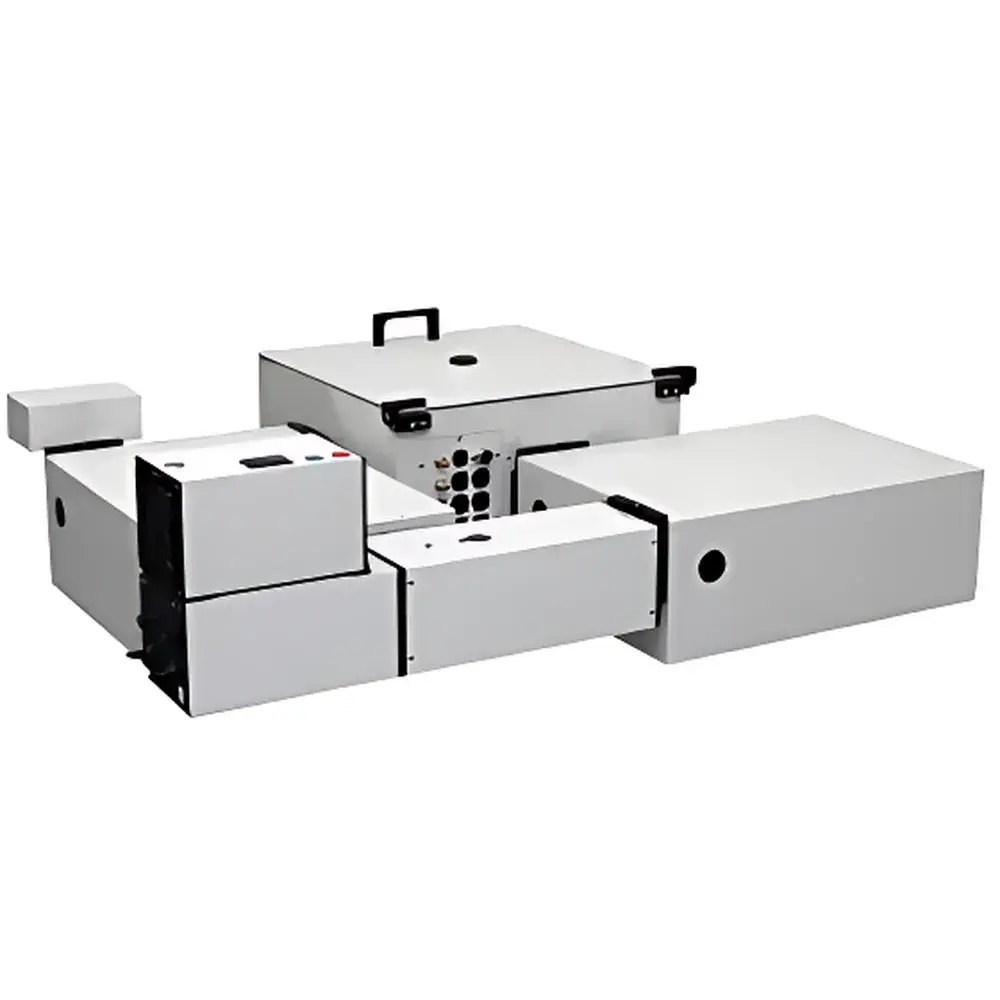
HORIBA QuantaMaster 8000 Series Modular Fluorescence Spectrometer
| Brand | HORIBA |
|---|---|
| Origin | Canada |
| Model | QuantaMaster 8000 |
| Wavelength Accuracy | ±0.3 nm |
| Spectral Resolution | 0.1 nm |
| Slit Width (Spectral Bandpass) | 0–30 µm |
| Sensitivity | >30,000:1 (Water Raman SNR) |
| Dispersive Element | Grating |
| Pulse Excitation Capability | Up to 100 MHz |
| NIR Phosphorescence Lifetime Range | Up to 5500 nm |
Overview
The HORIBA QuantaMaster 8000 Series is a research-grade, fully modular fluorescence spectrometer engineered for high-precision steady-state and time-resolved photoluminescence measurements across UV-Vis-NIR spectral domains. Based on Czerny-Turner optical architecture with 300 mm focal length monochromators, the system employs motorized triple-grating turret selection and computer-controlled microstepping (0.022 nm step size) to deliver sub-0.1 nm spectral resolution in both excitation and emission pathways. Its core measurement principle relies on photon counting detection of emitted fluorescence following pulsed or continuous-wave excitation, enabling quantitative analysis of quantum yield, anisotropy, energy transfer (FRET), phosphorescence decay kinetics, and time-resolved emission spectra (TRES). Designed for rigorous academic and industrial R&D environments—including materials science, pharmaceutical development, nanotechnology, and life sciences—the QuantaMaster 8000 integrates TCSPC (Time-Correlated Single Photon Counting), Strobe-gated detection, and single-shot phosphorescence lifetime acquisition (SSTD) within a unified hardware platform compliant with GLP/GMP-aligned data integrity practices.
Key Features
- Triple-grating monochromator with motorized turret and automated flip mirror for dual-input/dual-output configuration—enabling simultaneous coupling of multiple excitation sources and detectors
- PowerArc™ elliptical reflector xenon lamp delivering 67% collection efficiency, reduced thermal load, and extended lamp lifetime versus conventional parabolic designs
- Open-access Quadra Centric™ sample chamber (92 × 72 × 31 cm footprint)—the most compact modular fluorescence platform in its class—accommodating cryostats, integrating spheres, temperature-controlled stages, and fiber-coupled microscope interfaces
- Native support for pulsed excitation sources from 210 nm to 2200 nm, including Q-switched lasers, OPOs, supercontinuum sources, pulsed LEDs, and nitrogen/dye lasers
- High stray-light rejection via aberration-corrected optics and optimized grating blaze matching—critical for low-background phosphorescence and weak-emission sample analysis
- Integrated 100 MHz pulse generator and time-to-amplitude converter (TAC) for TCSPC operation; optional SSTD module for single-pulse phosphorescence decay acquisition down to 1 µs lifetimes
Sample Compatibility & Compliance
The QuantaMaster 8000 supports liquid, solid, powder, thin-film, and fiber-based samples through interchangeable holders, Peltier-cooled cuvette stages, liquid nitrogen dewars, and custom-built mounting fixtures. Its open optical path permits seamless integration with external accessories such as Horiba’s DeltaFlex lifetime system, confocal microscopes (e.g., Olympus IX series), and electrochemical cells. All firmware and software modules comply with FDA 21 CFR Part 11 requirements for electronic records and signatures when deployed in regulated environments. Audit trails, user access controls, and version-locked method files ensure traceability per ISO/IEC 17025 and ASTM E2919 standards for photoluminescence quantification.
Software & Data Management
FelixGX™ is the native, Windows-based application suite providing full control over instrument parameters, real-time data acquisition, and advanced post-processing. It natively supports steady-state intensity mapping, synchronous scanning, excitation-emission matrix (EEM) acquisition, and lifetime decay fitting using iterative reconvolution algorithms. Pre-installed application-specific modules include carbon nanotube characterization (chirality assignment), FRET efficiency calculation, CIE chromaticity analysis, absorbance correction routines, and absolute quantum yield determination using integrating sphere coupling. All lifetime fitting functions—including multi-exponential, stretched exponential, and distributed decay models—are freely accessible without license restrictions. Raw data export follows HDF5 and ASCII formats, ensuring compatibility with MATLAB, Python (NumPy/Pandas), and third-party statistical platforms.
Applications
- Quantitative luminescence quantum yield measurement of OLED emitters, perovskite nanocrystals, and upconversion nanoparticles
- Microsecond-to-second phosphorescence lifetime profiling of triplet-state organic semiconductors and metal–organic frameworks (MOFs)
- Time-resolved Förster resonance energy transfer (FRET) studies in protein–ligand binding and nucleic acid conformational dynamics
- In situ monitoring of photocatalytic reaction intermediates via transient emission spectroscopy
- Single-cell Ca2+ imaging and ratiometric fluorescence analysis when coupled to inverted epifluorescence microscopes
- Electroluminescence and photovoltaic device characterization under variable temperature and bias conditions
FAQ
Does the QuantaMaster 8000 support both TCSPC and Strobe detection modes?
Yes—hardware-level synchronization enables seamless switching between TCSPC (for picosecond–nanosecond decays) and Strobe-gated detection (for microsecond–millisecond phosphorescence), without requiring physical reconfiguration.
Can I upgrade my existing QuantaMaster 40/50/60 system to QuantaMaster 8000 specifications?
No—QuantaMaster 8000 represents a complete architectural redesign. However, legacy PTI accessories (e.g., temperature controllers, filter wheels) may be adapted via custom interface modules upon technical review.
Is NIR phosphorescence lifetime data acquired directly in FelixGX without external oscilloscopes?
Yes—integrated TAC electronics and FPGA-based timing logic enable direct digitization and display of decay transients up to 5500 nm, eliminating reliance on external signal analyzers.
What is the minimum detectable lifetime using SSTD mode?
The system achieves reliable single-pulse phosphorescence decay capture with effective temporal resolution of 1 µs, validated using standard europium-doped reference materials (e.g., Eu(TTA)3phen).
Are calibration certificates provided for wavelength and intensity accuracy?
All instruments ship with NIST-traceable wavelength calibration using Hg/Ne/Ar spectral lines and certified water Raman SNR validation reports. Optional annual recalibration services are available under ISO/IEC 17025-accredited procedures.




