
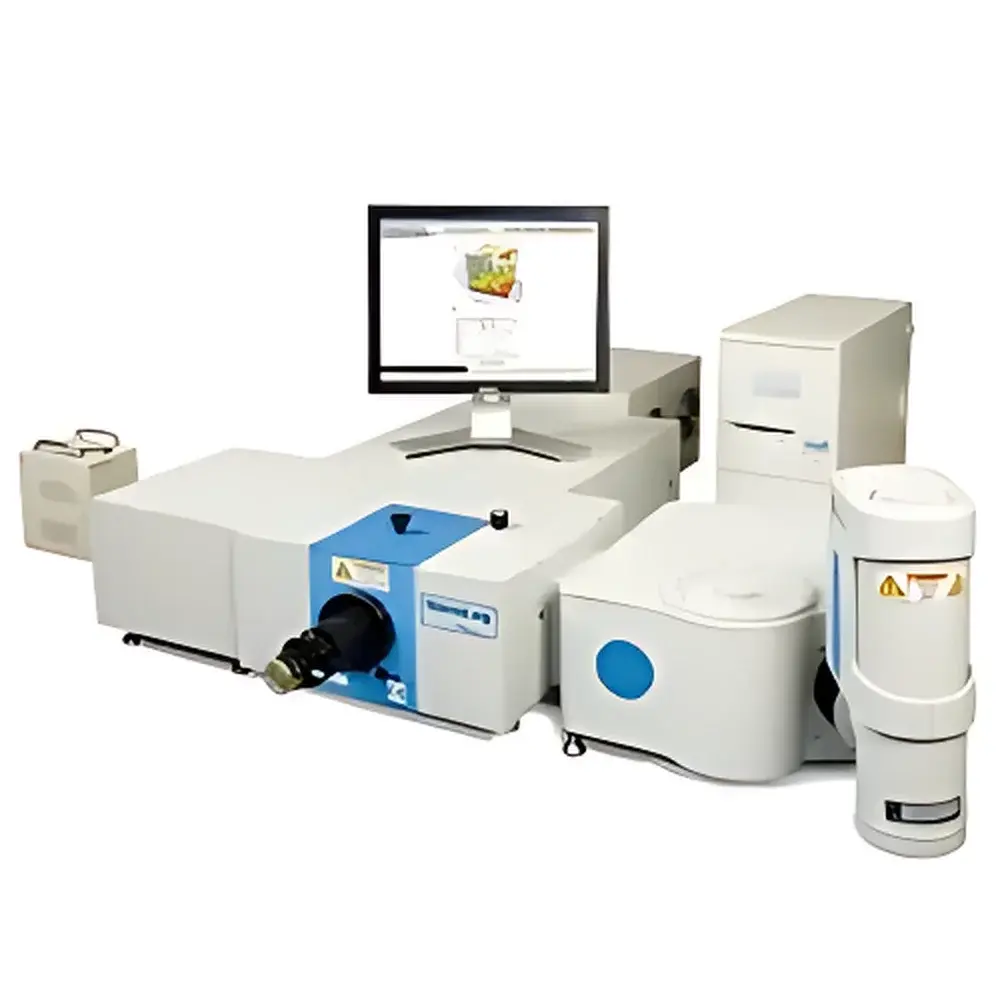
HORIBA Scientific Nanolog® Modular Fluorescence Spectrometer
| Brand | HORIBA |
|---|---|
| Origin | USA |
| Model | Nanolog® |
| Excitation Source | 450 W continuous xenon lamp |
| Wavelength Range | UV–NIR (200–1700 nm, extendable to ~3 µm) |
| Spectral Resolution | 0.06 nm |
| Slit Width (Spectral Bandpass) | 0–20 nm |
| Wavelength Accuracy | ±0.2 nm |
| Sensitivity | >20,000:1 (at 1,550 nm, using liquid-nitrogen-cooled InGaAs array) |
| Detection Modes | Steady-state, time-resolved (TCSPC), and combined steady-state/time-resolved spectroscopy |
| Detector Options | PMT (UV–NIR), Symphony II InGaAs array (800–1700 nm |
| Lifetime Range | Fluorescence 100 ps–1 ms |
| Software | NanoSizer® for SWNT characterization (diameter distribution, FRET analysis), FluoroLog®-based acquisition and analysis suite |
| Compliance | Fully compatible with GLP/GMP data integrity requirements |
Overview
The HORIBA Scientific Nanolog® is a high-performance, modular fluorescence spectrometer engineered for advanced photophysical characterization across the ultraviolet, visible, and near-infrared (NIR) spectral regions—from 200 nm to 1700 nm, with optional extension up to ~3 µm. Built upon the proven FluoroLog® platform, the Nanolog® integrates both steady-state and time-resolved detection capabilities within a single, reconfigurable optical architecture. Its core measurement principle relies on wavelength-selective excitation and emission dispersion via double monochromators (iHR320 emission spectrometer with 320 mm focal length, f/4.1, and 2.64 nm/mm linear dispersion), coupled with high-throughput grating-based optics and precision slit control (0–20 nm bandpass). The system employs time-correlated single-photon counting (TCSPC) for lifetime measurements spanning 100 picoseconds to over 10 seconds—enabling rigorous kinetic analysis of fluorophores, phosphors, and long-lived emissive states in nanomaterials.
Key Features
- Modular dual-mode operation: seamless switching between steady-state intensity mapping and TCSPC-based lifetime acquisition without hardware realignment
- Symphony II InGaAs linear array detector (800–1700 nm) with liquid-nitrogen or thermoelectric cooling—optimized for low-noise NIR photon counting (650 e⁻ RMS noise)
- High-resolution iHR320 emission monochromator featuring fully motorized triple-grating turret (1200 gr/mm standard), delivering <0.06 nm resolution and ±0.2 nm wavelength accuracy
- 450 W continuous xenon lamp providing stable, broadband excitation from UV through NIR—ideal for full-excitation/emission matrix (EEM) acquisition
- NanoSizer® software module specifically developed for single-walled carbon nanotube (SWNT) analysis: automates diameter distribution modeling, chirality assignment, and FRET efficiency quantification from 2D/3D fluorescence maps
- Sub-second acquisition of full excitation-emission matrices (EEMs); complete 2D spectra acquired in microseconds, 3D EEMs in ≤1 second
- Multi-detector compatibility: interchangeable PMT (UV–NIR), CCD (UV–Vis), and InGaAs (NIR) detectors—each optimized for sensitivity, speed, or temporal resolution
Sample Compatibility & Compliance
The Nanolog® accommodates diverse sample formats—including cuvettes (1–250 µL), solid substrates, thin films, powders, microplates, and fiber-coupled configurations—via an extensive portfolio of optional accessories: temperature-controlled magnetic stirrer holders (single-, dual-, or quad-position), integrating spheres, cryogenic dewars (liquid nitrogen), Peltier-based thermal stages (–40 °C to +120 °C), HPLC flow cells, microscope coupling interfaces, and automated titration injectors. All optical paths maintain alignment stability under thermal cycling and mechanical vibration. From a regulatory standpoint, the system supports Good Laboratory Practice (GLP) and Good Manufacturing Practice (GMP) workflows when deployed with validated FluoroLog® software versions. Audit trail generation, user access controls, electronic signatures, and 21 CFR Part 11 compliance are achievable through documented configuration and IQ/OQ/PQ protocols.
Software & Data Management
Data acquisition and analysis are managed through the FluoroLog®-based software environment—a Windows-native application supporting real-time spectral visualization, batch processing, spectral deconvolution, global lifetime fitting (e.g., multi-exponential decay models), and FRET distance calculations. NanoSizer®, embedded as a dedicated module, applies empirical and theoretical models to extract SWNT diameter distributions directly from NIR fluorescence contours. Raw data are stored in vendor-neutral HDF5 format, ensuring long-term readability and third-party interoperability. Metadata—including instrument parameters, calibration history, user annotations, and environmental conditions—is embedded automatically. Export options include CSV, ASCII, and industry-standard JCAMP-DX for spectral archiving and LIMS integration.
Applications
- Quantitative and structural characterization of single-walled carbon nanotubes (SWNTs), including chirality mapping and bundling state assessment
- Time-resolved photoluminescence studies of quantum dots, perovskite nanocrystals, and rare-earth-doped materials
- FRET-based biosensing and conformational dynamics analysis in proteins and nucleic acids
- Photocatalyst evaluation under operational conditions (e.g., in situ monitoring of charge-carrier recombination kinetics)
- Quality control of NIR-emitting pharmaceutical excipients and bioconjugates
- Development and validation of luminescent solar concentrators and NIR OLED materials
FAQ
What is the maximum detectable emission wavelength with the standard Nanolog® configuration?
The base system covers 800–1700 nm using the Symphony II InGaAs array. Extended-range detectors (1.1–2.2 µm) and single-channel InSb or MCT options enable measurements up to ~3 µm.
Can the Nanolog® perform absolute quantum yield measurements?
Yes—when equipped with an integrating sphere accessory and calibrated reference standards, the system supports absolute photoluminescence quantum yield (PLQY) determination across UV–NIR.
Is TCSPC lifetime data acquisition compatible with all detector types?
TCSPC is fully supported with PMT and hybrid PMT/InGaAs configurations. While array detectors operate in parallel-acquisition mode for rapid EEMs, lifetime mapping requires scanning or gated detection modes—available via optional time-gated ICCD or SPAD array upgrades.
How is wavelength calibration maintained over time?
The iHR320 monochromator includes internal Hg/Ar spectral line references and supports automated recalibration routines traceable to NIST-certified emission lines.
Does HORIBA provide application support for nanomaterial characterization?
Yes—HORIBA Scientific offers application notes, method templates, and remote or on-site technical assistance focused on SWNTs, quantum dots, and other low-dimensional emissive systems.
Related Products






