
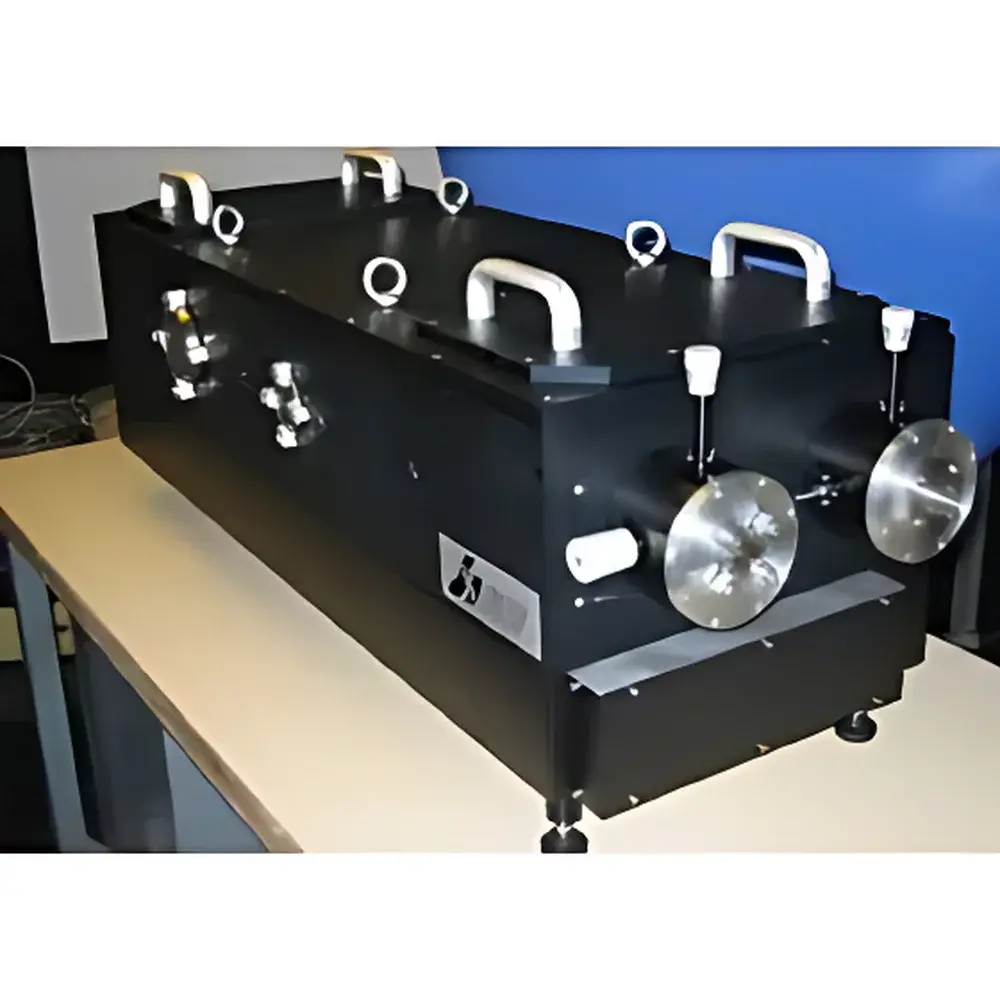
HORIBA Jobin Yvon VHR640 and VHR1000 Vacuum Ultraviolet Spectrograph
| Brand | HORIBA |
|---|---|
| Origin | France |
| Model | VHR640 / VHR1000 |
| Focal Length | 640 mm / 1000 mm |
| Input/Output Ports | Dual entrance & dual exit |
| Grating Mount | Turret with dual gratings |
| Optical Design | Czerny–Turner |
| Wavelength Range | 100 nm – 15 µm (grating-dependent) |
| Spectral Resolution (10 µm slit) | 0.016 nm (VHR640) / 0.010 nm (VHR1000) |
| Wavelength Accuracy | ±0.03 nm |
| Wavelength Repeatability | ±0.015 nm |
| Scanning Speed | >300 nm/s |
| Spectral Dispersion | 1.2 nm/mm (VHR640) / 0.8 nm/mm (VHR1000) |
| Entrance F/# | f/5.4 (VHR640) / f/9.0 (VHR1000) |
| Grating Size (single-grating mode) | 110 mm × 110 mm |
| Grating Size (dual-grating mode) | 80 mm × 110 mm |
| Slit Range | 0–2 mm (micrometer-adjustable) |
| Vacuum Compatibility | <1×10⁻⁵ mbar |
| Vacuum Flanges | DN25 KF (pump & gauge), DN63 LF (slit), DN100 LF (CCD), PC interface (RS232 to USB) |
| Dimensions (L×W×H) | 740×350×350 mm (VHR640) / 1160×430×350 mm (VHR1000) |
| Mass | 65 kg (VHR640) / 70 kg (VHR1000) |
| Optional Accessories | Pre-mirror chamber (two toroidal mirrors), Post-mirror chamber (two toroidal mirrors), Sample chamber (up to four 25 mm Ø samples), Polarizer inserts, 4 K cryostat, Vacuum pump |
Overview
The HORIBA Jobin Yvon VHR640 and VHR1000 are high-performance vacuum ultraviolet (VUV) spectrographs engineered for precision spectral analysis across an exceptionally broad wavelength range—from 100 nm in the vacuum ultraviolet through the visible and into the mid-infrared up to 15 µm. Based on a robust Czerny–Turner optical architecture, these instruments deliver low optical aberration, high throughput, and exceptional thermal stability. Their monolithic, stress-free aluminum housing eliminates thermally induced mechanical drift—critical for long-duration experiments requiring sub-picometer wavelength stability. The VHR series supports both single- and dual-grating configurations via a motorized turret, enabling flexible trade-offs between resolution, throughput, and spectral coverage. Designed for integration into advanced photoluminescence, synchrotron beamline, plasma diagnostics, and fundamental atomic/molecular physics setups, the VHR640/VHR1000 operate under ultra-high vacuum (<1×10⁻⁵ mbar), ensuring optimal transmission below 190 nm where atmospheric oxygen absorption dominates.
Key Features
- Ultra-stable monolithic optical bench minimizing thermal drift and maintaining wavelength calibration over extended acquisition periods
- Dual entrance and dual exit ports supporting simultaneous or sequential detection modalities (e.g., PMT + CCD)
- Motorized dual-grating turret with rapid positioning (<300 nm/s scan speed) and precise angular control for reproducible grating selection
- High-line-density grating compatibility (up to 3600 grooves/mm) enabling sub-0.01 nm resolution at 10 µm slit width
- Optimized Czerny–Turner geometry with toroidal mirror coupling options (pre- and post-chamber) for efficient light collection and collimation across wide spectral bands
- Vacuum-integrated mechanical design with standardized KF and LF flanges (DN25, DN63, DN100) for seamless integration with UHV systems, cryostats, and beamline instrumentation
- Modular detector interface supporting single-channel detectors (PMT, InGaAs, Si photodiodes) and scientific-grade CCD/CMOS arrays with flat-field correction
Sample Compatibility & Compliance
The VHR640 and VHR1000 are fully compatible with vacuum-compatible sample environments—including 4 K cryogenic stages, plasma chambers, and gas-phase reaction cells—via optional sample chambers accommodating up to four 25 mm diameter samples. All vacuum interfaces conform to ISO-KF and ISO-LF standards, and the instrument’s mechanical design supports operation under GLP-compliant laboratory conditions when integrated with validated vacuum monitoring and pressure logging systems. While not intrinsically FDA 21 CFR Part 11 compliant, the system supports audit-trail-capable software environments when paired with HORIBA’s Synapse or third-party LabVIEW-based acquisition platforms configured for electronic record integrity. The optical train meets ISO 10110 surface quality specifications for coated aluminum optics and complies with CE electromagnetic compatibility directives (2014/30/EU).
Software & Data Management
Control and data acquisition are managed via HORIBA’s Spectra Manager™ software suite or programmable APIs (LabVIEW, Python, MATLAB) supporting full remote operation and script-driven experimental sequences. Spectral calibration is performed using standard emission lines (e.g., Hg, Ne, Ar lamps) with automated peak-fitting algorithms that maintain traceability to NIST-certified reference spectra. Raw data are stored in vendor-neutral HDF5 or ASCII formats, preserving metadata including grating position, slit width, integration time, vacuum pressure, and temperature logs. Time-resolved modes support gated detection synchronization with external triggers (TTL, LVDS), enabling pump–probe PL decay measurements and plasma emission kinetics analysis. All software modules support export to industry-standard formats (JCAMP-DX, CSV, SPC) for downstream processing in Origin, Igor Pro, or Python-based analysis pipelines.
Applications
- Time-resolved and steady-state photoluminescence spectroscopy of quantum dots, 2D materials, and rare-earth-doped phosphors
- Vacuum ultraviolet reflectance and absorption studies of wide-bandgap semiconductors (e.g., AlN, Ga₂O₃, diamond)
- Plasma emission diagnostics in fusion research and industrial plasma etching reactors
- Synchrotron-based soft X-ray absorption fine structure (NEXAFS) and resonant inelastic scattering (RIXS) beamlines
- Fundamental atomic and molecular spectroscopy in discharge lamps and laser-induced plasmas
- Calibration transfer and cross-platform validation against FTIR and monochromator-based reference systems
FAQ
What vacuum level is required for optimal VUV performance below 190 nm?
Operation below 190 nm requires sustained vacuum better than 1×10⁻⁵ mbar to minimize O₂ absorption; the VHR series includes integrated KF25 vacuum pump and gauge ports to facilitate this.
Can the VHR640/VHR1000 be used as both a monochromator and spectrograph?
Yes—the dual exit port configuration allows simultaneous use with a single-channel detector (monochromator mode) and a CCD array (spectrograph mode), or sequential switching via internal flip mirrors.
Is flat-field correction supported for CCD-coupled operation?
Yes—optional 25 mm flat-field output port and dedicated toroidal mirror sets ensure uniform spectral dispersion across the CCD active area, with correction coefficients supplied per grating and wavelength range.
How is wavelength calibration maintained during long-term thermal cycling?
The monolithic aluminum body, low-CTE optical mounts, and real-time encoder feedback on the grating rotation stage enable recalibration stability within ±0.015 nm over 8-hour continuous operation without manual intervention.
Are custom grating coatings available for enhanced VUV reflectivity?
HORIBA offers MgF₂-, LiF-, and Ir-coated gratings optimized for specific VUV sub-bands (e.g., 100–120 nm, 120–190 nm); coating selection must be specified at order entry and impacts final spectral range and efficiency.



