
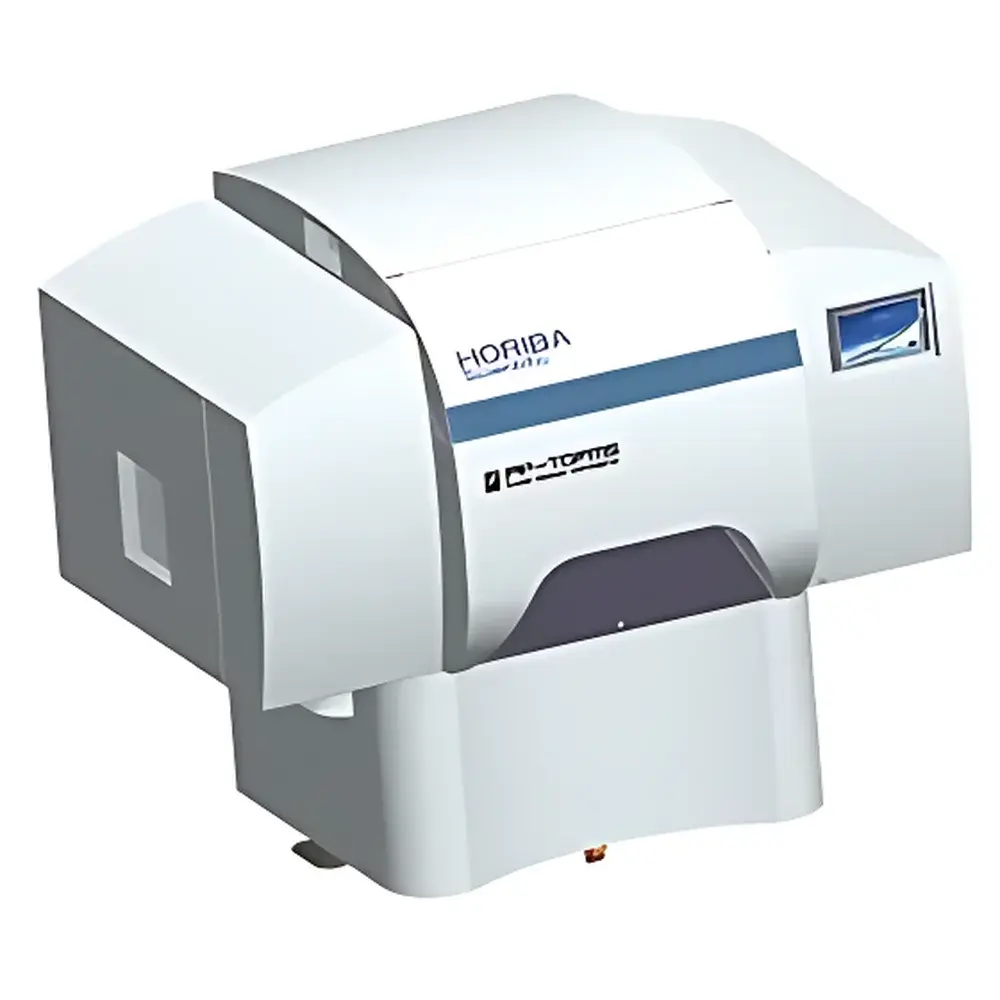
HORIBA JY PP-TOFMS Plasma Profiling Time-of-Flight Mass Spectrometer
| Brand | HORIBA |
|---|---|
| Origin | France |
| Model | PP-TOFMS |
| Acquisition Rate | 1 spectrum per 30 µs |
| Mass Resolution | 5,000 (at m/z 208, high-resolution mode) |
| Dynamic Range | 10⁷ |
| Mass Accuracy | ±40 ppm |
| Sensitivity | 10³ cps/ppm |
| Depth Resolution | <1 nm |
| Ion Mode | Positive and Negative |
| Flexible Ion Blanking | Up to 4 ions |
| Sample Loading | Horizontal, ambient-pressure compatible |
| Mass Coverage | H to U, including isotopes and molecular species |
| Analysis Mode | Pulsed RF sputtering with 3D depth profiling capability |
| Quantification | Matrix-effect-reduced semi-quantitative analysis without calibration standards |
Overview
The HORIBA JY PP-TOFMS is a plasma profiling time-of-flight mass spectrometer engineered for high-fidelity, quantitative depth profiling of solid materials. It integrates a radiofrequency (RF) or direct-current (DC) glow discharge plasma source with orthogonal-acceleration time-of-flight (oa-TOF) mass analysis—enabling simultaneous detection of all elements from hydrogen to uranium, including isotopic variants and small molecular fragments. Unlike conventional magnetic sector or quadrupole-based GD-MS systems, the PP-TOFMS acquires full-mass spectra at microsecond-scale temporal resolution (1 spectrum per 30 µs), preserving transient signal dynamics during sputtering. This architecture supports true 3D compositional mapping by correlating ion arrival time (mass), sputter duration (depth), and lateral position (when coupled with optional rastering stages). The system operates under moderate vacuum conditions (~1–10 Pa), eliminating the need for ultra-high-vacuum chambers or extensive sample pre-treatment—significantly reducing analysis turnaround and enhancing throughput in QC and R&D laboratories.
Key Features
- High-speed spectral acquisition: Full mass spectra collected every 30 µs, enabling real-time monitoring of interface evolution and transient sputter behavior.
- Mass resolution up to 5,000 (FWHM at m/z 208) in high-resolution mode—sufficient to resolve critical isobaric interferences (e.g., 56Fe+ vs. 40Ar16O+, 98Mo+ vs. 98Ru+) without energy filtering.
- Dynamic range exceeding 10⁷ enables concurrent detection of major constituents and trace dopants (sub-ppb level) within a single acquisition.
- Sub-nanometer depth resolution achieved through optimized RF pulsing, controlled sputter yield, and precise ion extraction timing—validated per ISO/IEC 17025-compliant depth scale calibration protocols.
- Dual-polarity operation allows parallel characterization of both cationic and anionic species, critical for analyzing insulating layers, oxides, and nitrides.
- Four-channel ion blanking provides selective suppression of dominant matrix peaks (e.g., O+, Si+, Ar+) to enhance signal-to-noise for low-abundance analytes without hardware retuning.
- Horizontal sample loading accommodates standard 1″–2″ wafers, metallurgical cross-sections, and coated substrates—compatible with ISO 14644-1 Class 5 cleanroom handling procedures.
Sample Compatibility & Compliance
The PP-TOFMS accepts conductive and non-conductive solids—including Si wafers, III–V compound semiconductors, optical thin films, magnetic multilayers, and corrosion-resistant alloys—without requiring conductive coating. Its RF glow discharge source maintains stable plasma impedance across dielectric samples (e.g., SiO₂, Al₂O₃, Ta₂O₅), ensuring reproducible sputter rates and stoichiometric fidelity. Instrument design complies with IEC 61000-6-3 (EMC) and IEC 61010-1 (safety). Data integrity meets FDA 21 CFR Part 11 requirements via audit-trail-enabled software, electronic signatures, and secure user-role management. Depth profiling workflows align with ASTM E1598 (GD-OES/GD-MS depth profiling) and ISO 18516 (surface chemical analysis — glow discharge mass spectrometry).
Software & Data Management
HORIBA’s proprietary MultiQuant™ software provides integrated control of plasma parameters (power, pressure, pulse duty cycle), TOF acquisition, and multidimensional data visualization. Raw spectra are stored in vendor-neutral HDF5 format with embedded metadata (instrument configuration, calibration history, operator ID). Depth profiles support export to CSV, ASCII, and CDF for integration with MATLAB, Python (via h5py), or industry-standard metrology platforms (e.g., KLA Candela, Applied Materials Aera). Batch processing includes automatic peak deconvolution using least-squares fitting against NIST SRM reference libraries, isotope ratio calculation (e.g., 18O/16O for oxidation kinetics), and layer-thickness quantification via sputter rate calibration curves traceable to SI units.
Applications
- Semiconductor process control: Quantitative dopant profiling (B, P, As, Sb) in Si, Ge, and SiC epitaxial layers; interfacial segregation analysis at gate oxide/Si interfaces.
- Photovoltaic R&D: Depth-resolved impurity mapping (Fe, Cu, Na) in CIGS and perovskite absorber stacks; diffusion barrier integrity assessment in tandem cell architectures.
- Functional coatings: Composition-gradient verification in PVD TiN/TiAlN multilayers; contamination tracing (Cl, F, S) in anti-reflective optical coatings.
- Corrosion science: In situ monitoring of isotopically labeled tracers (18O, 2H) during accelerated aging tests; passive film stoichiometry (Cr/Fe/Ni/O ratios) in stainless steels.
- Advanced packaging: Interface chemistry analysis at Cu/SnAg solder joints; void formation kinetics in under-bump metallization (UBM) stacks.
FAQ
What vacuum level is required for PP-TOFMS operation?
The system operates at a base pressure of 1–10 Pa during glow discharge, eliminating the need for UHV pumping infrastructure.
Can the PP-TOFMS analyze insulating samples without sputter-induced charging?
Yes—the pulsed RF source dynamically compensates for surface charge accumulation, maintaining stable sputtering on glasses, ceramics, and polymers.
Is certified reference material (CRM) calibration mandatory for quantitative results?
No. Semi-quantitative depth profiles are generated using relative sensitivity factors (RSFs) derived from fundamental sputtering and ionization physics, minimizing matrix effects per ISO 18516 Annex B.
How is depth scale accuracy verified?
Through cross-correlation with SIMS depth standards (e.g., NIST SRM 2137) and TEM cross-sectional metrology, with uncertainty budgets reported per ISO/IEC 17025.
Does the system support automated batch analysis?
Yes—MultiQuant™ supports unattended run queues, pass/fail criteria based on elemental thresholds, and auto-generated PDF reports compliant with GLP documentation requirements.
Related Products





