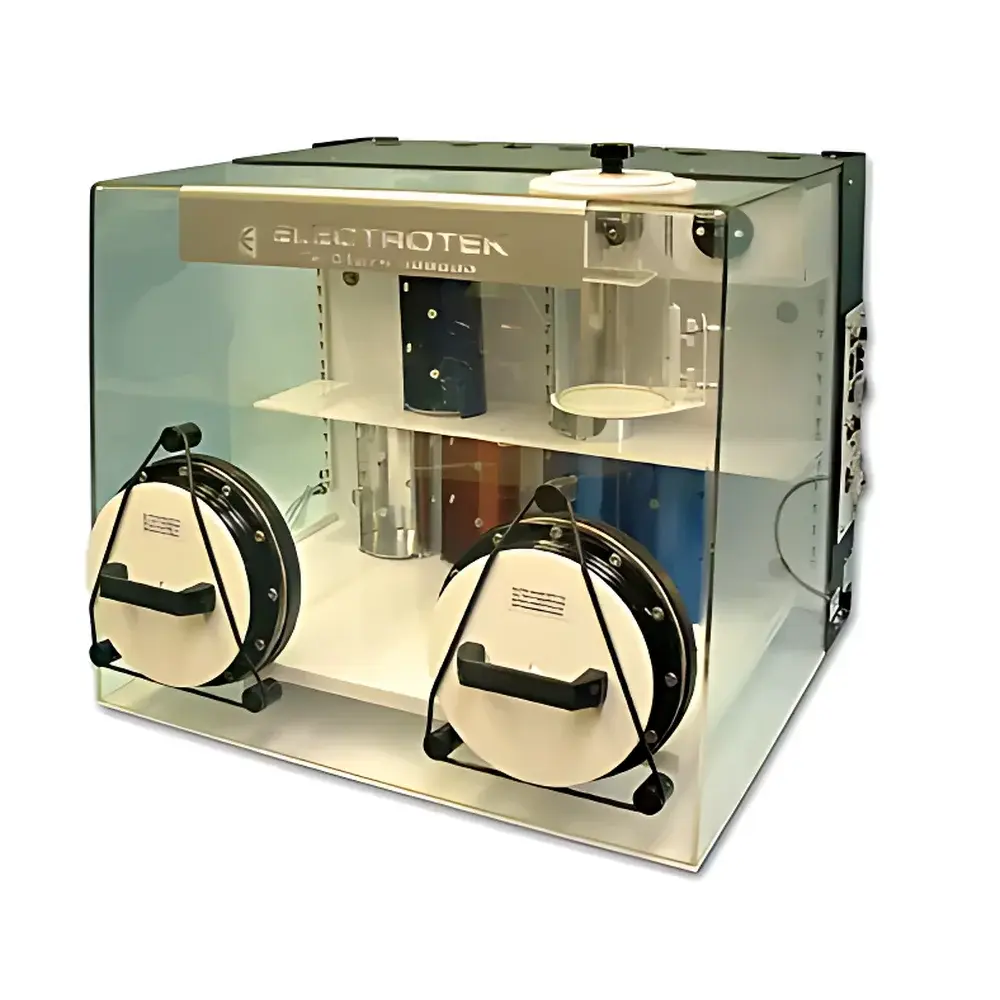
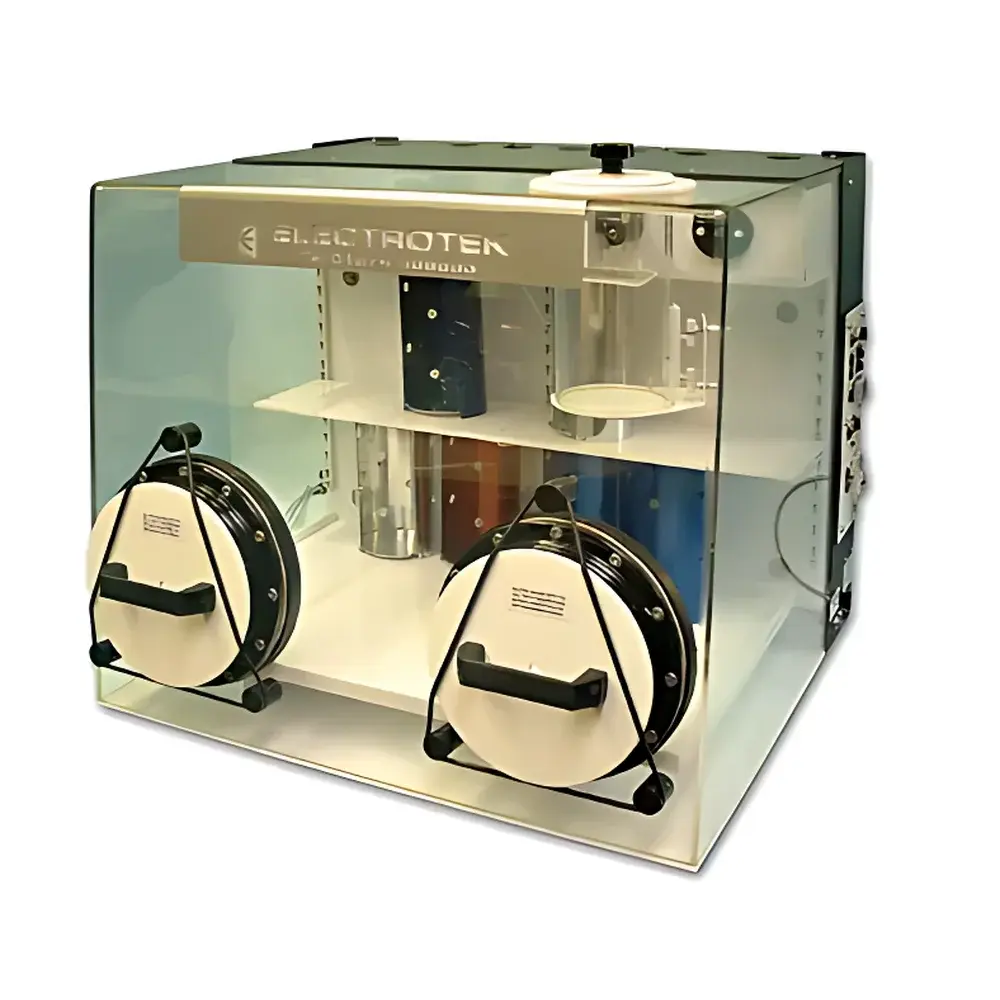
ELECTROTEK AW200SG Anaerobic Workstation
| Brand | ELECTROTEK |
|---|---|
| Origin | United Kingdom |
| Model | AW200SG |
| Chamber Capacity | 220 Petri Dishes |
| Transfer Lock Capacity | 10 Petri Dishes |
| Gas Mixture | 10% H₂ + 10% CO₂ + 80% N₂ (Anaerobic) / 5% O₂ + 10% CO₂ + 85% N₂ (Microaerophilic) |
| Temperature Range | Ambient +4°C to 45°C |
| Temp. Stability | ±0.5°C at 37°C |
| Dimensions (W×D×H) | 648×635×572 mm |
| Power Supply | 220 V, 50 Hz, 300 W |
| Humidity Control | Active Condensation-Based System with Removable Water Collection Bottle |
| Safety | Integrated Earth Leakage Protection, Auto Diagnostics (Low Pressure, Leak, Airflow Anomaly) |
Overview
The ELECTROTEK AW200SG Anaerobic Workstation is a compact, self-contained microbiological isolation system engineered for precise cultivation and manipulation of obligate anaerobes, microaerophiles, and oxygen-sensitive cell lines under rigorously controlled atmospheric conditions. Based on the principle of catalytic hydrogen-mediated oxygen scavenging within a sealed, positively pressurized chamber, the AW200SG eliminates ambient O₂ via palladium-based catalysts reacting with trace H₂ to form water—enabling stable, long-term anaerobiosis without reliance on high-cost electrochemical O₂ sensors. Its design prioritizes operational efficiency in space-constrained laboratories while maintaining ISO 13485-aligned engineering integrity and GLP-compliant environmental stability. The workstation operates without footswitches or manual gas valves, relying instead on fully automated pneumatic sequencing, real-time O₂ monitoring via colorimetric indicator (replacing costly sensor arrays), and closed-loop PID temperature regulation with forced-air convection.
Key Features
- Compact footprint (648 × 635 × 572 mm) optimized for benchtop deployment in core facilities, clinical microbiology labs, and academic research suites.
- Four-sided transparent acrylic chamber with reinforced insulation and chemical-resistant surface finish—compatible with routine decontamination using 70% ethanol or hydrogen peroxide vapor.
- Positive-pressure architecture maintains internal overpressure relative to ambient environment, preventing O₂ ingress during glove-free access and ensuring uninterrupted anaerobic integrity.
- Glove-free wrist-seal entry system: elastomeric air seals conform to operator wrists, enabling rapid hand insertion (<3 seconds) and maximizing usable workspace volume without compromising gas economy.
- Integrated dual-gas capability—switchable between anaerobic (10% H₂/10% CO₂/80% N₂) and microaerophilic (5% O₂/10% CO₂/85% N₂) modes via front-panel selection—supporting diverse physiological growth requirements.
- Automated humidity management via thermoelectric condensation plate and adjustable humidification reservoir; condensed water collected in removable, calibrated bottle—eliminating hygroscopic desiccants and associated maintenance drift.
- Onboard catalyst regeneration cycle and automatic detoxification protocol continuously neutralize volatile metabolic byproducts (e.g., H₂S, short-chain fatty acids), preserving media integrity across extended incubation periods.
- Comprehensive safety architecture including residual-current device (RCD), real-time pressure differential monitoring, leak-detection algorithm, and multi-stage fault logging with audible/visual alerts.
Sample Compatibility & Compliance
The AW200SG accommodates standard 90–100 mm Petri dishes (up to 220 units per run) and supports common anaerobic culture formats including roll tubes, agar stabs, and microtiter plates (with optional rack adapters). Its gas composition control meets ASTM E2694–22 specifications for anaerobic environment verification and aligns with CLSI M11-A9 guidelines for susceptibility testing of fastidious organisms. The absence of alkaline desiccants and use of non-reactive chamber materials ensure compatibility with oxygen-labile reagents (e.g., reduced metronidazole, ferrous sulfate supplements) and sensitive primary isolates (e.g., Clostridioides difficile, Bacteroides fragilis, Fusobacterium nucleatum). All electrical components comply with IEC 61010-1:2010 for laboratory equipment safety.
Software & Data Management
While the AW200SG operates via embedded microcontroller without external PC dependency, its control firmware incorporates audit-trail-capable event logging (ISO/IEC 17025 Annex A.2 compliant), recording timestamped entries for temperature excursions, gas mode changes, door open/close cycles, and alarm triggers. Data export is supported via USB interface for CSV-formatted reports—facilitating integration into LIMS environments and satisfying FDA 21 CFR Part 11 requirements when paired with institutional electronic signature protocols. Firmware updates are delivered via secure encrypted package and validated through checksum verification prior to installation.
Applications
- Clinical microbiology: Isolation and identification of anaerobic pathogens from wound, blood, and stool specimens per UK NEQAS and CAP standards.
- Gut microbiome research: Cultivation of strict anaerobes for strain banking, metabolomic profiling, and gnotobiotic model development.
- Pharmaceutical QC: Anaerobic stability testing of probiotic formulations and antimicrobial agents under pharmacopoeial conditions (USP <61>, EP 2.6.12).
- Veterinary diagnostics: Routine culture of equine and ruminant-derived anaerobes where transport limitations necessitate on-site processing.
- Education and training: Hands-on instruction in anaerobic technique, catalytic deoxygenation principles, and biosafety-level 2 (BSL-2) containment practices.
FAQ
How does the AW200SG achieve and verify anaerobiosis without an electrochemical O₂ sensor?
It employs a low-maintenance colorimetric O₂ indicator system—a chemically reversible redox dye coupled with a miniature peristaltic pump—providing visual confirmation of sub-10 ppm O₂ levels. This method avoids sensor calibration drift and extends service intervals beyond 18 months.
Can the workstation be validated for GMP-regulated environments?
Yes—its deterministic gas exchange kinetics, documented thermal uniformity mapping (±0.5°C at 37°C), and built-in alarm logging support IQ/OQ/PQ execution per Annex 15 of the EU GMP Guide.
What maintenance is required for the catalyst and humidity system?
Catalyst cartridges require replacement every 12–18 months depending on usage frequency; humidity condensate bottles must be emptied daily during continuous operation and sanitized weekly.
Is the AW200SG compatible with hydrogen peroxide vapor (HPV) decontamination?
Yes—the chamber body, gloves, and internal polymer components are HPV-rated per VHP® compatibility standards (35% w/w H₂O₂, 60 min exposure), supporting periodic bio-decontamination without disassembly.
Does the unit support remote monitoring or network integration?
Not natively—but analog voltage outputs (0–10 V) for temperature and O₂ status are available via optional I/O module, enabling connection to building management systems or SCADA platforms.