
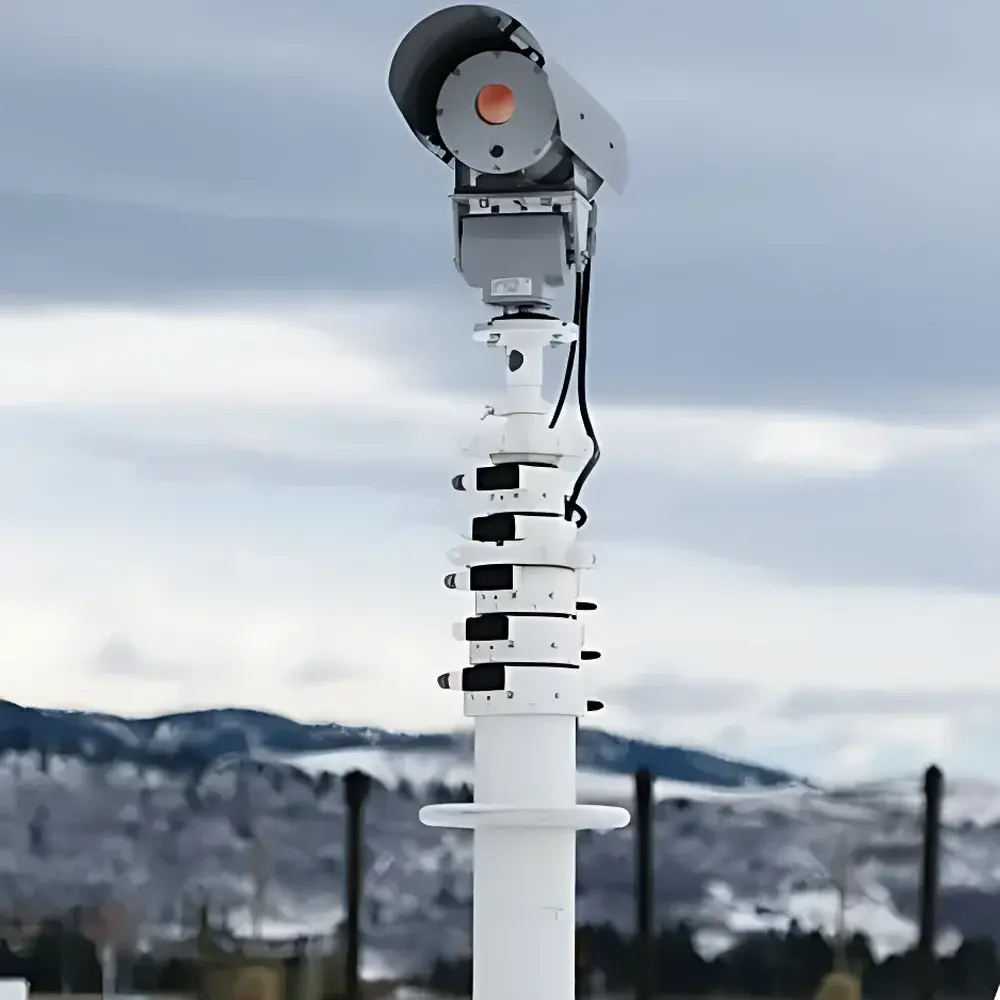
Pri-eco AirScan 2000 Quantum Gas Lidar System for Methane Leak Visualization and Quantification
| Brand | Pri-eco |
|---|---|
| Origin | Beijing, China |
| Manufacturer Type | Original Equipment Manufacturer (OEM) |
| Country of Origin | China |
| Model | AirScan 2000 |
| Detection Principle | Tunable Diode Laser Absorption Spectroscopy (TDLAS) coupled with Single-Photon Avalanche Diode (SPAD) detection and 3D scanning lidar architecture |
| Detection Scope | OGMP 2.0 Tier 4 & Tier 5 compliant site-level continuous monitoring and component-level leak localization |
| Measurement Range | 360° panoramic field-of-regard, up to 200 m detection distance |
| Limit of Detection | ≥90% Probability of Detection (PoD) under representative atmospheric conditions |
| Quantification Accuracy | ±2× uncertainty (1-sigma) dependent on wind speed and direction |
| False Positive Rate | 0% when using factory-validated data processing algorithms and recommended client configuration |
| Laser Safety Class | Class 1M |
| Operating Temperature | –40 °C to +50 °C |
| IP Rating | IP67 |
| Dimensions | 43 × 18 × 18 cm |
| Weight | 8 kg (including pan-tilt mount) |
| Power Supply | 24 VDC, 30 W |
| Communication Interfaces | Ethernet, Wi-Fi, mobile API endpoint |
Overview
The Pri-eco AirScan 2000 is a quantum-enhanced gas lidar system engineered for real-time, quantitative visualization and spatial localization of methane (CH4) emissions. It integrates tunable diode laser absorption spectroscopy (TDLAS) with single-photon avalanche diode (SPAD) detection and a high-resolution 3D scanning lidar architecture to deliver simultaneous three-dimensional scene reconstruction, gas plume imaging, and source quantification—without reliance on thermal contrast or ambient lighting. Unlike passive optical gas imaging (OGI) cameras, the AirScan 2000 actively probes the atmosphere using eye-safe, Class 1M near-infrared laser pulses, enabling reliable operation day or night, in rain, fog, snow, or direct sunlight. Its core measurement principle relies on wavelength-modulated absorption spectroscopy at 1650.9 nm—a methane-specific spectral line—combined with time-of-flight ranging and photon-counting sensitivity to resolve trace gas concentrations within dynamic plumes at distances up to 200 meters.
Key Features
- 360° panoramic scanning capability with automated azimuth/elevation control for unattended site surveillance
- Single-photon sensitivity enabling long-range detection (>200 m) with low-power, Class 1M laser emission
- Immunity to solar glare, surface temperature gradients, and water vapor interference due to narrowband spectral filtering and differential absorption analysis
- Real-time plume characterization: quantifies leak rate (kg/h), plume geometry (length, width, height), temporal persistence, and spatial origin with geo-referenced output
- OGMP 2.0 Tier 4 (site-level continuous monitoring) and Tier 5 (component-level quantification) compliance support via standardized reporting templates and metadata tagging
- Ruggedized enclosure rated IP67, operational across –40 °C to +50 °C, suitable for permanent outdoor deployment on masts or mobile platforms
- Integrated data telemetry via Ethernet, Wi-Fi, and RESTful API for integration into SCADA, CMMS, or emissions management dashboards
Sample Compatibility & Compliance
The AirScan 2000 is optimized exclusively for methane detection and exhibits negligible cross-sensitivity to non-methane hydrocarbons (NMHCs), carbon dioxide, water vapor, or common industrial background gases. Its spectral selectivity ensures specificity in complex environments such as upstream oil & gas facilities, coal mines, landfills, wastewater treatment plants, and agricultural biogas sites. The system supports regulatory alignment with EPA Method 21–adjacent operational protocols, OGMP 2.0 reporting requirements, and ISO 14064-3 verification frameworks. All measurement logs include embedded timestamps, GPS coordinates (when paired with external GNSS), instrument health metrics, and environmental metadata (wind speed/direction, ambient temperature, relative humidity)—enabling full auditability for GHG inventory reporting and third-party verification under ISO 14064 or GHGRP guidelines.
Software & Data Management
The AirScan 2000 operates with Pri-eco’s proprietary Quantify™ software suite, which provides real-time visualization of 3D point clouds overlaid with methane concentration iso-surfaces. Data streams are timestamped and stored locally (on-board SD card) and remotely (via configurable cloud sync). The software implements factory-calibrated quantification algorithms that account for atmospheric dispersion using integrated anemometer inputs (optional external sensor), yielding leak-rate estimates traceable to NIST-traceable reference standards. Audit trails comply with GLP/GMP principles: all parameter changes, firmware updates, and calibration events are logged with user ID, timestamp, and hash-verified integrity. Optional FDA 21 CFR Part 11-compliant mode enables electronic signatures, role-based access control, and immutable record retention for regulated operations.
Applications
- Oil & gas infrastructure: fugitive emission surveys at well pads, compressor stations, and LNG terminals
- Coal mining operations: ventilation shaft and gob gas monitoring
- Municipal solid waste management: landfill perimeter and cover gas flux mapping
- Wastewater treatment: anaerobic digester and sludge dewatering area leak assessment
- Agricultural biogas facilities: storage tank, flare, and pipeline interface monitoring
- Regulatory compliance: Tier 4/5 reporting for OGMP, EPA Greenhouse Gas Reporting Program (GHGRP), and EU MRV
FAQ
What detection principle does the AirScan 2000 use?
It employs wavelength-modulated tunable diode laser absorption spectroscopy (TDLAS) at 1650.9 nm, combined with single-photon counting and 3D scanning lidar for active, range-resolved methane quantification.
Is the system suitable for continuous unattended operation?
Yes—it supports 24/7 autonomous scanning, local data buffering, and remote telemetry via Ethernet or Wi-Fi, with power consumption optimized for solar-battery hybrid deployments.
Does it require external meteorological sensors for accurate quantification?
Wind speed and direction data improve quantification fidelity; integrated or externally connected anemometers are supported via analog or Modbus interface.
How is false positive performance validated?
Zero false positives are achieved using Pri-eco’s certified data processing pipeline and default configuration settings—verified through third-party intercomparison studies per ISO 13843.
Can the AirScan 2000 be integrated into existing emissions management platforms?
Yes—RESTful API, MQTT, and OPC UA interfaces enable seamless integration with enterprise EHS, CMMS, or digital twin systems.







