
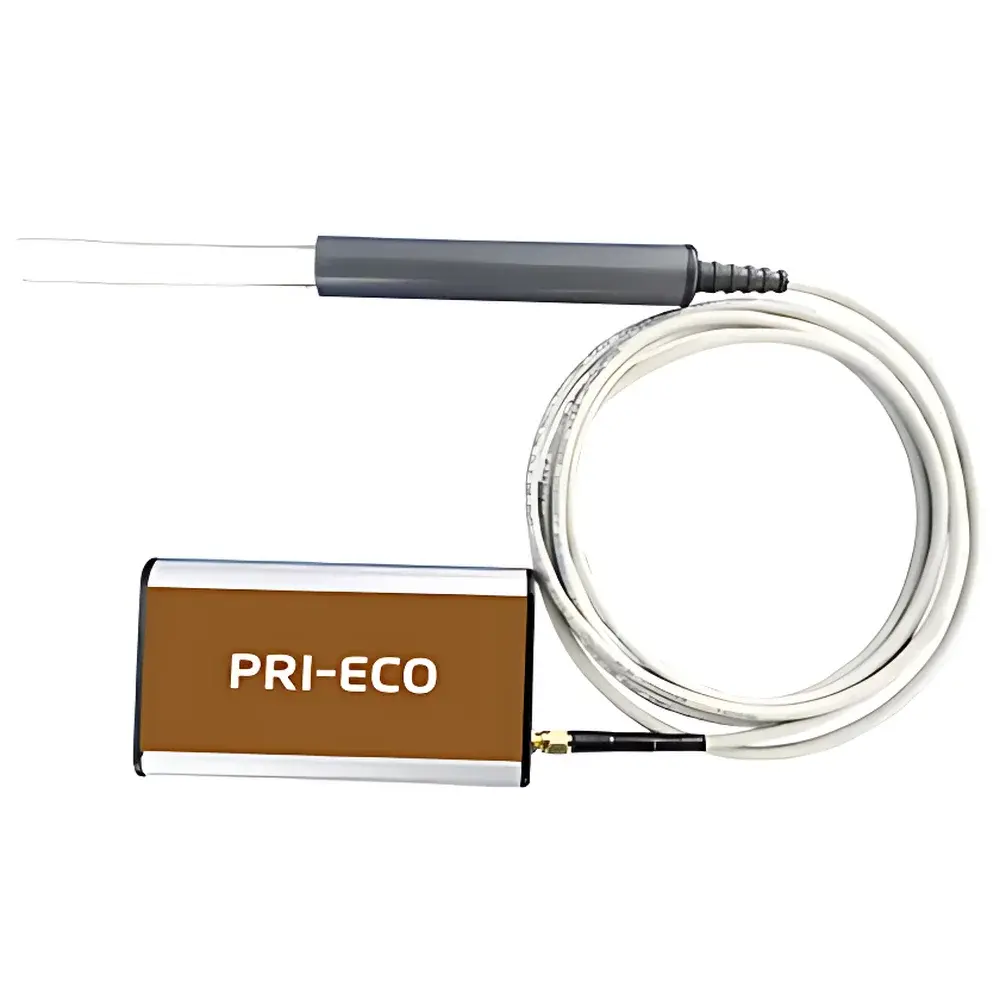
Pri-eco Plover Portable Soil Moisture, Temperature & Electrical Conductivity Measurement System
| Brand | Pri-eco |
|---|---|
| Origin | Beijing, China |
| Manufacturer Type | Manufacturer |
| Country of Origin | China |
| Model | Plover |
| Instrument Type | Multi-parameter Portable Soil Analyzer |
| Measurement Principle | True Time-Domain Reflectometry (TureTDR®) at ~1.5 GHz |
| Sensor Compatibility | TDR-001 (moisture-only) or TDR-002 (moisture/temperature/conductivity) |
| Data Acquisition Channels | 1 channel |
| Calibration | Field-deployable online calibration |
| Power Supply | Rechargeable Li-ion battery (2500 mAh, 3.7 VDC) |
| Battery Life | Up to 3,000 measurements or 182 days in standby |
| Operating Temperature | −25 °C to +50 °C |
| Wireless Communication | 2.4 GHz ISM band, up to 20 m range |
| Dimensions (Data Logger) | 1.9 cm × 7.0 cm × 12.5 cm |
| Weight (Data Logger) | 200.5 g |
| Moisture Accuracy | ±2% vol/vol (±1% vol/vol after site-specific calibration) |
| Temperature Accuracy | ±0.5 °C (±0.1 °C after calibration) |
| EC Accuracy | ±10% (0–1 S/m), improved with calibration |
| Moisture Resolution | 0.1% vol/vol |
| Temperature Resolution | 0.1 °C |
| EC Resolution | 1 mS/m |
| Moisture Range | 0–100% vol/vol |
| Temperature Range | −25 °C to +50 °C |
| EC Range | 0.000–1 S/m |
| Probe Configuration | Dual stainless-steel rods (100 mm length, 3 mm diameter) |
| Sensing Volume | Cylindrical zone ~5 cm diameter × 11 cm height around probe |
| Probe Housing | PVC tube (2 cm diameter, 15–150 cm customizable length) |
| Cable Length Options | 1.5–6.0 m |
Overview
The Pri-eco Plover Portable Soil Moisture, Temperature & Electrical Conductivity Measurement System is an engineered field instrument designed for high-fidelity, real-time quantification of three critical soil physical parameters—volumetric water content (θv), bulk electrical conductivity (ECb), and soil temperature—using True Time-Domain Reflectometry (TureTDR®) technology operating at approximately 1.5 GHz. Unlike conventional low-frequency TDR or capacitance-based sensors, the Plover system minimizes dielectric dispersion and ionic polarization effects by employing a high-bandwidth electromagnetic pulse. This enables robust performance across diverse soil textures—from sandy loam to heavy clay—and under variable salinity conditions (ECb up to 1 S/m), without requiring soil-specific empirical models or extensive factory calibration databases. The system’s physics-based measurement architecture delivers direct, model-free output of θv (in % vol/vol), temperature (°C), and ECb (S/m), supporting traceable, repeatable data acquisition in uncontrolled field environments.
Key Features
- True Time-Domain Reflectometry (TureTDR®) at ~1.5 GHz for minimal polarization artifact and enhanced salinity resilience
- Single-channel data logger compatible with either TDR-001 (moisture-only) or TDR-002 (triple-parameter) probes
- On-device online calibration capability—no PC required for field recalibration against known standards
- Integrated rechargeable lithium-ion battery (2500 mAh, 3.7 VDC) enabling >3,000 discrete measurements per charge
- Compact, lightweight design (200.5 g) with IP67-rated enclosure for extended outdoor deployment
- Bluetooth-enabled Android application for real-time visualization, geotagged logging, and CSV export
- Low-noise coaxial signal path with precision SMA connectors ensuring signal integrity over cable lengths up to 6.0 m
- Dual stainless-steel rod probe (100 mm × 3 mm) housed in chemically inert PVC tubing (2 cm diameter, 15–150 cm customizable)
Sample Compatibility & Compliance
The Plover system is validated for use across mineral soils, organic substrates, and amended growing media, including those with elevated sodium adsorption ratio (SAR) or chloride concentrations. Its insensitivity to soil texture and pore-water chemistry eliminates the need for post-hoc correction algorithms—making it suitable for long-term monitoring in saline-affected agricultural zones, coastal dune systems, and reclaimed mine soils. While not certified to ISO 11277 or ASTM D5859 as a standalone laboratory device, the Plover meets functional equivalency benchmarks for field-deployed TDR instrumentation per USDA-NRCS Soil Survey Laboratory protocols. Data integrity complies with GLP-aligned practices: timestamps, GPS coordinates (via paired mobile device), sensor ID, and battery voltage are automatically embedded in each record. Raw waveform files (binary .tdr format) are retained for audit-level traceability.
Software & Data Management
The companion Android application provides a secure, offline-capable interface for configuration, measurement initiation, and live parameter display. All datasets are stored locally in SQLite format and exportable as ISO 8601-compliant CSV with metadata headers (e.g., “datetime_utc”, “lat_deg”, “lon_deg”, “theta_v_pct”, “temp_c”, “ec_b_s_m”). No cloud upload is mandatory; users retain full ownership of raw and processed data. Firmware updates are delivered via signed APK packages, with version-controlled changelogs and SHA-256 checksums. For integration into institutional LIMS or IoT platforms, the app supports Bluetooth Serial Port Profile (SPP) output, enabling direct ingestion into Python-based data pipelines or SCADA systems via serial-to-HTTP gateways.
Applications
- Irrigation scheduling and water-use efficiency assessment in precision agriculture
- Soil moisture–temperature–salinity coupling studies in ecohydrological modeling
- Long-term edaphic monitoring in grassland restoration and afforestation projects
- Calibration and validation of satellite-derived soil moisture products (e.g., SMAP, Sentinel-1)
- Field validation of vadose zone transport simulations (e.g., HYDRUS-1D input verification)
- Regulatory compliance sampling for landfill cover performance or remediation site monitoring
FAQ
What distinguishes TureTDR® from conventional TDR?
TureTDR® employs a broadband (~1.5 GHz) step-pulse excitation and high-speed digitization to resolve the true reflection signature without low-pass filtering artifacts—thereby decoupling dielectric permittivity from conductive losses more rigorously than sub-500 MHz systems.
Can the Plover be used in frozen soils?
No. The system is specified for operation between −25 °C and +50 °C, but accurate TDR-based moisture quantification requires unfrozen pore water; ice formation disrupts electromagnetic wave propagation and invalidates calibration assumptions.
Is sensor calibration transferable between sites?
Yes—due to its physics-based approach, factory calibration remains valid across soil types. However, for <±1% θv uncertainty, a two-point in-situ calibration using oven-dry and saturated paste samples is recommended per ISO 11277 Annex B.
Does the system comply with FDA 21 CFR Part 11?
While not marketed for pharmaceutical applications, the Android app supports audit-trail-enabling features (user login, electronic signatures, immutable logs) that may be configured to meet Part 11 requirements in regulated environmental monitoring contexts.
How is probe insertion depth controlled during installation?
The PVC probe housing includes laser-etched depth markers at 10 cm intervals; optional stainless-steel drive caps ensure consistent vertical alignment and minimize soil disturbance during emplacement.
Related Products







