
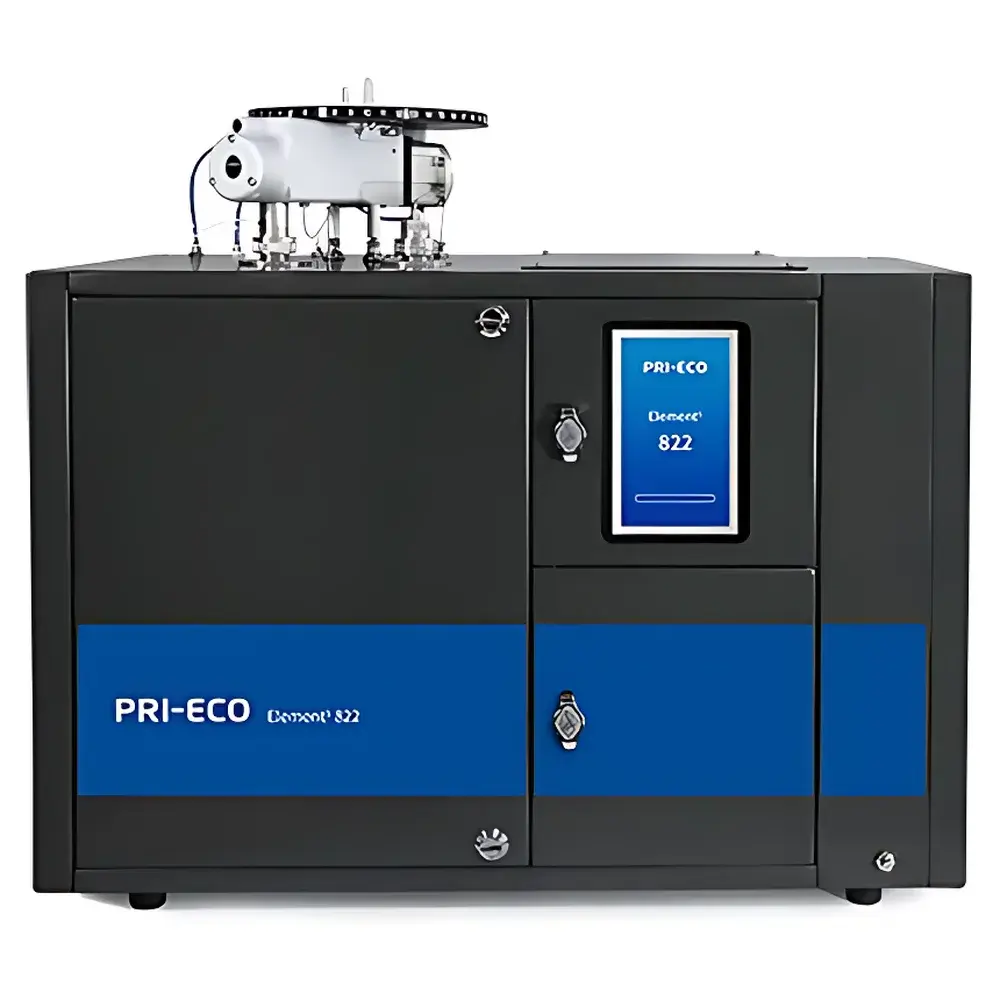
Pri-eco Element5 822 CN Organic Elemental Analyzer
| Brand | Pri-eco |
|---|---|
| Origin | Beijing, China |
| Manufacturer Type | Manufacturer |
| Model | Element5 822 |
| Detection Elements | C, N |
| Sample Forms | Solid and Liquid |
| Combustion Configuration | Dual-Furnace (Oxidation + Reduction) |
| Detection Principle | Dumas Flash Combustion Coupled with Gas Chromatographic Separation and Thermal Conductivity Detection (TCD) |
| Automation Features | Automated Leak Detection, Intelligent Oxygen Dosage Control, Electronic Flow Regulation, Self-Calibrating TCD |
| Sample Capacity | Up to 147 positions (Pneumatic Autosampler) |
| Analysis Time per CN Run | ~5 min |
| Measurement Range | C/N: 0.002–20 mg |
| Accuracy | <0.2% (Certified Reference Materials, Purity >99.9%) |
| Precision (RSD) | <0.1% (n ≥ 10, CRM) |
| Furnace Temp | Up to 1100 °C (Dual Independent Zones) |
| Separation Oven Temp | Up to 110 °C |
| Carrier Gas | Ultra-High-Purity Helium (99.999%, 3–5 bar) |
| Reactant Gas | Ultra-High-Purity Oxygen (99.999%, 3–5 bar) |
| Auxiliary Gas | Oil-Free Compressed Air |
| GC Column | 3 m Packed Capillary Column |
| Software | EAS Clarity v3.x (Compliant with FDA 21 CFR Part 11 Audit Trail & User Access Control) |
| Dimensions | 810 × 500 × 370 mm |
| Weight | 68 kg |
| Power Supply | 230 V, 50/60 Hz, 5 A, 1100 W |
| Sample Container | High-Purity Tin or Silver Cups |
| Optional Accessories | Analytical Balance Integration, Consumables Kits (Tubes, Cups, Reagents), Isotope Ratio Interface (IRMS-ready) |
Overview
The Pri-eco Element5 822 CN Organic Elemental Analyzer is a high-performance, dual-furnace combustion system engineered for precise, reproducible quantification of carbon and nitrogen in organic matrices. Built upon the legacy Dumas flash combustion technology licensed from NCT (formerly Costech Instruments, Italy), the Element5 822 CN integrates rapid high-temperature oxidation (up to 1100 °C), catalytic reduction, gas chromatographic separation (3 m packed column), and thermal conductivity detection (TCD) into a single automated platform. Unlike single-furnace designs, its independent left (oxidation) and right (reduction) furnaces enable strict thermal zoning—critical for minimizing cross-contamination, optimizing catalyst lifetime, and ensuring stoichiometric completeness across diverse sample types. The system operates under helium carrier gas with pulsed oxygen injection, where elemental release is followed by chromatographic resolution of CO₂ and N₂ prior to TCD measurement. This architecture delivers robustness for routine QC environments while maintaining the sensitivity and linearity required for research-grade applications in ecology, agrochemistry, pharmaceutical development, marine biogeochemistry, food authenticity testing, and petrochemical feedstock characterization.
Key Features
- Dual independent high-temperature furnaces (each up to 1100 °C) for spatially separated oxidation and reduction reactions, enhancing method robustness and reducing interferences from incomplete combustion or recombination.
- Intelligent oxygen dosing algorithm dynamically calculates and delivers optimal O₂ volume per sample based on mass and expected C/N content—minimizing gas consumption and extending catalyst service life.
- Fully automated leak detection protocol executed at system startup and between analyses, verifying integrity of all gas pathways (He, O₂, air) without manual intervention.
- Self-calibrating TCD detector eliminates dependency on reference gases; baseline stability and sensitivity are maintained via real-time thermal compensation and digital zero tracking.
- Electronic mass flow controllers (MFCs) regulate carrier and reactant gas flows with ±0.5% full-scale accuracy, enabling method transferability and long-term retention time stability.
- Modular autosampler options: pneumatic 147-position carousel or motorized 32/50/100-position trays—compatible with standard tin or silver microcrucibles (0.1–500 mg sample mass).
- Touchscreen HMI with embedded EAS Clarity software provides intuitive method setup, real-time diagnostics, and integrated calibration management (linear, quadratic, cubic).
Sample Compatibility & Compliance
The Element5 822 CN accommodates heterogeneous organic samples—including soils, plant tissues, animal feed, pharmaceutical excipients, polymers, biofuels, and liquid formulations—without derivatization. Solid samples are weighed directly into high-purity tin cups; liquids are sealed in silver cups with appropriate oxidant additives. Oxidation tube diameters (e.g., 10 mm vs. 15 mm) and catalyst configurations are selectable to match sample carbon load (0.002–20 mg C/N), ensuring complete conversion while avoiding overloading or memory effects. The system complies with ASTM D5373 (coal and coke), ISO 13878 (soils), USP (elemental impurities), and supports GLP/GMP workflows through EAS Clarity’s 21 CFR Part 11-compliant audit trail, electronic signatures, and role-based user permissions. All consumables—including quartz reaction tubes, NiO/CuO catalysts, and Mg(ClO₄)₂ water traps—are traceably sourced and certified for low blank performance.
Software & Data Management
EAS Clarity v3.x serves as the unified control, acquisition, and reporting engine. It supports multi-point calibration curves (linear, quadratic, cubic), automatic integration of peak areas using adaptive baseline algorithms, and real-time correction for drift via internal standard normalization (when configured). Raw chromatograms, method parameters, instrument logs, and user actions are stored in an encrypted SQLite database with immutable timestamps. Reports conform to ISO/IEC 17025 requirements, including uncertainty estimation per ISO/IEC Guide 98-3 (GUM), and can be exported in PDF, CSV, or LIMS-compatible XML formats. Optional LIMS connectivity via ASTM E1384 or HL7 protocols enables seamless integration into enterprise QA/QC infrastructures.
Applications
- Environmental monitoring: Total organic carbon (TOC) and total Kjeldahl nitrogen (TKN) equivalents in sediments, compost, and wastewater biosolids.
- Agricultural science: Protein estimation (via N × 6.25) in cereals, forages, and fertilizers; carbon sequestration studies in soil organic matter.
- Pharmaceutical R&D: Elemental composition verification of APIs and excipients per ICH Q5C guidelines; residual catalyst screening.
- Food safety: Authenticity testing (e.g., adulteration detection in dairy, honey, or protein concentrates) using C/N ratio profiling.
- Petrochemical analysis: Nitrogen speciation in crude oils and distillates per ASTM D4294; carbon content in lubricants and additives.
- Isotope-ratio readiness: Direct coupling to IRMS systems (e.g., Thermo Scientific DELTA V) via heated transfer lines for δ¹³C and δ¹⁵N measurements.
FAQ
What sample types are compatible with the Element5 822 CN?
Solid matrices (powders, granules, filters, tissues) and homogeneous liquids (aqueous solutions, oils, solvents)均可 analyzed using appropriate cup types and combustion enhancers.
Does the system support regulatory compliance for pharmaceutical testing?
Yes—EAS Clarity implements full 21 CFR Part 11 functionality, including electronic signatures, audit trails, and data integrity controls aligned with ALCOA+ principles.
How is oxygen consumption optimized during analysis?
An embedded algorithm calculates stoichiometric O₂ demand based on sample mass and estimated C/N content, delivering only the required volume via precision MFCs.
Can the Element5 822 CN be interfaced with an isotope ratio mass spectrometer?
Yes—the system features dedicated IRMS interface ports, heated transfer lines, and synchronization signals for seamless δ¹³C/δ¹⁵N analysis.
What maintenance intervals are recommended for the dual-furnace system?
Catalyst replacement every 1,000–2,000 injections (depending on sample matrix); quartz tube cleaning every 200 runs; annual calibration verification with CRM materials.
Related Products






