
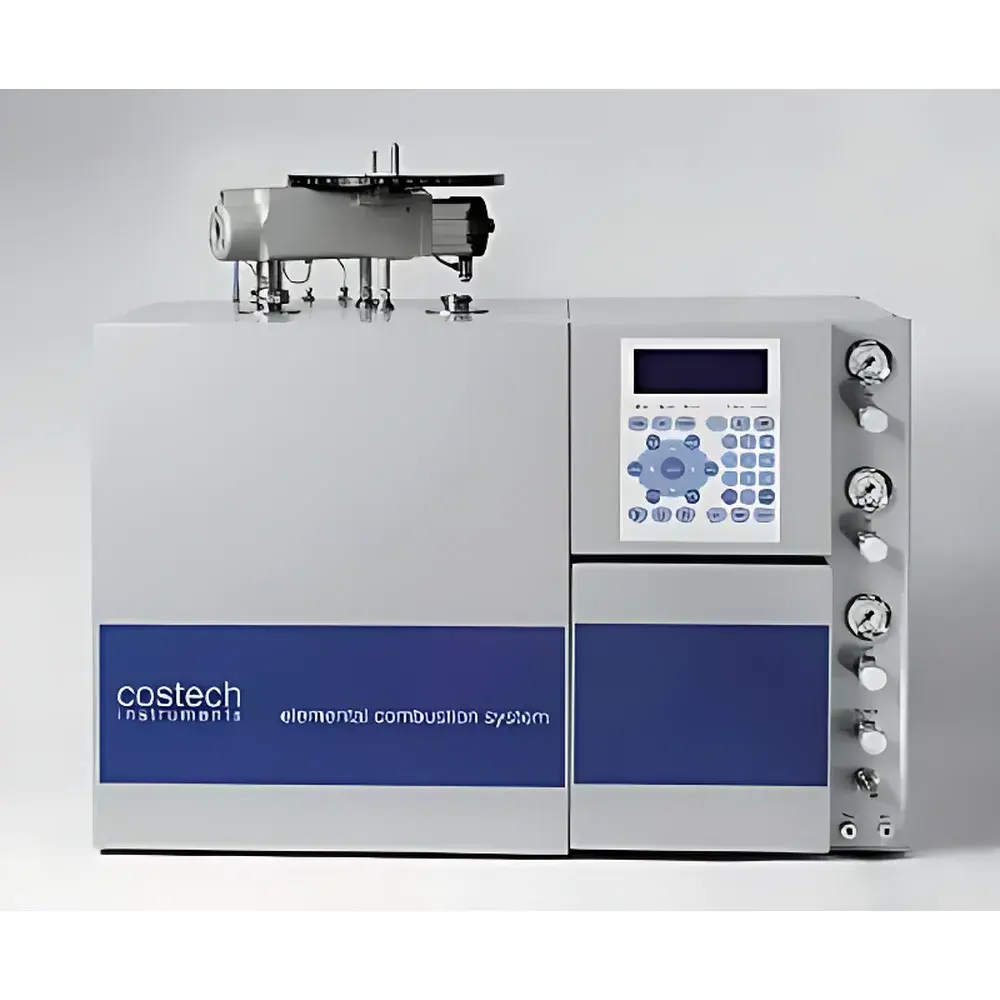
NCT ECS 4010 CHNSO Organic Elemental Analyzer
| Brand | NC Technologies |
|---|---|
| Origin | Italy |
| Model | NCT ECS 4010 |
| Detection Principle | Dumas Combustion Coupled with Gas Chromatographic Separation |
| Elements Analyzed | C, H, N, S, O |
| Sample Mass Range | 0.01–200 mg |
| Accuracy (std. materials) | < 0.2% |
| Precision (std. materials) | < 0.1% |
| LOQ | 1–5 µg |
| Oxidation Furnace Temp. | 800–1100 °C |
| Reduction Furnace Temp. | 600–1100 °C |
| GC Column Temp. Range | 30–110 °C |
| Analysis Time (CHNS) | ~15 min |
| GC Column Length | 2 m |
| Detector | Patented NCT Thermal Conductivity Detector (TCD), Self-Calibrating |
| Autosampler Options | Pneumatic (up to 147 positions), Electronic (32/50/100 positions), Manual |
| Gas Requirements | High-purity He (99.999%, 3–5 bar), O₂ (99.999%, 3–5 bar), Compressed Air |
| Power | 230 VAC ±10%, 1–10 A |
| Dimensions (L×W×H) | 760 × 350 × 700 mm |
Overview
The NCT ECS 4010 CHNSO Organic Elemental Analyzer is a high-precision, fully automated combustion-based instrument engineered for quantitative determination of carbon, hydrogen, nitrogen, sulfur, and oxygen in organic and organometallic samples. It implements the classical Dumas combustion method—modified with advanced flash combustion and gas chromatographic (GC) separation—to achieve simultaneous, independent quantification of all five elements in a single run. Samples are introduced into a high-temperature oxidation reactor (800–1100 °C), where complete combustion converts elemental C, H, N, and S into CO₂, H₂O, NOₓ, and SO₂, respectively; oxygen is determined via pyrolytic reduction in a separate high-temperature reduction furnace (600–1100 °C). The resulting gaseous effluent passes through a thermostatically controlled capillary GC column (30–110 °C, user-adjustable), enabling baseline-resolved separation of CO₂, H₂O, SO₂, and N₂ prior to detection. This architecture eliminates cross-interference between analyte peaks and supports robust, matrix-independent quantification without reliance on reference gases.
Key Features
- Patented self-calibrating Thermal Conductivity Detector (TCD): Eliminates need for external calibration gases; maintains long-term baseline stability and drift-free operation.
- Modular, multi-furnace combustion system: Independent oxidation and reduction zones optimized for CHNS and O analysis, each with programmable temperature profiles (±1 °C control).
- Flexible autosampling: Three interchangeable options—pneumatic carousel (up to 147 positions), electronic rotating disk (32/50/100 positions), or manual introduction—supporting unattended overnight operation and method-specific throughput optimization.
- Integrated GC separation module: 2-meter fused-silica capillary column with precise oven temperature control ensures reproducible retention times and peak resolution across diverse sample matrices.
- Open interface architecture: Standard analog/digital I/O and Ethernet connectivity enable seamless integration with external isotopic ratio mass spectrometers (e.g., IRMS), Picarro cavity ring-down spectrometers, or third-party LIMS systems.
- Low operational footprint: No liquid nitrogen or cryogenic cooling required; helium carrier gas consumption optimized via pulsed flow control; minimal consumables beyond quartz combustion tubes and catalysts.
Sample Compatibility & Compliance
The ECS 4010 accommodates solid, liquid, and viscous samples—including pharmaceutical APIs, marine biomass, petrochemical fractions, foodstuffs, polymers, and soil extracts—within a mass range of 0.01–200 mg (dependent on elemental concentration and matrix volatility). Its combustion protocol complies with ASTM D5291, ISO 17249, and USP for elemental impurity testing. Data integrity meets FDA 21 CFR Part 11 requirements when operated with EAS CLARITY software configured for audit-trail logging, electronic signatures, and role-based access control. All hardware components conform to CE, RoHS, and IEC 61010-1 safety standards. Method validation documentation supports GLP and GMP laboratory accreditation workflows.
Software & Data Management
EAS CLARITY software provides full instrument control, real-time chromatogram visualization, peak integration, calibration curve generation (linear, quadratic, cubic), and customizable report templates compliant with ISO/IEC 17025. It supports dynamic baseline correction, automatic peak identification based on retention time windows, and statistical evaluation of precision (RSD), accuracy (recovery %), and linearity (r²). Raw data files (.raw) are stored in vendor-neutral formats compatible with third-party chemometric tools. Audit trails record all parameter changes, calibration events, and user actions with timestamps and operator IDs. Software updates are delivered via secure HTTPS and validated per change control SOPs.
Applications
The ECS 4010 serves as a primary tool in QC/QA laboratories for regulatory-compliant elemental profiling: quantifying residual catalyst metals in API synthesis, verifying stoichiometry in coordination compounds, determining nitrogen content in fertilizers per AOAC 990.11, measuring sulfur in low-sulfur diesel per ASTM D5453, and validating oxygen content in biodegradable polymers. In research settings, it supports metabolomics (C/N ratios in phytoplankton), stable isotope tracer studies (when coupled to IRMS), and forensic analysis of unknown organics. Its sensitivity (LOQ: 1–5 µg) and precision (<0.1% RSD on certified reference materials) make it suitable for both routine screening and method development.
FAQ
Does the ECS 4010 require external calibration gases for TCD operation?
No—the NCT-designed TCD incorporates an internal reference cell and real-time thermal compensation algorithm, enabling continuous self-calibration without standard gases.
Can the instrument analyze oxygen independently from CHNS in the same run?
Yes—oxygen is measured in a dedicated pyrolysis/reduction step upstream of the GC column; CHNS analysis occurs in parallel via combustion effluent, allowing true five-element co-quantification.
What sample preparation is required prior to analysis?
Minimal preparation: homogeneous solids may be weighed directly; liquids require encapsulation in tin or silver capsules; volatile or hygroscopic samples should be sealed under inert atmosphere prior to loading.
Is the GC column maintenance-intensive?
No—capillary columns are rated for >10,000 injections; column conditioning is automated during startup, and contamination alerts trigger optional bake-out protocols.
How does the system ensure compliance with ISO 17025 data integrity requirements?
EAS CLARITY enforces electronic signature workflows, immutable audit logs, version-controlled method storage, and encrypted raw data archiving—all configurable to meet ILAC-G18 and EURACHEM guidance.
Related Products







