
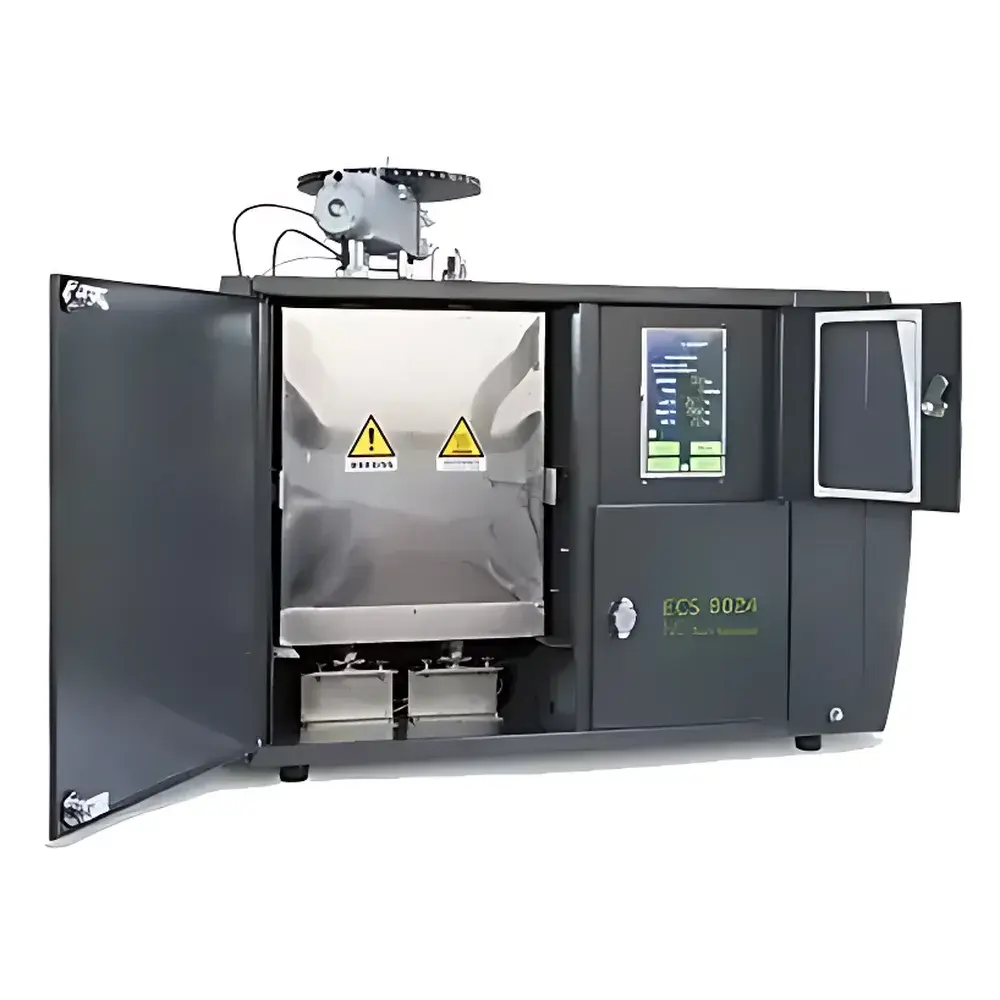
NC Technologies ECS 8024 CN Elemental Analyzer for Soil Analysis
| Brand | NC Technologies |
|---|---|
| Origin | Italy |
| Model | ECS 8024 |
| Measurable Elements | C, N |
| Sample Types | Solid (e.g., soil, sediment, plant tissue) and liquid |
| Detection Principle | Dumas combustion coupled with gas chromatographic separation and thermal conductivity detection (TCD) |
| Measurement Range | C/N: 0.002–20 mg |
| Accuracy | <0.2% (certified reference materials, purity >99.9%) |
| Precision | <0.1% RSD (n=10, CRM) |
| Analysis Time | ~5 min per CN determination |
| Furnace System | Dual-zone high-temperature combustion furnaces (up to 1100 °C each) |
| Separation Column | 3 m GC column |
| Detector | Self-calibrating high-resolution TCD (no reference gas required) |
| Gas Requirements | Helium (99.999%, 3–5 bar), Oxygen (99.999%, 3–5 bar), oil-free compressed air |
| Auto-sampling Options | Pneumatic (147-position), Electronic (32/50/100-position), or manual |
| Software | EAS Clarity v5.x with GLP-compliant audit trail, calibration curve fitting (linear, quadratic, cubic), and method validation tools |
| Compliance | Designed to support ISO 13879, ASTM D5373, EPA Method 9060A, and USP <231> for elemental carbon/nitrogen quantification in environmental matrices |
| Dimensions | 81 × 50 × 37 cm |
| Weight | 68 kg |
| Power | 230 V, 50/60 Hz, 5 A, 1100 W max |
Overview
The NC Technologies ECS 8024 CN Elemental Analyzer is a dedicated Dumas-combustion-based instrument engineered for precise, high-throughput quantification of total carbon (C) and total nitrogen (N) in soil, sediments, compost, agricultural biomass, and other heterogeneous environmental solid matrices. Unlike Kjeldahl-based methods limited to organic nitrogen, the ECS 8024 employs flash combustion at up to 1100 °C in a dual-furnace configuration—ensuring complete oxidation of refractory carbon forms (e.g., black carbon, char) and all nitrogen species (organic, ammoniacal, nitrate, nitrite) into CO2 and N2. These gaseous products are then separated on a 3-meter capillary GC column and quantified via a self-calibrating, high-stability thermal conductivity detector (TCD). The absence of reference gas dependency, combined with electronic flow control and real-time oxygen dosing algorithms, ensures long-term baseline stability and metrological traceability across extended unattended runs.
Key Features
- Dual-zone combustion furnace system optimized for catalyst longevity and complete sample mineralization—even for high-clay or iron-rich soils.
- Three interchangeable autosampler configurations: pneumatic (147-position), electronic (32/50/100-position), and manual—enabling flexibility from routine QC to method development.
- Self-calibrating TCD detector with integrated temperature stabilization and drift compensation—eliminating daily reference gas purging and reducing operational overhead.
- Real-time consumables monitoring: automatic tracking of CuO/Cr2O3 catalyst depletion, silver wool trap saturation, and desiccant exhaustion with predictive alerts.
- Intelligent oxygen dosing: dynamic calculation and metering of O2 volume per sample based on mass and expected C/N content—minimizing gas waste and extending cylinder lifetime by up to 40%.
- Touchscreen HMI with embedded EAS Clarity software interface for method setup, live reaction monitoring (furnace temp, pressure, flow), and immediate pass/fail flagging against user-defined acceptance criteria.
Sample Compatibility & Compliance
The ECS 8024 accommodates samples ranging from 0.5 mg to 1000 mg dry mass—including air-dried, freeze-dried, or homogenized soil cores; slurry suspensions (via sealed tin capsules); and digested plant tissues. Sample encapsulation uses high-purity tin or silver boats compatible with halogen-free combustion protocols. The system meets critical regulatory requirements for environmental testing laboratories: it supports full compliance with ISO 13879 (soil C/N determination), ASTM D5373 (coal and coke), EPA Method 9060A (total organic carbon in solids), and USP (heavy metals and elemental impurities). Its software architecture includes 21 CFR Part 11–ready audit trails, electronic signatures, and calibration history logging—validated for GLP and GMP-aligned QA/QC workflows.
Software & Data Management
EAS Clarity v5.x provides a validated, Windows-based platform for instrument control, data acquisition, and report generation. It supports multi-level user permissions, automated calibration curve generation (linear, quadratic, cubic), and forced blank correction. All raw chromatograms, integration parameters, and system logs are stored in encrypted SQLite databases with immutable timestamps. Batch processing allows concurrent analysis of heterogeneous sample sets (e.g., field-collected soils + CRM controls + method blanks), with auto-generated LIMS-compatible CSV exports. Optional API integration enables direct linkage to laboratory information management systems (LIMS) or enterprise resource planning (ERP) platforms.
Applications
- Soil health assessment: Total organic carbon (TOC), C/N ratio, and nitrogen mineralization potential in agronomic and ecological studies.
- Contaminated site characterization: Quantification of petroleum hydrocarbon residues (as total C) and nitrogen-containing explosives (e.g., RDX, TNT) in remediation monitoring.
- Carbon sequestration verification: Baseline and post-intervention C stock measurements aligned with IPCC Tier 2 reporting frameworks.
- Waste-to-energy feedstock screening: Rapid C/N profiling of sewage sludge, food waste, and manure prior to anaerobic digestion.
- Isotope-ratio preparatory analysis: Seamless coupling with Picarro CRDS or IRMS systems via standardized 1/8″ stainless steel transfer lines for δ13C and δ15N stable isotope ratio analysis.
FAQ
Does the ECS 8024 require external calibration gases for TCD operation?
No—the TCD is factory-characterized and self-calibrating via internal thermal reference circuits; no carrier gas or span gas is needed for routine operation.
Can the instrument analyze wet or high-moisture soils directly?
Yes, provided samples are pre-encapsulated in sealed tin cups with appropriate desiccant layers; moisture is flash-evaporated in the first furnace zone without interfering with C/N quantification.
What maintenance intervals are recommended for catalyst and traps?
CuO/Cr2O3 catalyst life averages 1,200–1,800 injections depending on sample matrix; silver wool traps require replacement every 300–500 analyses; system software tracks usage and triggers service alerts.
Is method transfer possible from legacy Dumas analyzers?
Yes—EAS Clarity supports import of legacy calibration files (e.g., from Elementar vario EL cube or Costech ECS 4010), and combustion parameters (temp ramp, O2 pulse width) are fully user-adjustable.
How is system integrity verified during unattended overnight runs?
Built-in automatic leak detection performs pressure decay tests before each sequence; continuous flow and temperature monitoring triggers immediate abort and alert if deviations exceed ±2% setpoint tolerance.




