
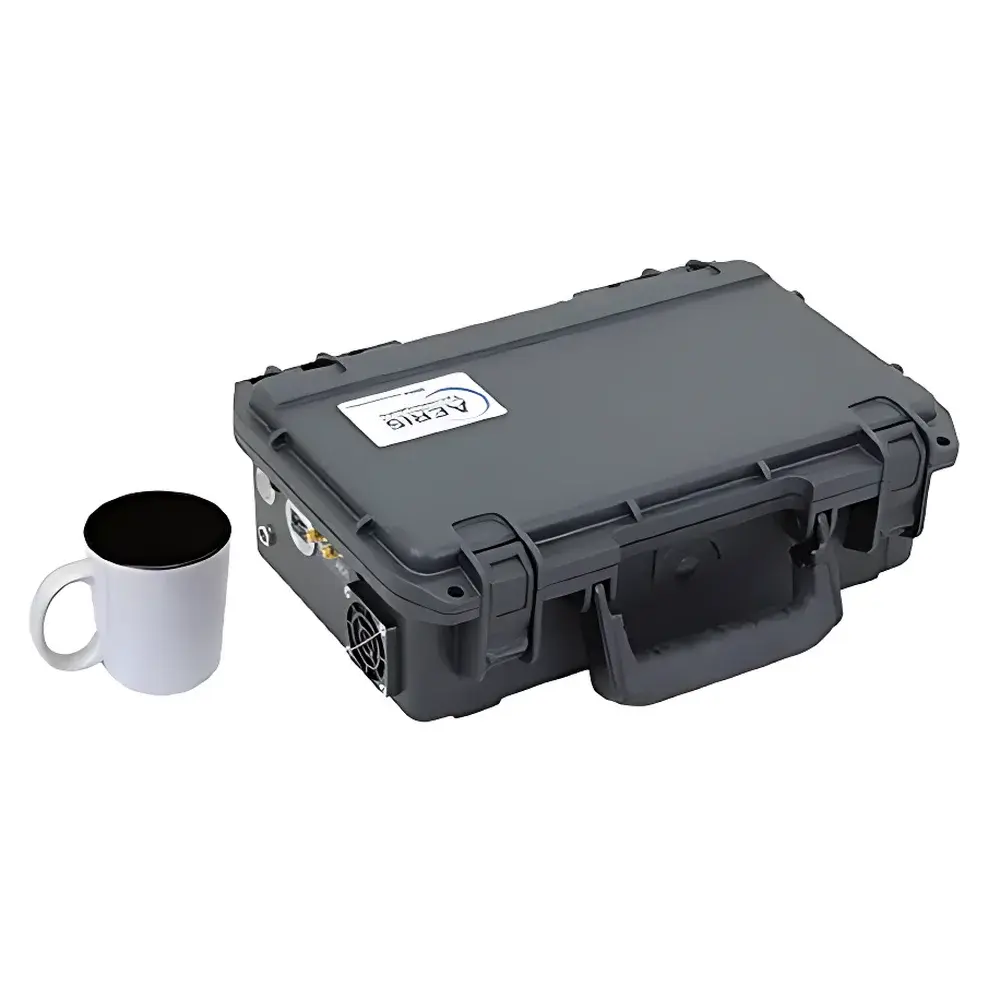
Aeris MIRA Pico Real-Time VOC Analyzer
| Origin | USA |
|---|---|
| Manufacturer Type | Authorized Distributor |
| Origin Category | Imported |
| Model | MIRA PICO VOC |
| Pricing | Available Upon Request |
Overview
The Aeris MIRA Pico Real-Time VOC Analyzer is a field-deployable, battery-operated trace gas analyzer engineered for high-precision, real-time quantification of formaldehyde (HCHO) in ambient air, indoor environments, and emission chambers. It employs proprietary mid-infrared (MIR) laser absorption spectroscopy—specifically targeting the fundamental vibrational absorption band of HCHO near 3.6 µm—to achieve sub-part-per-trillion (ppt) noise-equivalent detection limits and 13 m effective pathlength) with Aeris’ custom monolithic laser/detector engine and patented “light-folding” design—eliminating reliance on fragile high-reflectivity mirrors while maintaining robustness against particulate fouling and thermal drift. The system operates across a dynamic concentration range from <1 ppb to 500 ppm, with a 1–2 Hz data acquisition rate and intrinsic linearity validated per ASTM D6007 and ISO 16000-3 protocols.
Key Features
- Sub-ppb detection limit (1 ppb/s noise-equivalent sensitivity) with <1 ppb absolute accuracy via integrated zero-point calibration
- True real-time response: 1–2 Hz output rate; full spectral acquisition and quantification completed within seconds
- Ultra-low power consumption: 15 W nominal; supports 6-hour continuous operation on internal rechargeable Li-ion battery
- Compact form factor: 11.5″ × 8″ × 3.75″; total mass 2.75 kg — portable enough for handheld surveying or fixed-site deployment
- Self-contained sampling: integrated diaphragm pump with flow-controlled inlet; no external vacuum or conditioning required
- Dual-parameter output: simultaneous reporting of HCHO concentration and water vapor mole fraction, enabling dry-basis correction (HCHOdry) per ISO 16000-9
- Communication interfaces: native Wi-Fi (802.11 b/g/n), RS-232 serial, USB-C; optional 4–20 mA analog output for SCADA integration
- Onboard 32 GB flash memory with timestamped, GPS-tagged (optional module) data logging compliant with GLP audit trails
Sample Compatibility & Compliance
The MIRA Pico is validated for direct analysis of undiluted, unfiltered gaseous samples across relative humidity levels of 10–95% RH (non-condensing) and ambient temperatures from 10–40°C. It meets performance criteria specified in ASTM D6007 (formaldehyde emission testing from wood-based panels), ISO 16000-3 (indoor air—determination of formaldehyde), and ISO 16000-9 (air sampling for formaldehyde using sorbent tubes—used here as a benchmark for method equivalence). Its MIR-based selectivity eliminates cross-sensitivity to common interferents including CO, CO₂, CH₄, methanol, acetaldehyde, and NO₂—unlike DNPH-HPLC methods requiring derivatization and chromatographic separation. The instrument’s firmware supports configurable calibration intervals and automated zero checks, satisfying FDA 21 CFR Part 11 requirements for electronic records when deployed in regulated environmental QA/QC workflows.
Software & Data Management
Aeris provides the MIRA Control Suite—a cross-platform desktop application supporting real-time visualization, spectral diagnostics, and batch export in CSV/NetCDF formats. All raw absorbance spectra, processed concentrations, diagnostic flags (e.g., laser power stability, cell temperature deviation), and metadata (GPS coordinates, battery voltage, pump status) are stored locally with SHA-256 hashing for data integrity verification. Remote firmware updates and configuration changes are delivered over secure TLS-encrypted Wi-Fi. Audit logs record all user-initiated actions—including calibration events, parameter edits, and data exports—with immutable timestamps and operator IDs. Exported datasets include embedded uncertainty estimates derived from Allan variance analysis of spectral residuals, supporting ISO/IEC 17025-compliant uncertainty budgets.
Applications
- Real-time emission rate quantification from engineered wood products (e.g., plywood, MDF, particleboard) in climate-controlled test chambers—reducing test duration from hours to minutes versus ASTM D6007
- Indoor air quality (IAQ) monitoring in residential, commercial, and healthcare facilities—correlating HCHO dynamics with HVAC operation, occupancy, and temperature gradients
- Industrial hygiene assessments near adhesives, resins, and urea-formaldehyde foam insulation manufacturing lines
- Environmental monitoring at brownfield sites and remediation zones where volatile organic compound (VOC) plume migration must be tracked at low background levels
- Research-grade validation of low-cost sensor networks—serving as a reference-grade field calibrator for distributed sensing arrays
- Mobile mapping of urban HCHO gradients using vehicle-mounted or drone-integrated configurations (with optional GPS and ruggedized enclosure)
FAQ
Does the MIRA Pico require routine calibration with certified gas standards?
No. It performs automatic zero-point calibration using its internal reference cavity and does not require external span gases under normal operating conditions. Optional NIST-traceable span verification can be performed annually for regulatory compliance.
Can it measure other VOCs besides formaldehyde?
The current MIRA Pico VOC model is optimized exclusively for HCHO. Aeris offers parallel MIR platforms (e.g., MIRA Trace) for CO, CO₂, CH₄, NH₃, and H₂S—but each requires dedicated laser wavelength tuning and spectral library validation.
Is the instrument suitable for outdoor long-term unattended operation?
Yes—when equipped with the optional weatherproof enclosure, external solar charging kit, and extended-life battery pack, it supports continuous 30-day deployments with remote telemetry via LTE/Wi-Fi.
How does it handle humidity-induced spectral interference?
The onboard algorithm applies real-time water vapor correction using co-measured H₂O concentration and pre-characterized HCHO/H₂O spectral cross-talk coefficients derived from NIST HITRAN database simulations.
What data security protocols are implemented for remote access?
All wireless communications use WPA3-Enterprise authentication and TLS 1.3 encryption. Local storage employs AES-256 full-disk encryption, and firmware signing ensures only authenticated Aeris binaries can be installed.
Related Products







