
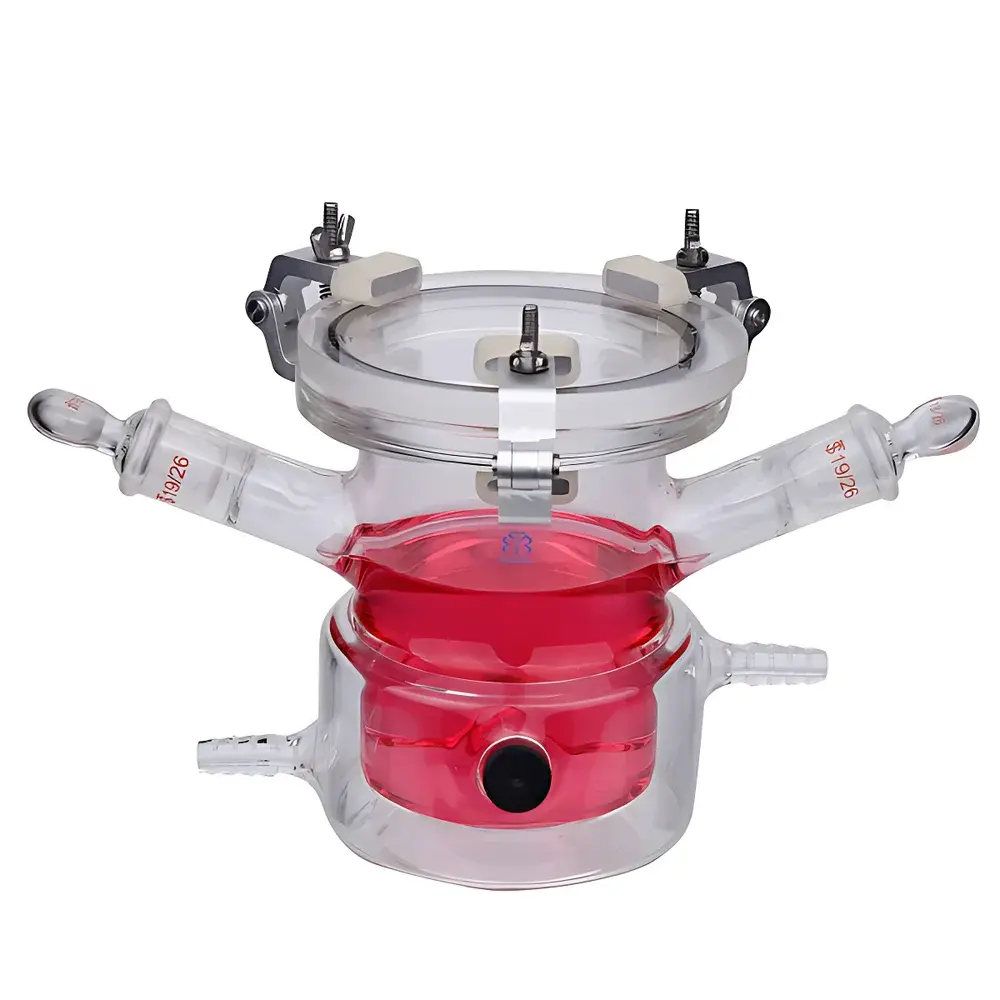
Photoreactor System PQ Series with Xenon Lamp Illumination
| Brand | PerfectLight |
|---|---|
| Origin | Beijing, China |
| Manufacturer Type | Authorized Distributor |
| Product Category | Domestic |
| Model | PQ Series Photoreactor |
| Light Source | 300 W Xenon Arc Lamp (Air-Cooled or Water-Cooled Optional) |
| Irradiation Mode | Top-Illumination (External Irradiation via Quartz Window) |
| Quartz Window | JGS-2 Fused Silica, Φ110 mm × 8 mm Thickness |
| Reactor Body | Borosilicate Glass, Total Volume ≈ 350 mL, Effective Reaction Volume ≈ 150 mL |
| Sealing | PTFE O-Ring + Flange Joint |
| Standard Ports | Two 19/26 Ground-Glass Joints |
| Sampling Port | Septum-Sealed Glass Threaded Port (Manual In-Situ Sampling Without System Venting) |
| Gas Handling | Dual Gas Inlet/Outlet for Purge & Atmosphere Control (N₂, Ar, O₂, Air) |
| Optional Accessories | Removable Quartz Jacketed Cooling Sleeve, Vacuum Port, Glass Valve, Extended Neck, Thermocouple Port |
| Compliance | Designed for ISO/IEC 17025-aligned laboratory workflows |
Overview
The PerfectLight PQ Series Photoreactor is a modular, top-illuminated benchtop system engineered for controlled heterogeneous and homogeneous photocatalytic degradation studies under simulated solar or near-UV irradiation. It operates on the principle of external irradiation—where a high-intensity xenon arc lamp (300 W, spectral output approximating AM1.5G solar irradiance) delivers collimated light through a precisely aligned JGS-2 fused silica window (Φ110 mm × 8 mm), minimizing thermal load while maximizing UV–visible transmission (190–2500 nm). The reactor body is constructed from borosilicate glass with flange-mounted PTFE-sealed joints, ensuring long-term chemical inertness against organic solvents, acidic/basic aqueous media, and reactive oxygen species generated during photocatalysis (e.g., •OH, O₂•⁻, H₂O₂). Its design conforms to fundamental photoreactor engineering criteria: uniform photon flux distribution across the reaction volume, minimal photon loss at interfaces, and reproducible optical path length (defined by fixed quartz window thickness and liquid height control). This architecture supports quantitative kinetic analysis in compliance with ASTM E2054-22 (Standard Practice for Determining Photocatalytic Activity of Materials) and ISO 10678:2010 (Photocatalysis — Determination of Photocatalytic Activity).
Key Features
- Top-illumination geometry with JGS-2 quartz window ensures consistent incident photon fluence rate and eliminates shadowing effects common in side-irradiated configurations.
- Septum-sealed sampling port enables sterile, atmosphere-retentive manual liquid sampling without reactor depressurization or exposure to ambient air—critical for time-resolved monitoring of transient intermediates (e.g., by HPLC or GC-MS).
- Two standardized 19/26 ground-glass joints allow seamless integration with vacuum manifolds, gas dosing lines, condensers, or online IR/UV-Vis flow cells.
- Integrated gas inlet/outlet ports support continuous purging (N₂, Ar) or reactive gas introduction (O₂, NOₓ, CO₂) to modulate redox potential and suppress electron–hole recombination.
- Optional removable quartz-jacketed water sleeve provides active temperature regulation (±0.5 °C stability) during extended irradiation cycles, mitigating exothermic side reactions and enabling Arrhenius-based activation energy studies.
- Flange-based assembly with replaceable PTFE gaskets ensures >10⁵ Pa vacuum integrity and compatibility with mild pressurization (<0.3 MPa) for accelerated degradation kinetics under elevated partial pressures.
Sample Compatibility & Compliance
The PQ Series accommodates suspensions of semiconductor photocatalysts (e.g., TiO₂ P25, g-C₃N₄, BiVO₄), dissolved organic pollutants (dyes, pharmaceuticals, pesticides), and colloidal quantum dots. Its inert glass–quartz interface resists leaching and adsorption artifacts, preserving analyte integrity per USP chromatographic method validation requirements. All wetted components comply with ISO 8536-1 (Glass Containers for Pharmaceutical Use) dimensional tolerances. The system supports audit-ready operation under GLP environments: sampling events, gas exchange logs, and lamp operating hours can be manually documented in accordance with OECD Series No. 117 (Guidance Document on Photolysis Testing).
Software & Data Management
While the base PQ reactor operates manually, it is fully compatible with third-party digital instrumentation: lamp power supplies with RS-485/Modbus outputs, thermocouple data loggers (e.g., Omega OM-DAQPRO-5300), and automated syringe pumps (e.g., Harvard Apparatus PHD 2000) for timed reagent addition. Integration with LIMS platforms is facilitated via CSV export of timestamped sampling metadata. For regulatory traceability, users may implement electronic lab notebooks (ELNs) compliant with FDA 21 CFR Part 11 when recording irradiation duration, gas composition, and sample ID linkage.
Applications
- Quantitative evaluation of photocatalyst quantum yield using actinometry (e.g., potassium ferrioxalate or Reinecke’s salt).
- Structure–activity relationship (SAR) studies of emerging contaminants under environmentally relevant light spectra.
- In situ DRIFTS monitoring of surface-bound intermediates during TiO₂-mediated oxidation of VOCs.
- Photoelectrochemical coupling experiments using integrated counter/reference electrode ports (via optional adapter).
- Accelerated weathering simulation for polymer photostability assessment per ISO 4892-3.
FAQ
Can the PQ reactor be used with mercury lamps?
Yes—though optimized for xenon illumination, the quartz window transmits >90% of 254 nm and 365 nm Hg-line emissions; users must verify lamp cooling and spectral mismatch corrections for absolute quantum yield calculations.
Is vacuum operation supported out of the box?
Yes—the standard 19/26 ground-glass joint and PTFE seal enable vacuum levels down to 10⁻² mbar when paired with a diaphragm pump and vacuum gauge.
What is the maximum operating temperature with the water jacket?
The quartz-jacketed cooling sleeve maintains stable temperatures between 5 °C and 60 °C; higher setpoints require external chiller circulation and pressure-rated tubing.
How is light intensity calibrated?
Users are advised to employ NIST-traceable silicon photodiode sensors (e.g., Thorlabs S120VC) placed at the reactor window plane prior to each experiment; spectral correction factors must be applied for non-xenon sources.
Are custom port configurations available?
Yes—PerfectLight’s in-house fabrication facility supports bespoke modifications including additional thermowell ports, optical fiber feedthroughs, or integrated pH/DO probes, subject to mechanical stress analysis and leak testing certification.




