
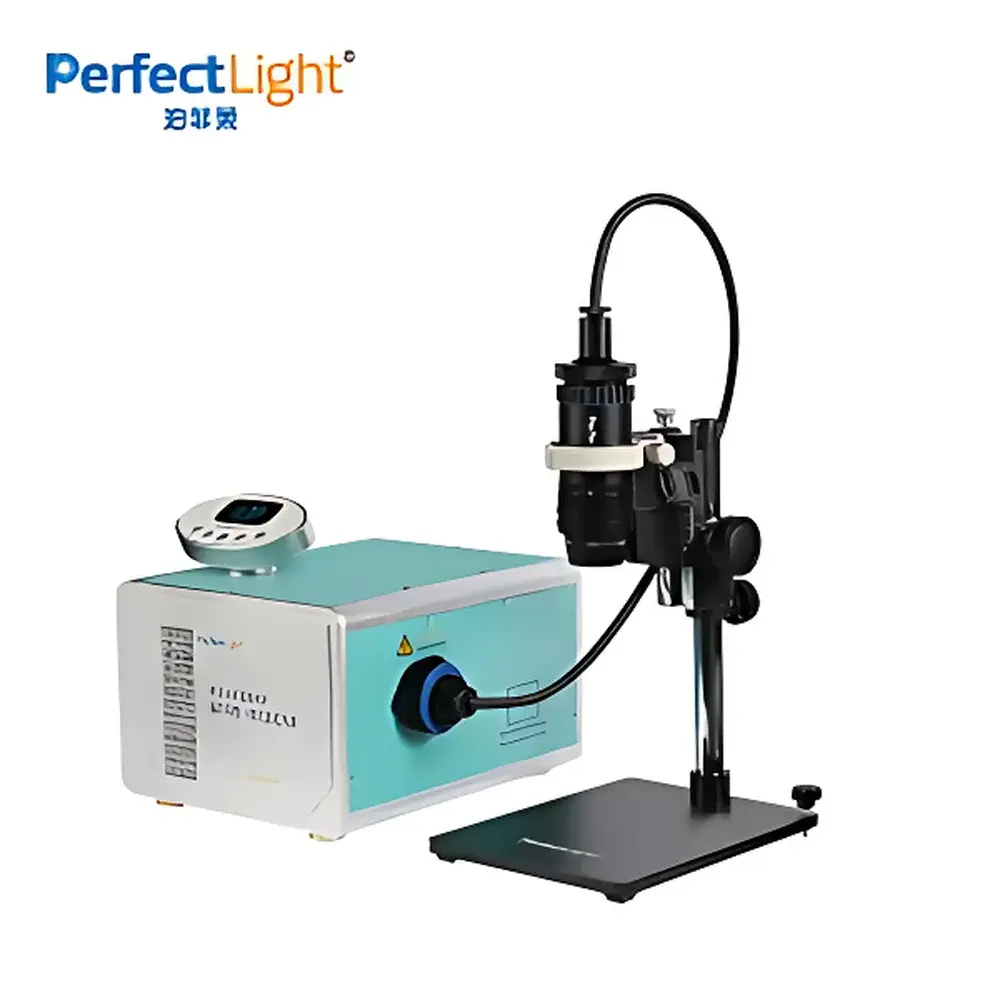
PLS-FX300HU High-Uniformity Integrated Xenon Light Source
| Brand | PerfectLight (PoPhilae) |
|---|---|
| Origin | Beijing, China |
| Model | PLS-FX300HU |
| Light Source Type | Xenon Arc Lamp |
| Illumination Mode | External Irradiation |
| Optical Output Power | 50 W |
| Spectral Range | 320–800 nm |
| Adjustable Rectangular Beam Size | 10×10 to 50×50 mm² |
| Beam Uniformity (≤20×20 mm²) | ≤±4% (A-class solar simulator compliant) |
| Long-Term Irradiance Stability (8 h) | <2% |
| Spatial Non-Uniformity | ±1% |
| Max. Irradiance Density | ≥3000 mW/cm² (at 10×10 mm², direct output) |
| Intensity Control | Constant-current regulation + motorized iris aperture |
| Lamp Lifetime | >1000 h (under standard photocatalytic operating conditions) |
| Safety Features | Integrated lamp/power housing, fan-failure protection with post-shutdown cooling delay, overcurrent/overload auto-shutdown |
| Control Architecture | Microprocessor-based digital power management with dedicated optical feedback loop |
Overview
The PLS-FX300HU is a high-precision, integrated xenon light source engineered for quantitative photoelectrochemical (PEC) and photocatalytic research requiring spatially uniform, spectrally stable, and intensity-controllable irradiation. Based on a DC-stabilized short-arc xenon lamp, it delivers broadband emission from 320 nm to 800 nm—covering the full UV-A, visible, and near-IR range relevant to semiconductor bandgap excitation in metal oxides, perovskites, and covalent organic frameworks. Its core design principle centers on radiometric reproducibility: a closed-loop optical feedback system continuously monitors real-time radiant flux via a calibrated photodiode sensor, enabling dynamic current compensation to maintain irradiance stability below 2% deviation over an 8-hour continuous operation cycle. Unlike modular lamp-and-housing configurations, the PLS-FX300HU adopts a monolithic mechanical architecture—integrating lamp chamber, power supply, thermal management, and beam-shaping optics into a single rigid chassis—thereby minimizing alignment drift, vibration-induced non-uniformity, and inter-unit coupling errors common in multi-component systems.
Key Features
- Rectangular beam delivery with continuous size adjustment from 10×10 mm² to 50×50 mm², optimized for standard photoelectrode substrates (e.g., FTO, ITO, or NiO-coated quartz slides) and multi-cell reactor arrays.
- A-class solar simulator compliance (IEC 60904-9 Ed. 3, ASTM E927-19) for beam uniformity (≤±4%) at ≤20×20 mm², validated using NIST-traceable scanning radiometer mapping protocols.
- Maximum irradiance density ≥3000 mW/cm² at 10×10 mm² output—enabling accelerated aging studies, high-flux quantum yield determination, and kinetic saturation analysis under industrially relevant photon flux densities.
- Dual-intensity modulation: fine-grained control via digitally regulated constant-current driver (0–21 A range) combined with motorized iris aperture (10–100% open area), supporting both absolute irradiance calibration and relative dose normalization across experimental series.
- Integrated thermal management with fail-safe fan control logic: active cooling continues for 90 seconds after shutdown to prevent quartz envelope thermal shock; fan failure triggers immediate lamp current cutoff and audible/visual alarm.
Sample Compatibility & Compliance
The PLS-FX300HU is compatible with standard electrochemical cells (e.g., three-electrode PEC cells with quartz windows), gas-phase flow reactors (for VOCs or NOx degradation), and liquid-phase batch photoreactors (e.g., top-irradiated cylindrical vessels with 25 mm optical path). Its spectral output—when paired with certified interference filters (e.g., 365 nm ±5 nm, 420 nm ±10 nm, or AM1.5G equivalent bandpass)—meets ISO 17025 traceability requirements for spectral irradiance calibration. The unit conforms to IEC 61000-6-3 (EMC emissions) and IEC 61000-6-2 (immunity), and its electrical safety architecture complies with IEC 61010-1 for laboratory equipment. All firmware operations log timestamped control parameters (current, aperture position, feedback error signal) to support GLP-compliant audit trails.
Software & Data Management
Control is executed via a dedicated embedded microcontroller (ARM Cortex-M4) running deterministic real-time firmware—not PC-dependent GUI software. All operational parameters—including setpoint current, aperture position, runtime counter, and optical feedback deviation—are accessible through RS-232 or USB-C serial interface using ASCII command protocol (e.g., “CURR?”, “APERTURE=75”, “STAB?”, “LOG”). Raw feedback data (10 Hz sampling) can be streamed to external DAQ systems for synchronization with potentiostat or gas chromatograph triggers. No proprietary drivers or cloud connectivity are implemented; configuration persistence survives power cycles without battery backup.
Applications
- Photoelectrochemical (PEC) characterization: Incident photon-to-current efficiency (IPCE) mapping, applied bias photon-to-current efficiency (ABPE), and transient photocurrent decay analysis under uniform illumination.
- Solar cell evaluation: J-V curve acquisition under simulated AM1.5G spectrum (with appropriate filter stack), open-circuit voltage (Voc) stability testing, and light-soaking protocols per IEC 61215-2 MQT 14.1.
- Heterogeneous photocatalysis: Quantitative degradation kinetics of gaseous pollutants (formaldehyde, toluene, NO) and aqueous contaminants (methylene blue, phenol, Cr(VI)) under controlled photon flux.
- Photocatalytic water splitting: Stoichiometric H2/O2 evolution quantification using gas chromatography, enabled by stable long-duration irradiation and minimal thermal load on reactor headspace.
- Advanced material screening: High-throughput evaluation of photoanode/cathode libraries, including spectral response profiling and wavelength-resolved quantum efficiency measurements.
FAQ
What spectral filters are compatible with the PLS-FX300HU?
Standard 25 mm diameter, 5 mm thick interference filters (UV, VIS, narrowband) with AR coating for 300–800 nm are mechanically and thermally compatible. Custom filter holders for 50 mm round or rectangular formats can be supplied upon request.
Is the output beam collimated or focused?
The system delivers quasi-collimated rectangular output via internal Köhler illumination optics; optional focusing lenses (f = 100 mm, f = 200 mm) are available for spot-size reduction while preserving uniformity within specified limits.
How is irradiance calibrated and verified?
Each unit ships with a factory-issued calibration certificate referencing NIST-traceable silicon photodiode standards. Users may perform field verification using a calibrated reference detector (e.g., Thorlabs S120VC) mounted on a precision XYZ stage aligned to the beam center.
Can the PLS-FX300HU operate continuously for >8 hours?
Yes—thermal design supports indefinite operation at ≤80% rated current (16.8 A) with ambient temperature ≤25°C and adequate ventilation; extended runs require periodic aperture cleaning and lamp alignment verification per maintenance schedule.
What is the recommended replacement interval for the xenon lamp?
Lamp lifetime exceeds 1000 hours when operated within manufacturer-specified current and cooling parameters; output degradation is monitored via the built-in feedback signal—replacement is advised when long-term stability deviates >3% over 8 h or when arc wander exceeds visual tolerance during beam profiling.



