
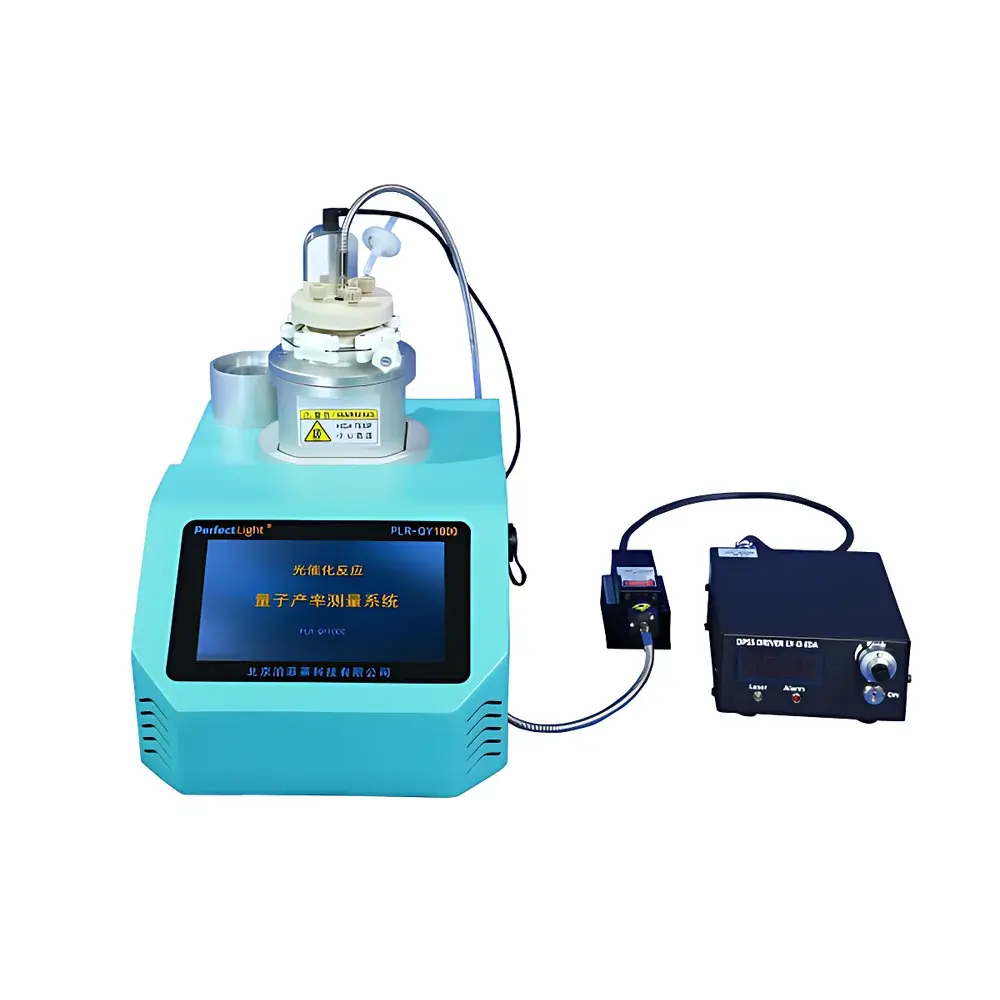
PLR-QY1000 Quantum Yield Measurement System
| Brand | PerfectLight |
|---|---|
| Origin | Beijing, China |
| Manufacturer Type | Authorized Distributor |
| Country of Origin | China |
| Model | PLR-QY1000 Quantum Yield Measurement System |
| Temperature Range | 0–60 °C |
| Temperature Control Accuracy | ±0.1 °C |
| Reaction Vessel Count | 1 |
| Reaction Volume Capacity | 100 mL |
| Light Source | 405 nm Laser Diode (Standard), Optional Wavelengths Available |
| Operating Pressure Range | 20–130 kPa |
| Gas Purge Pressure | 0.4–0.45 MPa (N₂) |
| Purge Cycles | 0–255 |
| Residual Oxygen Level | ≤100 ppm |
| Stirring Speed | 250–1250 rpm |
| Measurable Quantum Yield Range | 0.05%–100% |
| Internal Environmental Monitoring | Integrated Temperature & Relative Humidity Sensors |
| Cooling Interface | External Circulating Water Connection |
| Data Export | USB Flash Drive Interface |
Overview
The PLR-QY1000 Quantum Yield Measurement System is a dedicated photoreactor platform engineered for the precise quantification of quantum yield (Φ) in photocatalytic and photochemical processes. It operates on the fundamental principle of actinometric photon counting—where monochromatic laser irradiation (standard 405 nm) delivers a known photon flux into a highly controlled reaction environment. The system employs an integrating black-body spherical reactor with a U-shaped optical window to minimize photon loss and maximize absorption uniformity across the sample volume. This geometry ensures near-complete photon capture within the solution phase, enabling rigorous photon balance calculations required by ISO 25927-1 and ASTM E2083 standards for quantum efficiency determination. Designed specifically for laboratory-scale gas-evolution photochemistry (e.g., H₂ or O₂ production), the PLR-QY1000 integrates real-time environmental monitoring, pressure-regulated inert gas purging, and active thermal management to maintain reproducible reaction conditions across extended kinetic runs.
Key Features
- Integrating spherical reactor with high-absorptance blackbody interior and U-shaped fused silica optical window—optimized for minimal photon escape and maximal spectral throughput.
- Stabilized 405 nm laser diode source with calibrated power output (traceable to NIST-traceable photodiode standards), enabling accurate photon flux calculation via E = Nphoton × hν.
- Integrated dual-sensor module measuring internal temperature and relative humidity in real time—critical for assessing solvent volatility, catalyst hydration state, and reaction thermodynamics.
- External circulating water interface compatible with standard chillers or thermostats, supporting stable isothermal operation from 0 °C to 60 °C with ±0.1 °C setpoint accuracy.
- Dedicated vacuum-pump-and-pressure-regulation subsystem: achieves background gas replacement (N₂) at 0.4–0.45 MPa inlet pressure; enables fine-tuned control over headspace pressure (20–130 kPa) and residual oxygen levels ≤100 ppm after up to 255 purge cycles.
- Magnetic stirring with adjustable speed (250–1250 rpm) and torque compensation to ensure homogeneous mass transfer without introducing seal-related contamination or leakage pathways.
- Onboard data acquisition with timestamped logging of irradiance, temperature, pressure, humidity, stir speed, and gas evolution (when coupled with external GC or mass spectrometer).
Sample Compatibility & Compliance
The PLR-QY1000 accommodates aqueous and organic-phase photocatalytic suspensions or molecular solutions in volumes ranging from 50 mL to 100 mL (nominal), with total internal free volume calibrated at ~150 mL. Its sealed, corrosion-resistant 316L stainless steel and PTFE-wetted construction supports compatibility with common photocatalysts (e.g., TiO₂, g-C₃N₄, MOFs), sacrificial reagents (e.g., triethanolamine, Na₂S/Na₂SO₃), and evolved gases (H₂, O₂, CH₄). The system complies with general safety requirements for pressurized photochemical reactors per ISO 12100 and CE machinery directives. While not certified as explosion-proof, its design incorporates pressure relief mechanisms and interlocked lid sensing to prevent operation under unsafe conditions. All firmware and hardware architecture support audit-ready data integrity practices aligned with GLP and GMP principles—including electronic logbook generation and user-accessible metadata tagging.
Software & Data Management
The PLR-QY1000 features embedded microcontroller-based firmware with a menu-driven LCD interface for local configuration and real-time parameter monitoring. All measurement logs—including irradiance calibration timestamps, purge cycle counters, temperature/humidity profiles, and pressure ramps—are stored internally and exportable via standard USB-A flash drive in CSV format. No proprietary software installation is required for basic operation or data retrieval. For advanced integration, ASCII-based serial communication (RS-232/USB-CDC) provides full command-line access to all sensor readings and actuator controls, enabling synchronization with external analytical instruments (e.g., gas chromatographs, quadrupole mass spectrometers) or custom Python/Matlab acquisition scripts. Raw photon count values, calculated quantum yields, and kinetic rate constants can be post-processed using open-source tools compliant with IUPAC-recommended quantum yield reporting conventions.
Applications
- Quantitative quantum yield determination for photocatalytic hydrogen evolution (HER) and oxygen evolution (OER) under monochromatic excitation.
- Wavelength-dependent action spectrum analysis when paired with optional tunable laser modules (e.g., 375 nm, 450 nm, 520 nm).
- Photostability assessment of molecular photosensitizers and semiconductor heterojunctions under controlled thermal and atmospheric conditions.
- Reaction kinetics modeling of photocatalytic gas evolution, including induction period analysis and apparent quantum efficiency (AQE) mapping.
- Method development and validation for ISO/ASTM-compliant photochemical testing protocols in academic, industrial, and regulatory R&D laboratories.
FAQ
What laser wavelengths are supported beyond the standard 405 nm?
The PLR-QY1000 chassis accepts OEM-integrated laser modules at discrete wavelengths including 375 nm, 450 nm, and 520 nm—each requiring individual optical alignment and power calibration prior to quantum yield computation.
Can the system operate under anaerobic conditions other than nitrogen?
Yes—argon and forming gas (5% H₂/95% N₂) are compatible provided inlet pressure remains within the specified 0.4–0.45 MPa range and gas purity meets ≤100 ppm O₂ specifications.
Is the 100 mL reaction volume fixed or adjustable?
The nominal working volume is 100 mL, but users may load 50–100 mL of solution; the internal free volume (~150 mL) must be recalibrated for each fill level to ensure accurate gas-phase concentration calculations.
Does the system include gas detection hardware?
No—the PLR-QY1000 is a reactor and photon-counting platform only; quantitative gas analysis requires external instrumentation such as a TCD-GC or QMS, connected via standardized gas sampling ports.
How is temperature uniformity verified inside the reactor sphere?
Calibration reports (available upon request) document radial and axial thermal gradients measured using embedded PT100 sensors and infrared thermography during steady-state operation across the full 0–60 °C range.



