
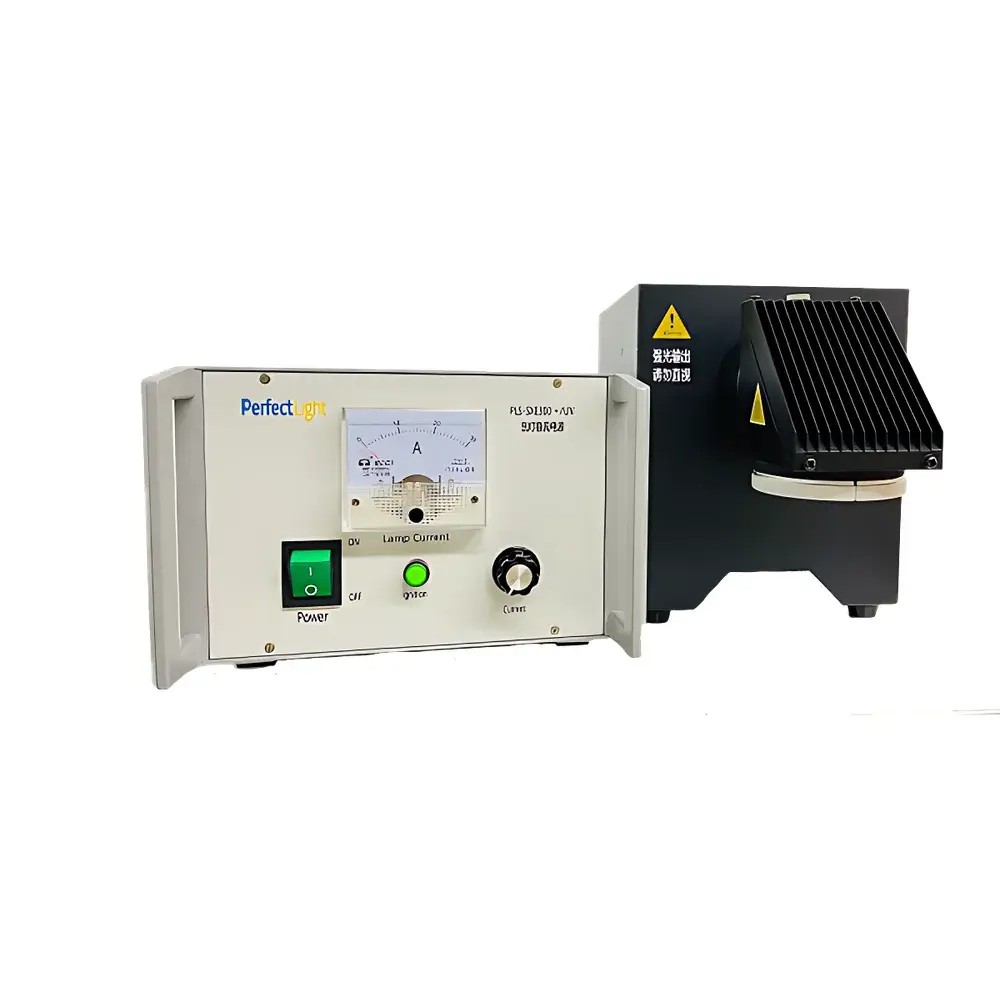
PLS-SXE300UV Solar Simulator Light Source by PerfectLight
| Brand | PerfectLight |
|---|---|
| Model | PLS-SXE300UV |
| Light Source Type | Xenon Arc Lamp-Based Solar Simulator |
| Optical Architecture | Single-Beam |
| Detector | Photodiode Array |
| Spectral Range | 320–780 nm (extendable to 2500 nm with optional filters) |
| Wavelength Control | Motorized Auto-Scanning |
| Total Output Power | 50 W |
| Beam Divergence | Avg. 6° |
| Illuminated Spot Diameter | 30–60 mm (distance-dependent) |
| Long-Term Irradiance Stability | ≤ ±3% over 8 h |
| Lamp Power Rating | 300 W (adjustable 150–300 W) |
| Lamp Lifetime | >1000 h (under standard photocatalytic operating conditions) |
| Trigger System | Integrated High-Voltage Ignition (dual-stage, no external HV cabling) |
| Current Limit | 21 A |
| Thermal Management | Passive Heatsink (large-area aluminum fin array) |
| EMI Shielding | Enclosed metal lamp housing |
| Control Interface | Microprocessor-based digital power management with programmable operation mode |
Overview
The PLS-SXE300UV is a high-stability, air-cooled xenon arc-based solar simulator engineered for laboratory-scale photochemical and photocatalytic research. It replicates the spectral distribution and irradiance characteristics of natural sunlight within the biologically and chemically active 320–780 nm range—covering the full UV-A, visible, and near-IR bands critical for semiconductor-driven processes such as water splitting, CO₂ reduction, and pollutant degradation. Unlike broadband lamps used in general illumination, this system employs a precisely collimated 300 W short-arc xenon lamp with optimized optical geometry to deliver spatially uniform, temporally stable irradiation. Its single-beam architecture integrates a photodiode array detector for real-time spectral monitoring and closed-loop intensity regulation. The unit is not a photovoltaic calibration reference (i.e., not Class AAA per IEC 60904-9), but rather a purpose-built irradiation source designed for reproducible reaction kinetics studies under controlled photon flux conditions.
Key Features
- Stable irradiance output with ≤ ±3% long-term drift over 8-hour continuous operation—validated via NIST-traceable radiometric calibration protocols.
- Modular filter compatibility enabling spectral band isolation: UV-cut (λ > 400 nm), UV-pass (λ < 400 nm), visible-band (400–700 nm), and narrowband interference filters (e.g., 365 nm, 420 nm, 520 nm).
- Passive thermal management using an extended aluminum heatsink—eliminates forced-air noise and vibration while sustaining thermal equilibrium during extended experiments.
- Digital microprocessor-controlled power supply with programmable ramp-up/down, current limiting (21 A max), and automatic lamp ignition sequencing.
- Electromagnetically shielded metal lamp housing and low-voltage interconnects—ensures compatibility with sensitive electrochemical cells and lock-in amplifiers in PEC setups.
- Integrated safety interlocks including overtemperature cutoff, open-circuit detection, and lamp-end-of-life warning based on cumulative arc time.
Sample Compatibility & Compliance
The PLS-SXE300UV supports diverse sample configurations: flat-plate reactors (gas-phase or liquid-phase), quartz cuvettes, custom electrochemical cells, and thin-film electrodes mounted on temperature-controlled stages. Its 6° average beam divergence enables focused irradiation on small-area samples (e.g., 1 cm² photoanodes) while maintaining sufficient working distance for in situ spectroscopic coupling. The system complies with IEC 61000-6-3 (EMC emission limits) and meets UL/CSA Class I electrical safety requirements. While not certified for GLP/GMP production environments, its digital logging capability—including timestamped irradiance values, lamp runtime, and power setpoints—supports audit-ready documentation for academic and industrial R&D workflows aligned with ISO/IEC 17025 principles.
Software & Data Management
Control is executed via RS-232 or USB interface using vendor-provided Windows-compatible software. The application enables scriptable irradiation sequences (e.g., stepwise intensity modulation, timed ON/OFF cycles), real-time irradiance trending, and export of CSV-formatted logs containing lamp voltage/current, detector response, and thermal sensor readings. All parameter changes are recorded with timestamps and user IDs, satisfying basic ALCOA+ data integrity criteria for non-regulated research. Optional LabVIEW and Python SDKs allow integration into automated reactor platforms and third-party DAQ systems—facilitating synchronized acquisition with GC-MS, FTIR, or potentiostat instruments.
Applications
- Photocatalytic hydrogen/oxygen evolution from aqueous solutions using TiO₂, g-C₃N₄, or MOF-based catalysts.
- CO₂ photoreduction to CH₄, CO, or HCOOH under ambient pressure and temperature.
- Gas-phase degradation of VOCs (formaldehyde, toluene), NOₓ, and SOₓ in flow-through reactors.
- Aqueous-phase decomposition of organic dyes (methylene blue, rhodamine B), phenols, and pharmaceutical residues.
- Photoelectrochemical (PEC) characterization of semiconductor photoelectrodes under simulated AM1.5G illumination.
- Quantum yield determination via actinometry (e.g., potassium ferrioxalate or Reinecke’s salt methods), provided spectral irradiance is independently calibrated.
FAQ
Is the PLS-SXE300UV compliant with ASTM G173 or IEC 60904-9 spectral match requirements?
No—it is not rated as a Class AAA, AA, or A solar simulator per those standards. Its spectral output approximates AM1.5G in the 320–780 nm region but lacks the tight spectral match and spatial uniformity required for PV cell calibration.
Can the system be used for accelerated weathering tests?
Not recommended. It lacks UV-B/C emission below 320 nm and does not replicate the full solar spectrum up to 2500 nm without add-on filters; dedicated xenon-arc weatherometers (e.g., Q-SUN) are appropriate for polymer aging studies.
What maintenance is required beyond lamp replacement?
Annual inspection of heatsink surface oxidation, cleaning of quartz exit window with spectroscopic-grade methanol, and verification of photodiode linearity using a reference radiometer are advised.
Does the unit support external TTL triggering for synchronization with pulsed lasers or cameras?
Yes—TTL-compatible trigger input/output ports are available on the rear panel for precise timing coordination in pump-probe or time-resolved PL experiments.
Is remote operation possible over Ethernet or Wi-Fi?
Standard configuration uses USB/RS-232 only. Ethernet connectivity requires optional serial-to-Ethernet converter hardware and custom driver integration.
Related Products





