
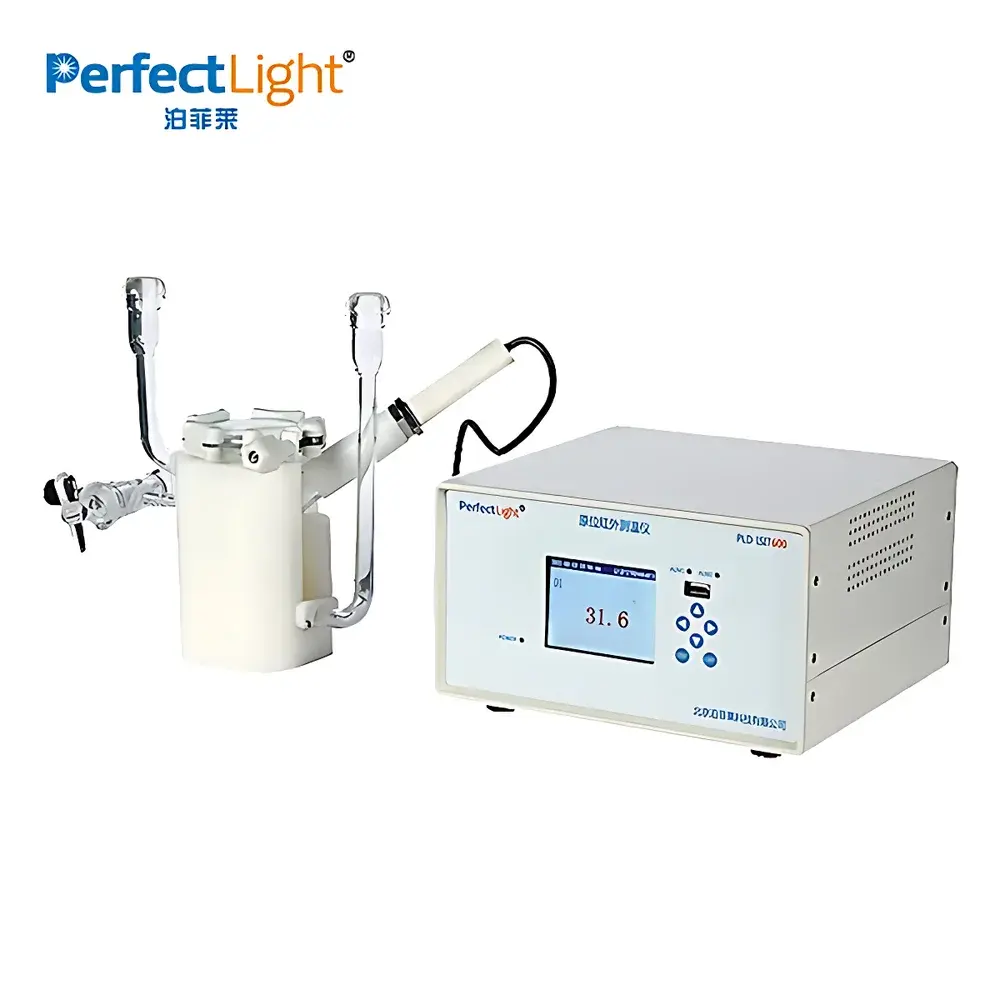
PLR OTPR-I Online Thermometric Gas-Solid Phase Photocatalytic Reactor
| Brand | PerfectLight |
|---|---|
| Origin | Beijing, China |
| Model | PLR OTPR-I |
| Type | In-situ thermometric, gas-permeating photocatalytic reactor for solid-phase catalysts |
| Compatibility | Designed for integration with Labsolar-6A all-glass automated micro-gas analysis system (OTPR-1 variant) or continuous-flow photo(thermal)catalytic setups (OTPR-2 variant) |
| Thermal Management | Integrated thermostatic jacket + non-contact IR temperature monitoring port |
| Gas Flow Mode | Forced-through (transmissive) configuration |
| Sample Forms | Powder, porous thin films, and low-thickness monolithic catalysts |
| Primary Function | Real-time surface temperature measurement during irradiation-driven gas-solid reactions |
| Compliance Context | Engineered for GLP-aligned photocatalysis research |
Overview
The PLR OTPR-I Online Thermometric Gas-Solid Phase Photocatalytic Reactor is a purpose-engineered reaction vessel designed for quantitative, in-situ thermal and kinetic investigation of heterogeneous photocatalytic and photo-thermal catalytic processes under controlled irradiation. Operating on the principle of forced gas permeation—where reactant gases are actively driven through the catalyst bed rather than relying on passive diffusion—the reactor ensures uniform gas–catalyst contact, minimizes boundary layer resistance, and enhances mass transfer efficiency critical for accurate rate determination. Its core innovation lies in integrated non-contact infrared thermometry: a dedicated optical port enables real-time, surface-localized temperature acquisition directly from the irradiated catalyst layer, decoupling photonic heating effects from bulk thermal drift. This capability is essential for distinguishing photon-driven activation from purely thermal contributions—a key requirement in mechanistic studies of CO₂ reduction, VOC degradation, NOₓ abatement, and other gas-phase photocatalytic transformations. The reactor is structurally optimized for low thermal dissipation via a dual-wall thermostatic jacket and high-emissivity internal surfaces, ensuring stable thermal baselines during prolonged UV–vis irradiation.
Key Features
- Forced-through gas flow architecture: Enables reproducible, pressure-controlled gas delivery across catalyst beds—compatible with both static batch (via Labsolar-6A coupling) and dynamic continuous-flow configurations.
- In-situ infrared thermometry interface: Standardized 8–14 µm spectral window aligned with industrial-grade IR pyrometers (e.g., Optris CT series), supporting sub-second temporal resolution and ±1.5 °C accuracy under typical lab irradiance (≥300 mW/cm²).
- Modular sample accommodation: Accepts powdered catalysts (loaded in quartz fritted discs), freestanding porous thin films (≤500 µm thickness), and monolithic substrates (e.g., cordierite honeycombs, SiC foams) up to Ø25 mm × 5 mm.
- Thermal isolation design: Double-jacketed borosilicate glass body with circulating coolant (15–35 °C range), reducing axial heat loss by >70% versus conventional open-cell reactors.
- Optical compatibility: Front-face quartz window (≥200 nm transmission) permits collimated or focused irradiation from Xe lamps, LED arrays, or solar simulators without spectral truncation.
- Gas-tight construction: All-metal-sealed flanges (CF-35 compatible) and Kalrez® O-rings ensure leak rates <1×10⁻⁹ mbar·L/s, validated per ISO 15848-1 for trace gas analytics.
Sample Compatibility & Compliance
The PLR OTPR-I accommodates heterogeneous catalysts in three physical formats without requiring binder addition or pelletization—preserving intrinsic surface area and active site accessibility. Its geometry and flow dynamics conform to ISO 22197-1 Annex B (gas-phase photocatalytic oxidation testing) and ASTM E2937-22 Section 6.2 (in-situ thermal mapping of irradiated catalysts). When coupled with Labsolar-6A, the integrated system satisfies USP analytical instrument qualification (AIQ) requirements for gas chromatographic detection of µL-level H₂, CH₄, CO, and O₂ evolution. Full documentation packages—including DQ/IQ/OQ protocols, material traceability certificates (ASTM E2917), and calibration records for IR sensor alignment—are available upon request for GMP-aligned laboratories.
Software & Data Management
While the PLR OTPR-I itself is hardware-only, its thermal and gas sampling interfaces are natively compatible with third-party data acquisition systems (e.g., LabVIEW™, MATLAB® Data Acquisition Toolbox, or Keysight PathWave). Temperature time-series from IR sensors can be synchronized with GC/FID/TCD output signals at 10 Hz sampling via TTL-triggered acquisition. Audit trails—including timestamped setpoints, ambient conditions, lamp intensity logs, and operator IDs—are maintained when used within 21 CFR Part 11-compliant LIMS environments (e.g., Thermo Fisher SampleManager, LabVantage). Raw thermal profiles export in CSV/ASCII format for post-hoc Arrhenius analysis or machine-learning–based thermal–kinetic correlation modeling.
Applications
- Quantitative photothermal efficiency mapping in plasmonic catalysts (e.g., Au/TiO₂, Cu₂O/CuO) under simulated AM1.5G illumination.
- Kinetic discrimination between photon-induced charge separation and lattice heating effects in CO₂ hydrogenation over Ni/g-C₃N₄.
- In-situ validation of transient temperature gradients during pulsed-laser photocatalysis (ns–ms timescales).
- Long-term stability assessment of MOF-based adsorbent–catalyst hybrids under cyclic humidified NO oxidation.
- Interlaboratory benchmarking of quantum yield measurements per ISO 25855:2022 (photocatalytic H₂ production).
FAQ
Is the PLR OTPR-I compatible with vacuum operation?
Yes—rated for operation from 1×10⁻³ mbar to 5 bar absolute pressure, with optional vacuum-compatible feedthroughs for electrical or optical access.
Can I use standard K-type thermocouples instead of IR sensing?
No—the reactor’s design intentionally excludes embedded thermocouples to prevent optical shadowing, thermal conduction artifacts, and catalytic site poisoning; IR measurement is mandatory for surface-specific thermal fidelity.
What gas flow rates are supported in forced-through mode?
Validated range: 1–500 mL/min (N₂-equivalent) at ≤2 bar backpressure; linear velocity across catalyst bed remains <0.15 m/s to avoid particle fluidization.
Does the thermostatic jacket support heating as well as cooling?
The standard jacket accepts only coolant circulation; for active heating, external PID-controlled hot-air manifolds or resistive tape wraps are recommended per ISO 17025 calibration guidelines.
How is catalyst loading quantified for reproducible comparison?
Each unit includes a calibrated quartz sample holder with engraved volume markings (±0.02 mL tolerance) and gravimetric loading protocol compliant with ASTM D7263-20 Section 7.3.



