
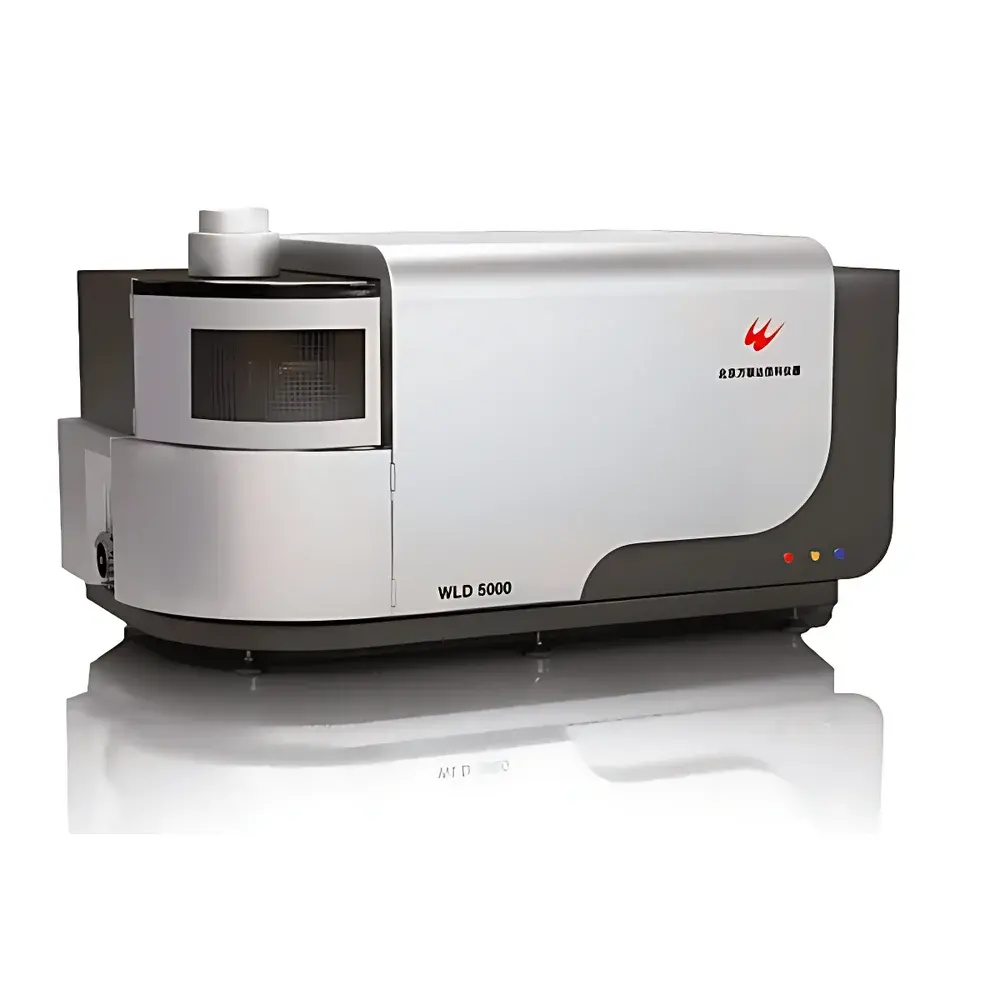
Wanlianda WLD-5000 Sequential Scanning Inductively Coupled Plasma Optical Emission Spectrometer
| Brand | Wanlianda |
|---|---|
| Origin | Beijing, China |
| Manufacturer Type | Authorized Distributor |
| Regional Classification | Domestic (China) |
| Model | WLD-5000 |
| Instrument Type | Sequential Scanning ICP-OES |
| Detection Limits | Zn 213.856 nm ≤ 0.003 µg/L, Mn 257.610 nm ≤ 0.002 µg/L |
| Precision (RSD) | ≤1.5% |
| Stability (RSD) | ≤2.0% |
| Wavelength Range | 190–500 nm (3600 lines/mm grating) or 190–800 nm (2400 lines/mm grating) |
| Optical Resolution | ≤0.008 nm (3600 L/mm), ≤0.015 nm (2400 L/mm) |
Overview
The Wanlianda WLD-5000 is a sequential scanning inductively coupled plasma optical emission spectrometer (ICP-OES) engineered for high-precision elemental analysis of liquid samples—including those derived from solid matrices via acid digestion or fusion. Operating on the principle of atomic emission spectroscopy, the instrument introduces nebulized sample aerosols into a high-temperature argon plasma (~6,000–10,000 K), where elements undergo desolvation, atomization, excitation, and subsequent emission of characteristic wavelengths. These emissions are dispersed via high-efficiency diffraction gratings and detected by a photomultiplier tube (PMT) system. The sequential scanning architecture enables selective, high-sensitivity measurement of target elements without simultaneous detector array constraints—ideal for laboratories prioritizing method flexibility, cost-effective operation, and regulatory traceability in environmental, geological, metallurgical, and quality control applications.
Key Features
- Self-tuned all-solid-state RF generator with continuously adjustable power (700–1500 W) and automatic impedance matching—enabling reliable, reproducible plasma ignition and stable operation across diverse matrix types.
- Dual-grating optical system offering selectable resolution and spectral coverage: 3600 lines/mm grating (190–500 nm, resolution ≤0.008 nm) for ultra-trace analysis; 2400 lines/mm grating (190–800 nm, resolution ≤0.015 nm) for extended element coverage including P, B, Si, Se, and Te.
- High-stability pneumatic gas control system with precision mass flow controllers (MFCs) for argon plasma, auxiliary, and nebulizer gas streams—ensuring consistent plasma conditions and minimizing signal drift.
- Modular sample introduction platform compatible with multiple international雾化器 designs (e.g., concentric glass, high-salt, HF-resistant quartz), refrigerated spray chambers, and peristaltic pump-driven waste management to maintain constant aspiration rate and minimize memory effects.
- Robust mechanical design with temperature-stabilized optical bench and vibration-damped mounting—contributing to long-term wavelength calibration stability and measurement repeatability (RSD ≤1.5% over 10 replicates).
Sample Compatibility & Compliance
The WLD-5000 supports aqueous solutions, digested environmental solids (EPA Method 200.7/6020B), leachates (TCLP), geological samples (ASTM D5682), and industrial process streams. It accommodates high-TDS, high-acid, and fluoride-containing matrices when paired with appropriate nebulizers and sample preparation protocols. While not pre-certified to ISO/IEC 17025 or FDA 21 CFR Part 11 out-of-the-box, the instrument’s hardware architecture—including audit-trail-capable software logging, user-access controls, and electronic signature support—enables full compliance readiness for GLP and GMP environments when implemented with documented SOPs and validation protocols (e.g., IQ/OQ/PQ). Calibration verification standards (e.g., NIST SRM 3100 series) and continuing calibration checks align with ASTM D1976 and ISO 11885 requirements.
Software & Data Management
Controlled via Windows-based analytical software with bilingual UI (English/Chinese), the system provides fully automated qualitative identification, quantitative calibration (linear/non-linear), internal standard correction, inter-element correction (IEC), and background subtraction. All acquisition parameters—including integration time, dwell time, number of readings, and replicate count—are programmable per element. Raw spectral data, calibration curves, QC reports (spike recovery, blanks, duplicates), and instrument performance logs are stored in a relational database with timestamped metadata. Export formats include PDF (for audit-ready reports), Excel (.xlsx), and Word (.docx), supporting seamless integration into LIMS environments. Data integrity safeguards include user-level permissions, electronic signatures, and immutable audit trails meeting ALCOA+ principles.
Applications
- Environmental testing: Quantification of regulated metals (As, Cd, Cr, Pb, Hg, Ni, Zn) in drinking water (EPA 200.7), wastewater, soils, and sediments.
- Geochemical exploration: Multi-element analysis of rock, ore, and mineral digestates at sub-ppb levels for rare earth elements (REEs) and transition metals.
- Metallurgical QC: Rapid determination of alloying elements (Al, Cu, Mg, Si, Fe, Mn, Ti) and impurities in aluminum, steel, and superalloys.
- Pharmaceutical excipients: Trace metal screening per USP / guidelines for catalyst residues (Pd, Pt, Ni) and elemental impurities.
- Food safety: Monitoring toxic elements (Cd, Pb, As) in agricultural commodities and infant formula according to EU Commission Regulation (EU) No 2023/915.
FAQ
What sample types are compatible with the WLD-5000?
Aqueous solutions, acid-digested solids (HNO₃/HF/HCl mixtures), and leachates prepared per EPA or ISO methods. Solid sampling requires prior dissolution or fusion.
Is the instrument compliant with 21 CFR Part 11?
The software architecture supports Part 11 compliance when configured with role-based access, electronic signatures, and audit-trail activation—but formal validation must be performed by the end user per organizational SOPs.
Can the WLD-5000 analyze non-metals such as phosphorus or boron?
Yes—using the 2400 lines/mm grating configuration, it quantifies P (178.222 nm), B (249.773 nm), Si (251.611 nm), Se (196.026 nm), and Te (214.281 nm) with detection limits in the low-ppb range.
How does sequential scanning compare to simultaneous ICP-OES in terms of throughput?
Sequential scanning achieves 5–8 elements per minute, with up to 20 elements/min under optimized dwell-time settings—making it highly efficient for targeted multi-element panels, though less suited for untargeted full-spectrum surveys.
What maintenance is required for long-term optical stability?
Annual wavelength calibration verification using Hg/Ar/Ne line sources, quarterly cleaning of torch and injector, and biannual PM of RF generator cooling and gas filters are recommended per manufacturer guidelines.






