
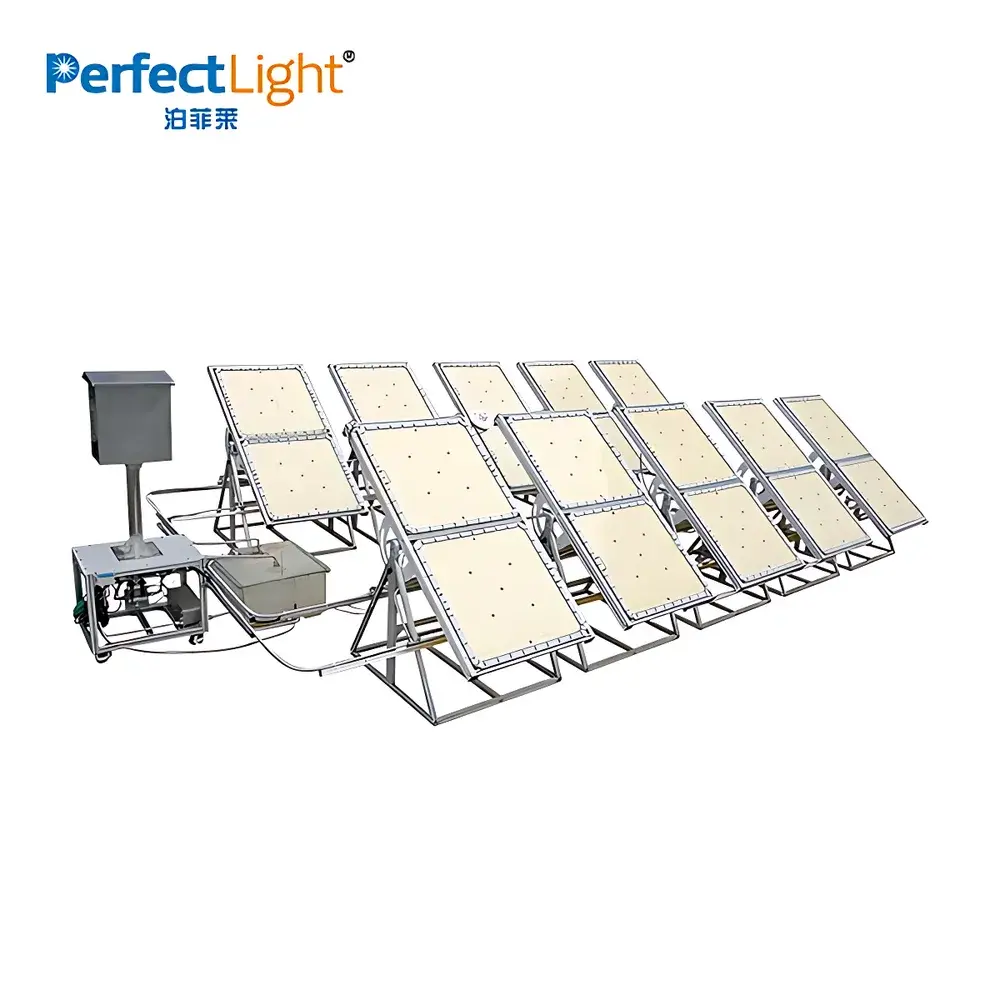
PerfectLight PLR-SPRG Industrial-Scale Planar Photoreactor System
| Brand | PerfectLight |
|---|---|
| Origin | Beijing, China |
| Model | PLR-SPRG |
| Reactor Type | Planar Flow-Through Photoreactor |
| Construction Material | Stainless Steel (316L) |
| Effective Illuminated Area per Unit | 0.5 m² |
| Scalable Array Size | Up to 100 m² (modular configuration) |
| Liquid Layer Thickness | 1–5 mm |
| Reactor Tilt Angle Adjustment | 0–90° continuous |
| Liquid Flow Rate | 0–200 mL/min |
| Carrier Gas Flow Rate | 4–100 mL/min |
| Operating Temperature Range | Ambient to 60 °C |
| Maximum Operating Pressure | ≤50 kPa (gauge) |
| Gas Recirculation Pump Capacity | 10–50 L/min |
| Wetted Materials | PA66, PMMA, PP, Fluoroelastomer |
| Control System | Integrated PLC with HMI touchscreen interface |
| Monitoring Parameters | Flow rate, pressure, pH, ORP, temperature, gas evolution volume |
Overview
The PerfectLight PLR-SPRG Industrial-Scale Planar Photoreactor System is an engineered solution for translational photochemical process development—from laboratory screening to pilot-scale and pre-commercial production. Unlike conventional batch photoreactors, the PLR-SPRG employs a planar, continuous-flow architecture based on modular illumination units, each providing 0.5 m² of uniform, high-intensity irradiated surface area. This design directly addresses the critical challenge of photoreactor scale-up: the non-linear interplay between photon flux distribution, mass transfer kinetics, catalyst–substrate contact efficiency, and gas–liquid phase separation dynamics. Rooted in fundamental principles of heterogeneous photocatalysis and fluidic photoreactor engineering, the system enables reproducible, spatially resolved irradiation under controlled hydrodynamic conditions—essential for validating reaction kinetics, quantum yield determination, and long-duration stability testing under industrially relevant throughput.
Key Features
- Modular planar reactor units with standardized mechanical and fluidic interfaces—enabling flexible series or parallel configurations to achieve total illuminated areas from 0.5 m² up to 100 m² (currently deployed at 10 m² in field installations).
- Interchangeable substrate supports accommodating diverse catalyst immobilization platforms—including non-woven carbon fiber cloth, carbon paper, borosilicate glass, PMMA, and fluoropolymer-coated surfaces—ensuring compatibility with metal oxide, covalent organic framework (COF), and single-atom photocatalysts.
- Integrated manual sampling valve compatible with direct coupling to GC/TCD/FID systems for real-time gaseous product analysis; optional integration with gas bags, Tedlar® sampling bags, or online mass spectrometry interfaces.
- Controlled laminar liquid flow across the illuminated catalyst surface (0–200 mL/min), promoting uniform reactant replenishment, minimizing concentration polarization, and facilitating continuous removal of gaseous products (e.g., H₂, O₂, CO, CH₄) via concurrent liquid transport.
- Dedicated gas–liquid phase separator with adjustable residence time and coalescence geometry—enabling quantitative collection, volumetric measurement, and downstream compositional analysis of evolved gases independent of liquid effluent.
- PLC-based control architecture with industrial-grade HMI touchscreen interface supporting programmable logic sequences, alarm thresholds, data logging (CSV/Excel export), and audit-trail-capable operation history—designed for compliance with GLP and preliminary GMP documentation requirements.
Sample Compatibility & Compliance
The PLR-SPRG accommodates aqueous, organic, and biphasic reaction media across pH 2–12 and temperatures up to 60 °C. All wetted components are constructed from chemically resistant polymers (PA66, PMMA, PP) and fluoroelastomers—validated for compatibility with common photocatalytic solvents (e.g., water, methanol, acetonitrile, isopropanol) and reactive intermediates (e.g., •OH, O₂•⁻, h⁺). The stainless steel structural frame (AISI 316L) meets ASTM A240 standards for corrosion resistance in humid, oxidative environments. While not certified to IEC 61000-6-2/4 or UL 61010-1 out-of-the-box, the system is designed to support third-party electrical safety and EMC validation for regional deployment. Its modular architecture facilitates adaptation to ISO 17025-compliant calibration protocols for flow, pressure, and temperature sensors.
Software & Data Management
The integrated PLC controller logs timestamped values for all monitored parameters—including liquid flow rate, system pressure, solution pH, oxidation–reduction potential (ORP), inlet/outlet temperatures, and cumulative gas volume—at user-configurable intervals (1 s to 10 min resolution). Data is stored locally on an industrial SD card and exportable via USB or Ethernet (Modbus TCP). The HMI interface supports multi-step recipe programming, alarm event tagging, and real-time trend visualization. For regulated environments, optional software add-ons provide 21 CFR Part 11–compliant electronic signatures, user access levels (admin/operator/auditor), and immutable audit trails—meeting foundational requirements for process validation and regulatory submission dossiers.
Applications
- Photocatalytic hydrogen evolution (HER) and CO₂ reduction under simulated solar illumination (AM 1.5G) or monochromatic LED arrays.
- Advanced oxidation processes (AOPs) for wastewater treatment: degradation of pharmaceuticals, endocrine disruptors, and perfluoroalkyl substances (PFAS).
- Photoelectrochemical (PEC) material screening—paired with potentiostats for in situ incident photon-to-current efficiency (IPCE) mapping.
- Scale-down validation of pilot plant photoreactor performance using geometrically similar modules.
- Long-term photocatalyst stability assessment (>500 h) under continuous flow and intermittent irradiation cycles.
- Reaction engineering studies on light penetration depth, photon utilization efficiency, and mass transfer limitations in thin-film photocatalytic systems.
FAQ
What is the maximum scalable illuminated area achievable with the PLR-SPRG system?
Up to 100 m² using standardized modular units—currently validated at 10 m² in operational installations at CNPC Research Institute and Dalian Institute of Chemical Physics.
Can the system operate under pressurized conditions?
Yes—rated for continuous operation up to 50 kPa(g) absolute pressure; higher-pressure variants require custom engineering and ASME Section VIII consultation.
Is remote monitoring supported?
Standard Ethernet (Modbus TCP) enables integration into existing SCADA or LabVIEW environments; cloud-based telemetry requires optional gateway hardware and TLS-secured MQTT configuration.
How is catalyst fouling mitigated during extended operation?
Through precisely controlled laminar flow profiles, periodic backflush routines (programmable via PLC), and optional ultrasonic transducer integration on substrate carriers.
Does the system comply with FDA or EMA regulatory frameworks?
The base configuration supports GLP-aligned operation; full 21 CFR Part 11 or Annex 11 compliance requires documented IQ/OQ/PQ protocols and optional software validation packages.
Related Products



