
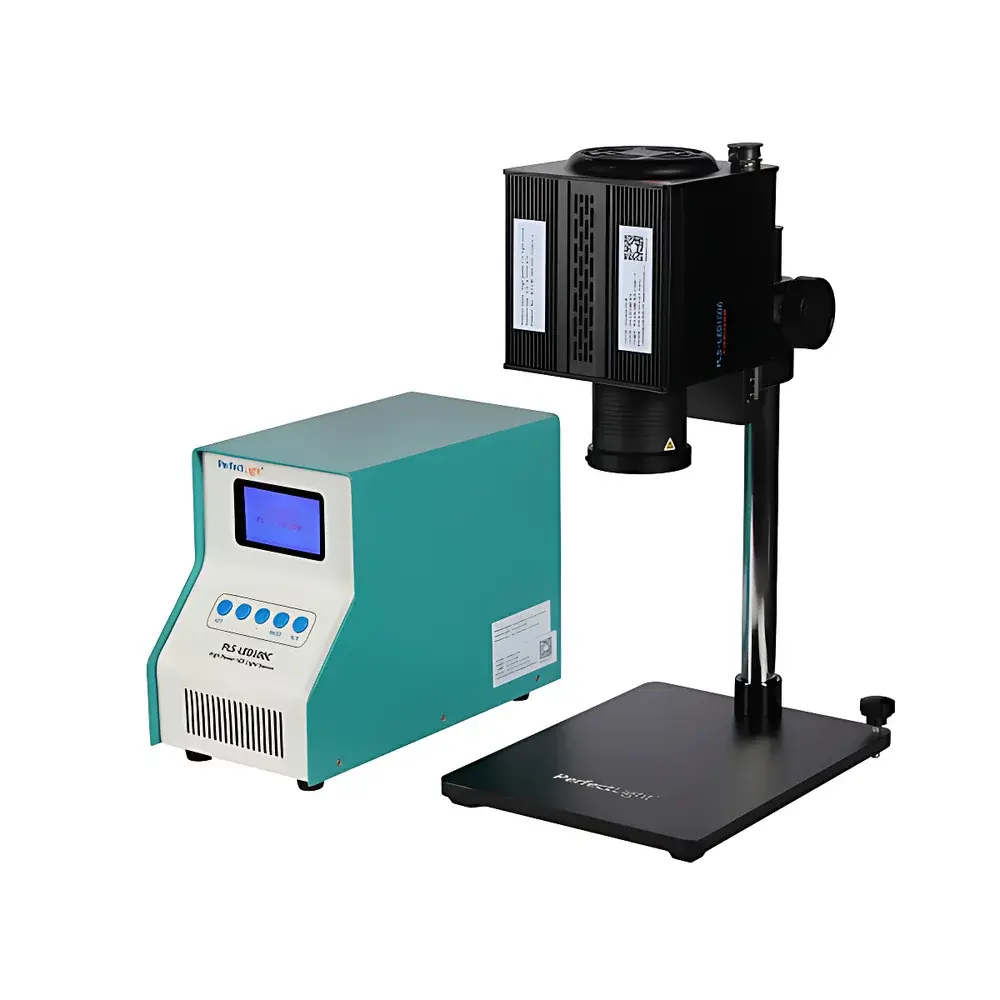
PLS-LED 100C High-Power Modular LED Light Source
| Brand | PerfectLight (PoPhilae) |
|---|---|
| Origin | Beijing, China |
| Model | PLS-LED 100C |
| Light Source Type | High-Intensity Monochromatic/Polychromatic LED Array |
| Illumination Mode | External Irradiation |
| Spectral Output | Narrowband (FWHM 15–20 nm), Center Wavelength Tolerance ±10 nm |
| Output Aperture | Φ38 mm (expandable via collimating or diffusing extension tubes) |
| Adjustable Collimated Spot Size | Φ50–60 mm (near-collimated, focus-tunable) |
| Wavelength Options | 365–940 nm (discrete monochromatic), Warm/Natural/Cool White (3000–>7000 K), Custom Multi-Spectral Arrays (e.g., 660 nm:460 nm = 9:1 to 1:9, Pink Broadband 380–840 nm, Hexa-/Hepta-LED) |
| LED Lifetime | >10,000 h |
| Output Stability | ≤±1% short-term fluctuation (measured over 1 h, ambient temp 25°C) |
| Control Interface | Digital microcontroller-based power management with continuous/pulsed/stepwise irradiation modes |
| Safety Features | Fan-failure auto-shutdown, over-current/over-load protection, 360° rotatable lamp housing, height-adjustable precision optical mount |
| Optional Accessory | PLS-LED ZM articulated beam steering head |
Overview
The PLS-LED 100C is a high-power, modular LED light source engineered for quantitative photochemical and photophysical experimentation in controlled laboratory environments. Unlike broadband arc lamps (e.g., Xe or Hg), it delivers spectrally narrow, stable, and reproducible irradiance across discrete UV–NIR wavelengths—enabling rigorous wavelength-dependent studies without spectral contamination or thermal load artifacts. Its core architecture employs a high-density surface-mount LED array coupled with active thermal regulation and digitally stabilized constant-current drivers. This design eliminates filament degradation, warm-up drift, and ozone generation associated with traditional discharge sources—making it ideal for long-duration kinetic measurements, quantum yield determination, and standardized photocatalytic testing per ISO 22197-1 (NO removal), ISO 22197-2 (acetaldehyde), and ASTM E2933 (photocatalytic water splitting). The system operates on the principle of electroluminescence from semiconductor junctions, ensuring photon flux linearity with drive current and sub-second temporal response for pulsed irradiation protocols.
Key Features
- Modular optical platform: Interchangeable LED lamp modules—including monochromatic (365–940 nm), white-light (3000–>7000 K CCT), and custom multi-spectral configurations—mount into a single universal power chassis.
- Precise irradiation control: Three operational modes—continuous DC, programmable pulse (1 ms–10 s width, 1 Hz–1 kHz repetition), and stepwise intensity ramping—support transient absorption, action spectrum mapping, and dose-controlled degradation kinetics.
- Optical flexibility: Standard Φ38 mm output port accepts optional collimating or diffusing extension tubes; collimated mode yields near-parallel beams (Φ50–60 mm at target plane, divergence adjustable via focal tuning); diffused mode enables uniform large-area illumination with controlled angular spread.
- Digital stability architecture: Embedded microcontroller monitors junction temperature, forward voltage, and cooling fan RPM in real time; maintains irradiance stability ≤±1% (RMS, 1 h) through closed-loop current compensation.
- Integrated safety systems: Dual-stage thermal protection (junction + heatsink), fan-failure interlock, over-current cutoff, and 360° rotational lamp housing with lockable positioning ensure operator safety and experimental repeatability.
Sample Compatibility & Compliance
The PLS-LED 100C is compatible with standard photochemical reactors (e.g., top-irradiated quartz cells, gas-phase flow cells, thin-film PEC electrodes, and immobilized catalyst coatings on conductive substrates). Its external irradiation geometry permits integration with in situ spectroelectrochemical cells, FTIR gas cells, and online GC/MS sampling manifolds. The system meets mechanical and electrical safety requirements per IEC 61010-1 (Laboratory Equipment) and supports GLP-compliant documentation when paired with calibrated reference photodiodes traceable to NIST SRM 2252. While not intrinsically rated for Class I Division 1 hazardous locations, its low surface temperature (<60°C under continuous operation) and absence of UV-C emission (no ozone-generating wavelengths <200 nm) facilitate use in standard fume hoods and gloveboxes. For regulatory submissions, irradiance profiles can be validated using ISO/IEC 17025-accredited spectroradiometers.
Software & Data Management
The PLS-LED 100C operates via front-panel tactile controls and optional RS-485/USB interface for host PC integration. No proprietary software is required for basic operation; however, ASCII-command protocol enables scripting in Python, LabVIEW, or MATLAB for synchronized triggering with detectors (e.g., lock-in amplifiers, CCD spectrometers) or potentiostats. All operational parameters—including setpoint intensity, mode selection, pulse timing, and thermal status—are logged internally with timestamping (non-volatile memory, 10,000-event buffer). Audit trails comply with FDA 21 CFR Part 11 requirements when exported as CSV files with digital signature support via third-party LIMS platforms. Firmware updates are delivered via secure HTTPS endpoint and verified via SHA-256 checksum.
Applications
- Quantitative photocatalysis: Action spectrum analysis, apparent quantum yield (AQY) measurement at defined λ, and comparative activity screening of TiO₂, g-C₃N₄, MOFs, and perovskite photocatalysts under monochromatic excitation.
- Photoelectrochemical (PEC) characterization: Bias-assisted charge separation studies on WO₃, BiVO₄, and Fe₂O₃ photoanodes; incident photon-to-current efficiency (IPCE) mapping.
- VOC and aqueous pollutant degradation: Kinetic modeling of formaldehyde, NOₓ, SOₓ, methylene blue, phenol, and benzene derivatives under environmentally relevant irradiance levels (10–200 mW/cm²).
- Photosynthetic research: Plant photobiology using red/blue ratio-tunable arrays; chlorophyll fluorescence induction kinetics; non-photochemical quenching (NPQ) assays.
- Advanced materials testing: Photoredox catalysis with Ir/Ru complexes, photoinduced electron transfer in organic semiconductors, and light-triggered polymerization initiation.
FAQ
What calibration standards are recommended for absolute irradiance measurement?
NIST-traceable silicon photodiodes (e.g., Hamamatsu S1337 series) or thermopile sensors (Gentec-EO UP19K-15S-H5-D0) are advised; spectral responsivity correction must be applied per selected LED center wavelength.
Can the PLS-LED 100C be synchronized with a pulsed laser system?
Yes—TTL-compatible external trigger input accepts 3.3/5 V logic signals for precise pulse-on-pulse alignment; jitter <100 ns (typ.) when driven by function generators meeting IEEE 1139 edge-rate specifications.
Is spectral bandwidth (FWHM) consistent across all monochromatic options?
FWHM ranges from 15–20 nm depending on peak wavelength and binning grade; full spectral data sheets (including normalized relative intensity vs. wavelength) are provided with each lamp module.
How is thermal management implemented during extended (>8 h) operation?
A dual-stage forced-air system combines axial fans with aluminum finned heat sinks; junction temperature is maintained <85°C via PWM-controlled fan speed regulated by real-time thermal feedback.
Does the system support automated wavelength scanning?
No—wavelength selection requires manual lamp module replacement; however, multi-LED arrays (e.g., 6-color) allow sequential activation under programmatic control without hardware change.



