
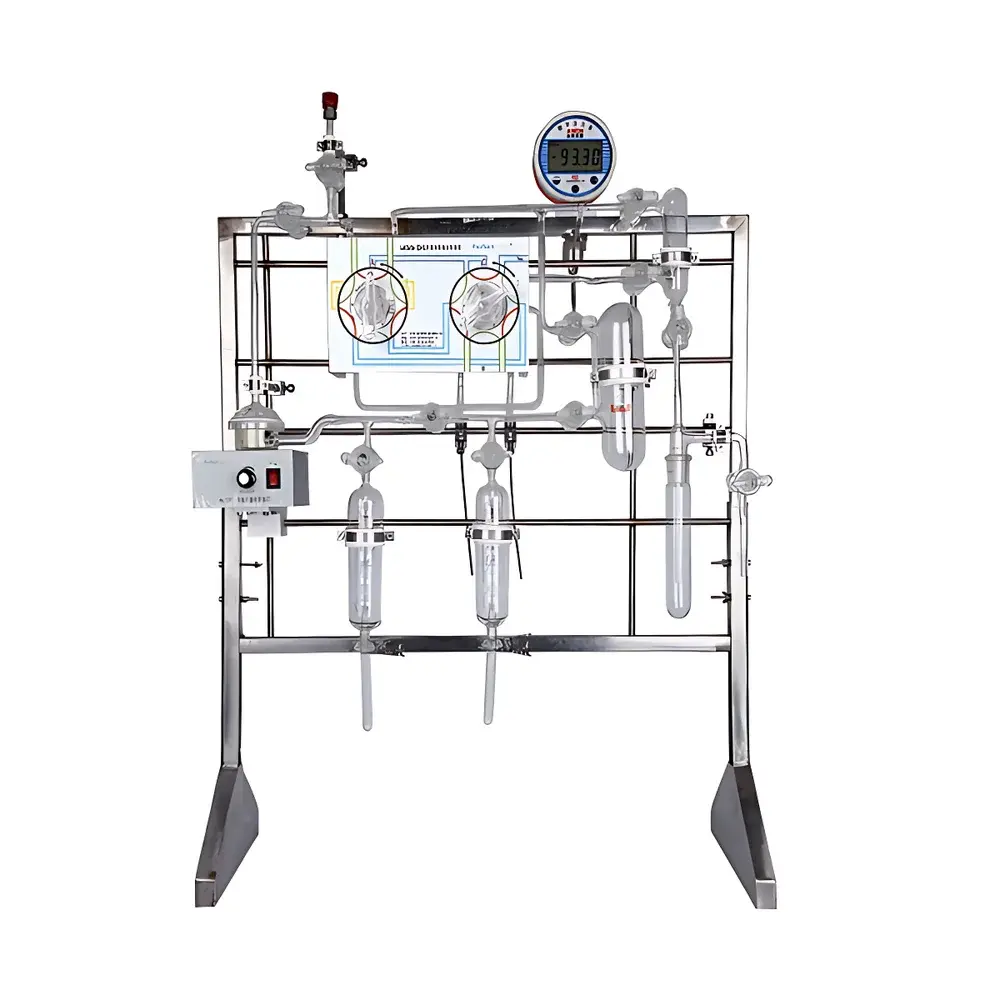
PerfectLight Labsolar-IIIAG Photocatalytic Water Splitting System
| Brand | PerfectLight |
|---|---|
| Origin | Beijing, China |
| Manufacturer Type | Authorized Distributor |
| Product Origin | Domestic (China) |
| Model | Labsolar-IIIAG |
| Pricing | Available Upon Request |
| Vacuum Level | ≤0.1 MPa (absolute) |
| Operating Pressure Range | 0 kPa to ambient pressure |
| Gas Tightness | ≤1 kPa pressure change over 24 h |
| Tubing Material | High-borosilicate glass |
| Minimum Tubing ID | 3 mm |
| Total System Volume | 150 mL |
| Sampling Loop Volume | 1.5 mL |
| Gas Storage Vessel | 250 mL |
| Condenser Type | Spherical condenser |
| Cold Trap | Integrated for low-boiling component separation |
| Vacuum Pump | Single-stage rotary vane pump, pumping speed ≥6 L/s |
| Magnetic Circulator Speed | ≥4000 rpm |
| H₂ Calibration Linearity | R² > 0.999 in range 100 μL–10 mL |
| Repeatability (RSD) | <3% for quadruplicate injections |
| Valve Count | 13 |
| Valve Material | High-borosilicate glass with precision lapped plug-and-body |
| Vacuum Grease | Dow Corning high-performance vacuum grease (–40°C to 200°C, low vapor pressure, chemical resistant) |
Overview
The PerfectLight Labsolar-IIIAG is a fully integrated, all-glass photocatalytic water splitting system engineered for quantitative gas evolution analysis in solar fuel research. It operates on the principle of closed-loop, magnetically driven gas circulation combined with online manual sampling and subsequent chromatographic quantification—enabling precise measurement of H₂, O₂, CO, CH₄, and other gaseous products from photocatalytic and photoelectrocatalytic reactions. Unlike metal-bodied systems, its monolithic high-borosilicate glass architecture eliminates surface adsorption, catalytic decomposition, or metallic ion leaching—critical for maintaining stoichiometric fidelity in H₂/O₂ evolution ratios and quantum yield determination. Designed for compatibility with both slurry-based and immobilized photocatalyst configurations, the Labsolar-IIIAG supports rigorous kinetic studies under controlled illumination (via external light sources), inert atmosphere handling, and long-duration stability testing up to 72+ hours. Its modular construction allows seamless integration with UV-Vis light sources, incident photon-to-current efficiency (IPCE) setups, and GC-TCD/FID detection platforms.
Key Features
- All-glass fluidic path constructed from high-borosilicate glass (e.g., Schott Duran® grade), ensuring chemical inertness, optical transparency, and zero metal-mediated interference in gas-phase reaction monitoring.
- Dual seven-port sampling manifold prevents carrier gas misrouting during sequential injection—eliminating cross-contamination and volumetric error in multi-point kinetic profiling.
- Passive magnetic drive circulation system (≥4000 rpm) operates without internal electrical wiring, removing ignition sources and eliminating electrochemical hydrogen generation artifacts that compromise Faradaic efficiency calculations.
- Spherical condenser and integrated cold trap jointly suppress water vapor ingress into downstream analytical instruments (e.g., GC columns, vacuum pumps), enhancing chromatographic resolution and extending pump service life.
- Thirteen precision-lapped glass valves with matched plug-and-body geometry ensure leak-tight operation (10,000 cycles.
- 150 mL total internal volume with 1.5 mL fixed-volume sampling loop enables accurate, calibration-traceable gas quantification per ASTM E2912–22 guidelines for photoreactor performance validation.
Sample Compatibility & Compliance
The Labsolar-IIIAG accommodates heterogeneous photocatalysts—including TiO₂, g-C₃N₄, MOFs, perovskites, and co-catalyst-loaded semiconductors—in aqueous suspension or immobilized on conductive substrates. It supports full water splitting (2H₂O → 2H₂ + O₂), selective H₂ evolution (with sacrificial agents), and CO₂ reduction pathways under N₂, Ar, or synthetic air atmospheres. The system conforms to ISO 10678:2021 (photocatalytic activity measurement), aligns with USP analytical instrument qualification protocols for gas evolution systems, and meets mechanical safety requirements per IEC 61010-1 for laboratory equipment. All vacuum greases comply with FDA 21 CFR 175.300 for incidental food contact, and glass components are certified free of heavy metals per RoHS Directive 2011/65/EU.
Software & Data Management
While the Labsolar-IIIAG is hardware-centric and does not include embedded firmware or proprietary control software, it is fully compatible with third-party data acquisition platforms including LabVIEW™, MATLAB® Data Acquisition Toolbox, and Chromeleon™ CDS. Manual sampling events are timestamped and logged alongside GC integration signals, enabling traceable correlation between reaction time, light intensity (measured via calibrated photodiode), and evolved gas volume. Audit trails for calibration standards, valve actuation logs, and vacuum integrity checks can be maintained in accordance with GLP-compliant documentation practices. The absence of onboard electronics simplifies 21 CFR Part 11 compliance when paired with validated chromatographic data systems.
Applications
- Quantitative H₂ and O₂ evolution kinetics in powder-based photocatalytic water splitting under simulated solar irradiation.
- Photoelectrocatalytic (PEC) half-reaction analysis using three-electrode cells coupled to the gas circulation manifold.
- Apparent quantum yield (AQY) determination at discrete wavelengths (e.g., 365 nm, 420 nm) per ISO 25922:2015 Annex B protocols.
- CO₂ photoreduction product distribution analysis (CO, CH₄, C₂H₆, H₂) under controlled partial pressures.
- Long-term photocatalyst stability assessment via 48–120 h continuous gas evolution monitoring.
- In situ mechanistic studies requiring strict exclusion of atmospheric O₂ or moisture via repeated evacuation-refill cycles.
FAQ
Is the Labsolar-IIIAG compatible with gas chromatographs from Agilent, Shimadzu, and Thermo Fisher?
Yes—the system’s 1/8″ Swagelok-compatible glass fittings and standardized 1.5 mL sampling loop interface directly with all major GC inlet configurations using standard PTFE ferrules and graphite compression rings.
Can the reactor chamber be customized for specialized illumination geometries?
Yes—PerfectLight offers OEM engineering support for custom quartz reactor windows, collimated beam ports, and fiber-optic coupling sleeves to accommodate focused LED arrays or monochromatic light sources.
Does the system support automated sampling?
No—sampling is manually executed via the high-borosilicate glass multiport valve; however, the design permits retrofitting with pneumatic actuators and solenoid-controlled valves under user-developed PLC logic.
What maintenance intervals are recommended for the vacuum pump and cold trap?
The rotary vane pump requires oil replacement every 500 operating hours; the cold trap should be emptied and cleaned after each 10-cycle sequence involving high-humidity reactants.
How is system vacuum integrity verified prior to experimentation?
A two-step protocol is advised: (1) evacuate to ≤0.1 MPa absolute and monitor pressure drift for 30 min; (2) perform helium leak check using a residual gas analyzer (RGA) at critical valve junctions and flange interfaces.



