
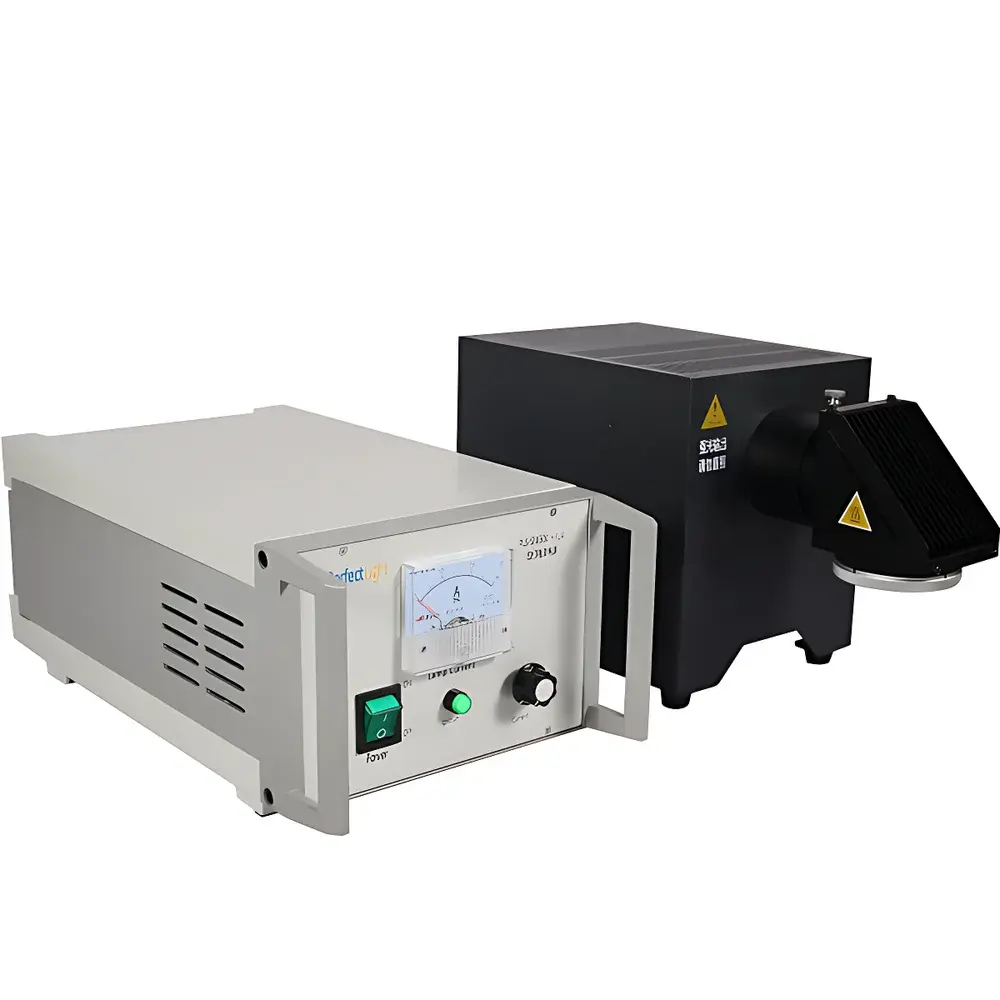
PLS-SXE300/300UV Xenon Light Source
| Brand | PerfectLight |
|---|---|
| Origin | Beijing, China |
| Light Source Type | Xenon Arc Lamp |
| Output Power Range | 150–300 W |
| Rated Lamp Power | 300 W |
| Total Optical Output Power | 50 W |
| Spectral Range | 320–780 nm (extendable to 2500 nm) |
| Beam Divergence | ~6° (full angle) |
| Spot Diameter | 30–60 mm (at working distance) |
| Long-Term Irradiance Stability | ≤ ±3% |
| Lamp Lifetime | >1000 h (under standard photocatalytic operating conditions) |
| Trigger Method | Integrated High-Voltage Ignition (dual-stage, no high-voltage cabling) |
| Max Current Limit | 21 A |
| Cooling | Passive heatsink-based thermal management |
| Illumination Mode | External (top-down or side-illumination compatible) |
| Safety Design | Low-voltage lamp-to-power-supply interconnect, EMI-shielded metal housing |
| Control Interface | Microprocessor-based digital power management with programmable mode |
Overview
The PLS-SXE300/300UV Xenon Light Source is a robust, digitally controlled broadband illumination system engineered for reproducible and stable irradiation in photochemical and photophysical research laboratories. Based on a 300 W short-arc xenon lamp, it delivers high-intensity continuous spectrum output spanning the UV-Vis-NIR region (320–780 nm), with spectral extension capability up to 2500 nm via optional optical components. Its design follows the fundamental principles of arc discharge physics and radiometric calibration standards for laboratory-grade light sources—ensuring uniform spatial irradiance distribution and temporal stability essential for quantitative photocatalysis, photoelectrochemistry, and time-resolved optical studies. Unlike pulsed or LED-based alternatives, this source provides true broadband continuum emission, enabling wavelength-selective experiments when paired with certified interference or cut-off filters.
Key Features
- Digitally regulated power supply with microprocessor-based control architecture, supporting programmable intensity ramping and preset operational modes.
- Passive thermal management system featuring oversized aluminum heatsinks, enabling uninterrupted operation at rated power for extended durations (>8 h) without active cooling.
- Integrated dual-stage ignition circuitry eliminates high-voltage transmission through interconnecting cables—reducing electromagnetic noise and improving operator safety.
- EMI-shielded stainless-steel lamp housing ensures compatibility with sensitive electrochemical instrumentation and low-noise detection systems.
- Optical output characterized by narrow beam divergence (~6° full angle) and consistent spot geometry (30–60 mm diameter depending on working distance), facilitating precise sample targeting in custom reactor setups.
- Lamp lifetime exceeds 1000 hours under typical photocatalytic irradiance conditions (e.g., 1 sun-equivalent irradiance at 10 cm distance), verified through accelerated aging tests per IEC 62471 Annex D protocols.
Sample Compatibility & Compliance
The PLS-SXE300/300UV is compatible with standard quartz-glass photoreactors (e.g., Pyrex-free configurations for UV transmission), gas-phase flow cells, liquid-phase immersion cuvettes, and thin-film electrode assemblies. It supports ASTM E2584-21 (Standard Practice for Determining Photocatalytic Activity of Materials) and ISO 22197-1:2021 (Photocatalytic Air Purification – Part 1: Measurement of Removal Efficiency of Nitrogen Oxides) test methodologies when configured with calibrated reference detectors and spectral filters. The system complies with IEC 61000-6-3 (EMC emission limits) and IEC 61000-6-2 (immunity requirements), and its low-voltage interconnect architecture meets IEC 61010-1:2012 safety criteria for laboratory electrical equipment.
Software & Data Management
The unit operates in standalone mode or integrates with third-party LabVIEW, Python (PyVISA), or MATLAB environments via RS-232 or USB-to-serial interface. Firmware supports timestamped logging of lamp current, voltage, runtime, and thermal status—enabling traceability for GLP-compliant experimental records. While no proprietary GUI is bundled, the communication protocol is fully documented and supports remote start/stop, power setpoint adjustment (150–300 W), and fault-code reporting (e.g., overtemperature, arc instability). Audit trails can be exported in CSV format for inclusion in FDA 21 CFR Part 11–aligned data repositories when deployed in regulated R&D settings.
Applications
- Photocatalytic water splitting (H₂/O₂ evolution) and overall water decomposition using TiO₂, g-C₃N₄, or MOF-based catalysts.
- CO₂ photoreduction to CH₄, CO, or C₂H₄ under simulated solar irradiance.
- Gas-phase degradation of VOCs (formaldehyde, toluene, NOₓ, SOₓ) in annular or packed-bed reactors.
- Aqueous-phase pollutant abatement (methylene blue, rhodamine B, phenol) under controlled photon flux.
- Photoelectrochemical cell (PEC) characterization including IPCE measurement and transient photocurrent analysis.
- Spectral responsivity calibration of photodetectors and quantum yield determination (Φ) using actinometry (e.g., potassium ferrioxalate).
FAQ
What spectral filters are compatible with this source?
Standard filter sets include UG11 (UV-pass), BG40 (visible-pass), and RG850 (NIR-pass); narrowband interference filters (10 nm FWHM) from 250 nm to 1100 nm are mechanically mountable via front-threaded adapter.
Can the output intensity be modulated during operation?
Yes—power is continuously adjustable between 150 W and 300 W via digital setpoint; intensity modulation is linear within ±1.5% of set value across the range.
Is the lamp replaceable by the end user?
Yes—the xenon lamp module is field-replaceable using standard Torx tools; alignment fixtures ensure repeatable optical coupling without realignment tools.
Does the system support automated shutter control?
No built-in shutter is included, but TTL-compatible external shutters (e.g., Thorlabs SH1) can be triggered via auxiliary I/O port.
What is the recommended minimum working distance for uniform irradiance?
For ±5% spatial uniformity across the central 80% of the beam profile, the optimal working distance is 150–200 mm—verified using NIST-traceable thermopile mapping.



