
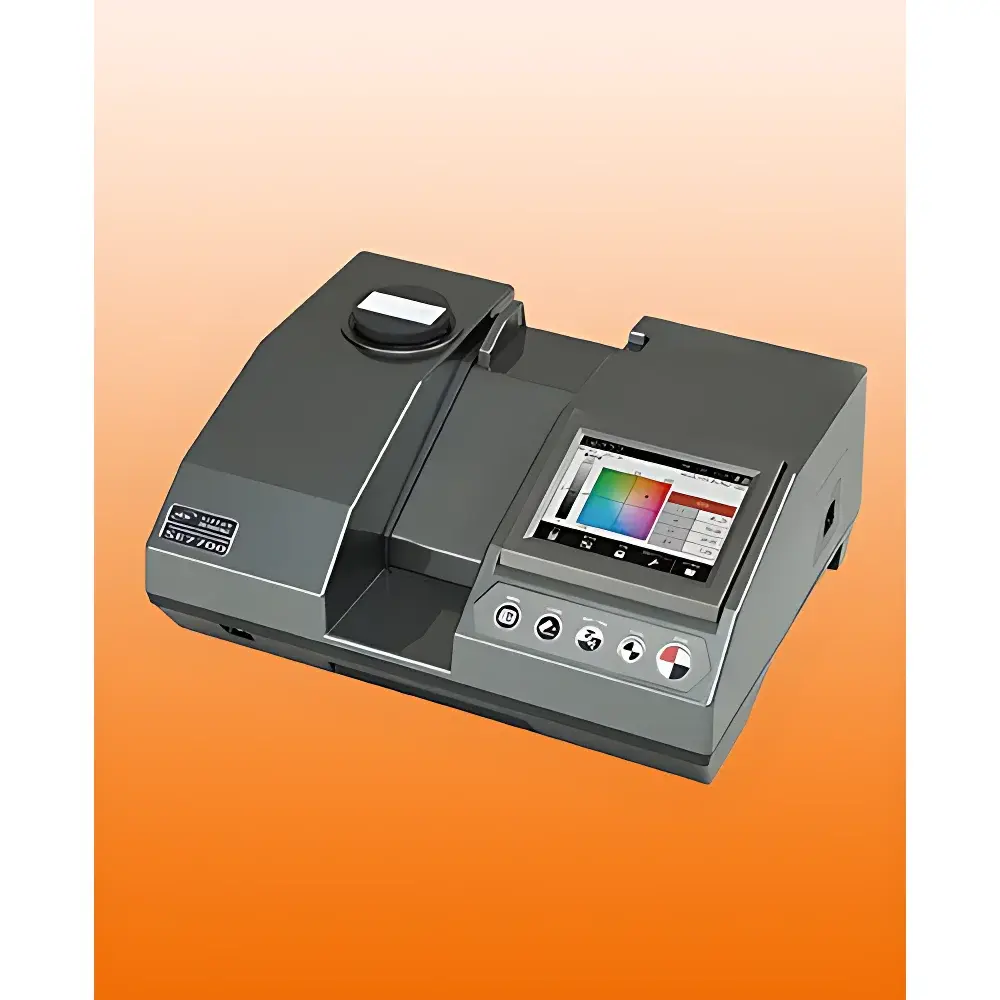
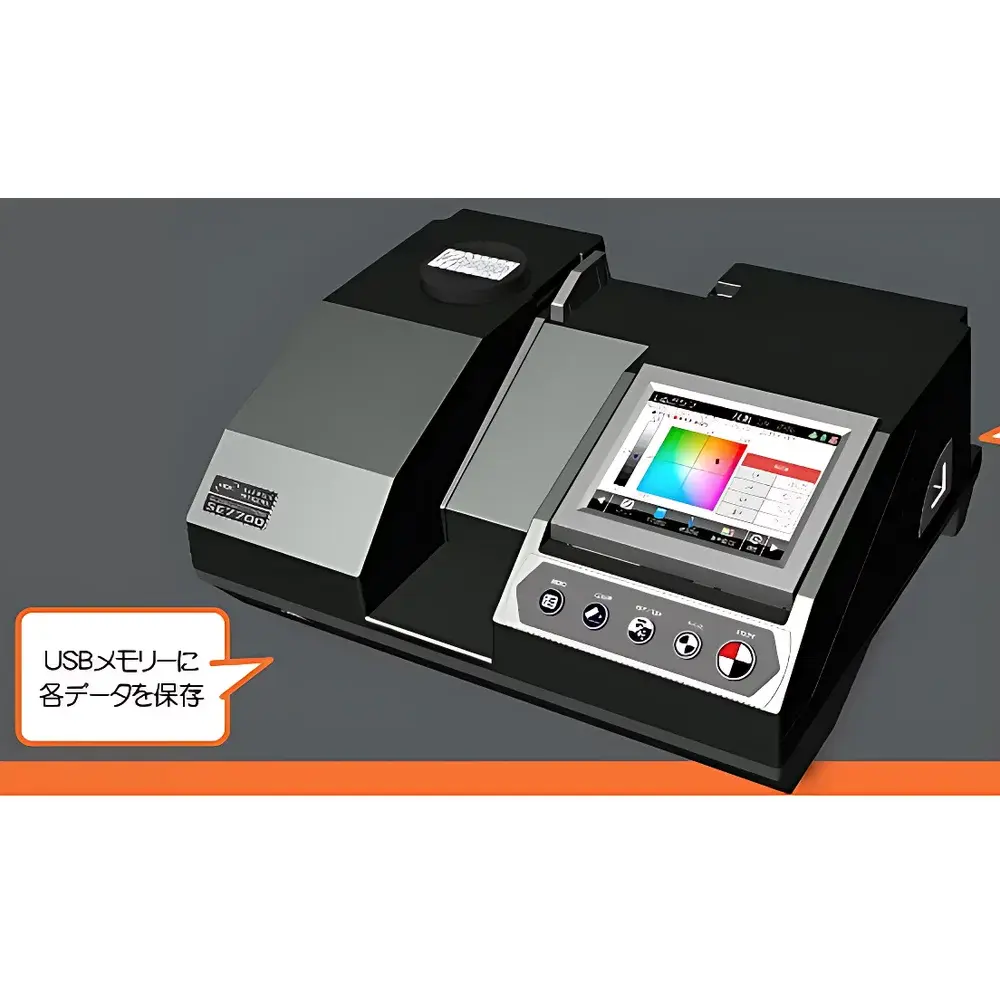
NIPPON DENSHOKU SE7700 Benchtop Spectrophotometric Colorimeter
| Brand | NIPPON DENSHOKU |
|---|---|
| Origin | Japan |
| Model | SE7700 |
| Product Type | Spectrophotometric Colorimeter |
| Instrument Type | Benchtop |
| Optical Geometry | 0/45° Integrating Sphere |
| Light Source | Tungsten Halogen Lamp |
| Spectral Range | 380–780 nm |
| Spectral Interval | 5 nm |
| Repeatability | ΔE*ab ≤ 0.03 |
| Measured Aperture Diameters | 6 mm, 10 mm, 25 mm, 35 mm, 50 mm |
| Display | Color Touchscreen LCD |
| Data Storage | USB Memory Card Support |
| Optional Accessories | Removable Optical Fiber Probe, Petroleum Sample Measurement Kit |
Overview
The NIPPON DENSHOKU SE7700 is a benchtop spectrophotometric colorimeter engineered for high-precision, multi-mode color measurement across reflective and transmissive samples. It operates on the principle of spectral reflectance and transmittance analysis using a tungsten halogen light source and a 0/45° integrating sphere optical geometry—compliant with CIE 15:2018 and ISO/CIE 11664-4 for geometrically defined colorimetric measurement. The instrument acquires full spectral data from 380 nm to 780 nm at 5 nm intervals, enabling calculation of CIE XYZ, L*a*b*, L*C*h°, ΔE*ab, ΔE*00, YI (ASTM E313, E308), whiteness (CIE/ISO 11475), yellowness index (ASTM D6290), and haze-related parameters where applicable. Its dual-function capability eliminates the need for separate reflectance and transmission instruments, reducing laboratory footprint and operational complexity while maintaining traceable photometric accuracy.
Key Features
- Single-sensor architecture enables seamless switching between reflectance and transmittance modes without mechanical recalibration or optical realignment.
- Motorized aperture selection supports five standardized measurement areas (6 mm, 10 mm, 25 mm, 35 mm, and 50 mm) to accommodate diverse sample geometries—from small tablets and thin films to bulk powders and liquid cuvettes.
- High-stability tungsten halogen lamp ensures consistent spectral output over extended operation; integrated thermal management maintains photometric stability during repeated measurements.
- Color touchscreen LCD provides intuitive navigation, real-time spectral curve visualization, and on-device statistical analysis (mean, SD, min/max, CPK).
- Robust black-anodized aluminum housing resists chemical exposure and facilitates routine cleaning in regulated environments such as pharmaceutical cleanrooms or paint QC labs.
- USB memory card interface enables standalone data logging, firmware updates, and method transfer—no PC dependency required for routine operation.
Sample Compatibility & Compliance
The SE7700 accommodates solid, liquid, powder, granular, and semi-transparent specimens—including resin pellets, coated panels, pharmaceutical tablets, food pastes, ink films, and polymer melts. Its modular accessory system supports optional fiber-optic probes for remote or confined-space sampling, and dedicated petroleum measurement kits compliant with ASTM D1500 and ISO 2049 for hydrocarbon-based product evaluation. The instrument meets JIS Z8722 (diffuse/regular reflectance), JIS Z8730 (color difference evaluation), JIS Z8781-4 (spectral measurement procedures), ASTM E313 (yellowness index), ASTM E308 (computing tristimulus values), ASTM D6290 (plastic yellowness), ISO 17223 (color measurement of transparent materials), and Chinese national standards GB/T 39822, GB/T 2913, HG/T 3862, and GB/T 6324.7. Design and validation documentation support GLP/GMP audit readiness per FDA 21 CFR Part 11 when paired with validated software configurations.
Software & Data Management
Instrument control and data analysis are supported via NIPPON DENSHOKU’s proprietary ColorView™ software (Windows-compatible), which provides full spectral database management, batch reporting, tolerance zone mapping (ellipse, rectangular, or custom polygonal), and export to CSV, PDF, or XML formats. Audit trail functionality records operator ID, timestamp, parameter changes, and result modifications—essential for ISO/IEC 17025-accredited laboratories. Raw spectral data and metadata (including aperture, geometry, illuminant, observer, and standard reference) are embedded in each exported file to ensure full traceability. Software modules support statistical process control (SPC) charting and integration with LIMS systems via ODBC or RESTful API interfaces.
Applications
The SE7700 serves quality control and R&D functions in industries requiring strict color consistency and spectral fidelity: coating formulation and batch release (automotive OEMs, architectural paints), pharmaceutical tablet and capsule color verification (per USP and ICH Q5C), food product grading (dairy, confectionery, beverages), plastic and resin manufacturing (ISO 2049-compliant transparency assessment), printing and packaging (Pantone® matching, substrate compensation), and chemical intermediates (yellowness index monitoring per ASTM D1209/D6290). Its 0/45° geometry minimizes texture-induced metamerism errors, making it especially suitable for textured surfaces, brushed metals, and matte-finish polymers.
FAQ
Does the SE7700 comply with FDA 21 CFR Part 11 requirements?
Yes—when used with validated ColorView™ software configured with electronic signatures, audit trails, and role-based access control.
Can the instrument measure translucent or hazy materials?
Yes—its 0/45° geometry and large-aperture options (up to 50 mm) enable robust measurement of semi-crystalline polymers, frosted glass, and emulsified liquids per ISO 17223.
Is calibration verification traceable to NIST or JCSS standards?
Yes—NIPPON DENSHOKU provides factory calibration certificates traceable to JCSS-accredited standards; optional NIST-traceable ceramic tile kits are available for daily verification.
What maintenance is required beyond routine calibration?
Annual lamp replacement and biannual sphere coating inspection are recommended; no optical alignment or detector recalibration is required under normal operating conditions.
Can the SE7700 be integrated into automated production lines?
Yes—via RS-232 or Ethernet communication protocols supporting SCPI command sets, enabling direct integration with PLCs and MES systems for inline color pass/fail decision logic.



