
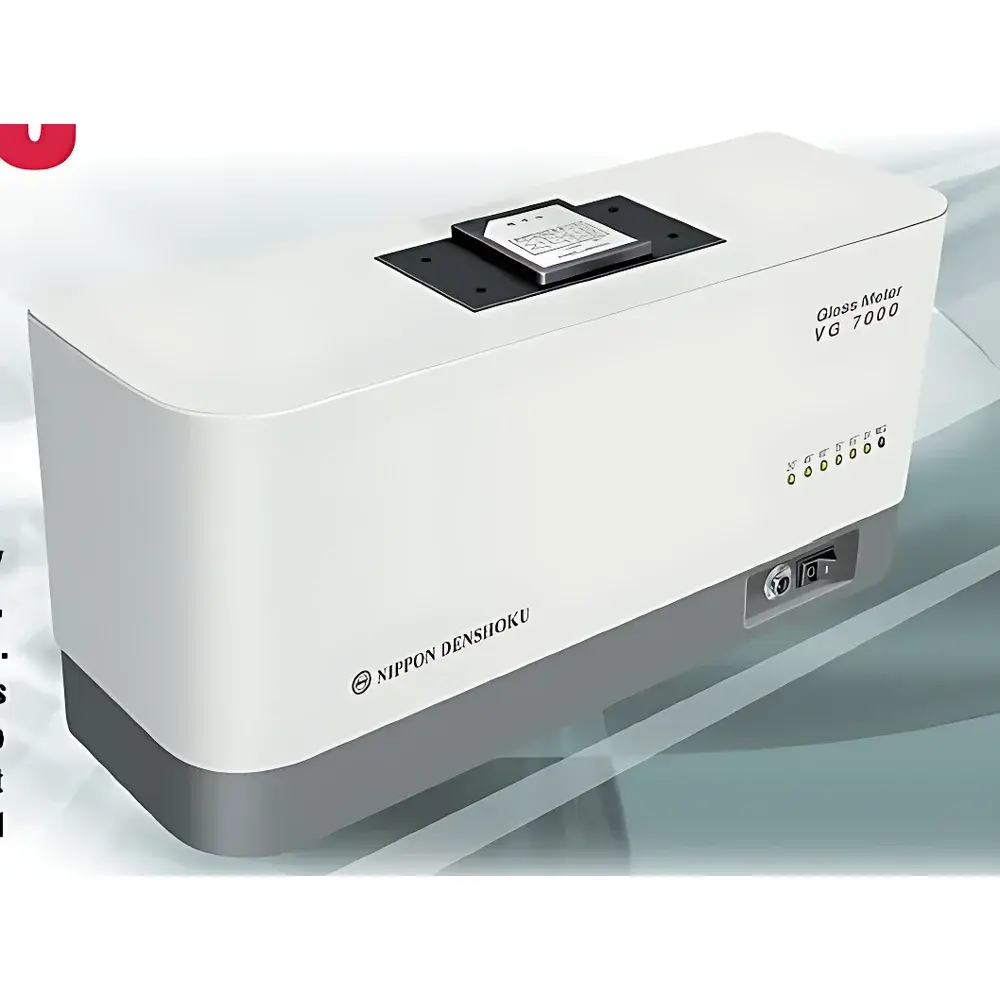
NIPPON DENSHOKU VG7000 Multi-Angle Automatic Gloss Meter
| Brand | NIPPON DENSHOKU |
|---|---|
| Origin | Japan |
| Model | VG7000 |
| Product Type | Automatic |
| Haze Range | 0–100% |
| Transmittance Range | 0–100% |
| Haze Repeatability | ±0.01% |
| Transmittance Repeatability | ±0.05% |
| Measurement Angles | 20°, 45°, 60°, 75°, 85° |
| Aperture | 14 mm × 45 mm |
| Measurement Time (5-angle) | ~4 s |
| Power Supply | 100–240 V AC, 50/60 Hz |
| Power Consumption | 20 W |
| Operating Environment | 10–40 °C, 30–80% RH (non-condensing) |
| Dimensions | 483 mm (W) × 157 mm (D) × 240 mm (H) |
| Weight | ~13 kg |
Overview
The NIPPON DENSHOKU VG7000 is a high-precision, fully automatic multi-angle gloss meter engineered for rigorous surface quality control in industrial R&D and production environments. It operates on the principle of specular reflectance measurement—quantifying the ratio of reflected luminous flux to incident luminous flux at defined geometric angles under standardized illumination (CIE Illuminant D65, white LED). Unlike single-angle instruments, the VG7000 integrates five fixed-angle optical paths (20°, 45°, 60°, 75°, and 85°) within a single robust housing, enabling simultaneous or sequential evaluation of surface reflectance behavior across distinct angular regimes. This capability supports comprehensive characterization of diverse material classes—including coated paper, laminated films, painted metal substrates, tempered glass, and injection-molded thermoplastics—where gloss response varies non-linearly with angle due to microtopography, pigment dispersion, or surface curing uniformity. The instrument employs a stable, long-life white LED source compliant with CIE spectral requirements and a fast-response silicon photodiode detector calibrated traceably to NMIJ (National Metrology Institute of Japan) reference standards.
Key Features
- Integrated five-angle optical system with dedicated collimated beams per angle—no mechanical repositioning required between measurements.
- Front-panel illuminated angle indicators provide immediate visual confirmation of active measurement geometry during operation.
- Standard footswitch interface enables hands-free, operator-consistent triggering—critical for high-throughput QC workflows and ergonomic compliance.
- Pre-calibrated measurement modes aligned with major international standards: ISO 8254-1 (75° for paper/board), ISO 8254-3 (20° for paper/board), JIS P 8142 (75°), JIS Z 8741 (20°, 45°, 60°, 75°, 85°), and TAPPI T 480 (20° and 75°).
- Thermally stabilized optical path and 30-minute warm-up protocol ensure <±0.1% short-term repeatability (20× measurements, 10-s intervals, 23°C ambient) and <±1% long-term stability (10-hour drift test).
- RS-232C serial interface for direct integration into LIMS, MES, or custom SPC platforms; compatible with optional CU-1 control unit or PC-based acquisition software.
Sample Compatibility & Compliance
The VG7000 accommodates flat, rigid, or semi-rigid specimens up to 300 mm × 300 mm with minimal curvature (radius >500 mm). Its 14 mm × 45 mm rectangular aperture ensures representative sampling across heterogeneous surfaces such as calendered paper, textured automotive trim, or anti-glare display cover glass. All measurement protocols adhere strictly to the geometric and photometric requirements of ISO 2813, ISO 8254, JIS Z 8741, and ASTM D523—ensuring data interoperability across global supply chains. The instrument’s calibration certificate includes traceability to NMIJ reference gloss standards, satisfying audit requirements under ISO/IEC 17025-accredited laboratories and supporting GLP/GMP documentation workflows. Fogging and transmittance functions (0–100% range each) are implemented per ASTM D1003 and ISO 14782, with haze repeatability of ±0.01% and transmittance repeatability of ±0.05%—enabling concurrent optical quality assessment of transparent and translucent materials such as PET films, polycarbonate lenses, and acrylic signage.
Software & Data Management
Data acquisition and reporting are managed via the optional CU-1 control unit or third-party software using ASCII-based RS-232C command syntax (e.g., “G20” for 20° gloss, “H” for haze). Raw values are output in real time with timestamp, angle identifier, and pass/fail flag based on user-defined tolerance limits. Export formats include CSV and TXT for direct import into statistical analysis tools (Minitab, JMP) or Excel-based SPC dashboards. Audit trail functionality—when deployed with validated PC software—supports FDA 21 CFR Part 11 compliance through electronic signatures, operator ID logging, and immutable record retention. Calibration history, environmental logs (temperature/humidity), and measurement sequence metadata are embedded in every exported dataset, facilitating full traceability from raw reading to final report.
Applications
- Coating uniformity verification of coil-coated steel and aluminum sheet in automotive and appliance manufacturing.
- Quality gate inspection of printed packaging—correlating gloss profiles with ink density, varnish application rate, and drying parameters.
- R&D evaluation of anti-fingerprint coatings on smartphone front panels using 85° geometry for low-gloss matte finishes.
- Process validation of extruded acrylic sheets where 60° gloss correlates with melt temperature and screw speed.
- Regulatory testing of medical device packaging films per ISO 11607, requiring simultaneous haze/transmittance/gloss metrics for barrier integrity assessment.
FAQ
Does the VG7000 require annual recalibration?
Yes. NIPPON DENSHOKU recommends annual recalibration against certified reference standards to maintain traceability to NMIJ. Certificate of calibration includes uncertainty budget per ISO/IEC 17025.
Can the instrument measure curved surfaces?
It is designed for flat or gently curved samples (radius ≥500 mm). For highly contoured parts, a portable gloss probe (e.g., IG-331) is recommended.
Is USB connectivity supported?
No—only RS-232C is provided. A USB-to-serial adapter may be used, but must be configured for legacy COM port emulation.
What is the minimum sample size for reliable measurement?
Samples must fully cover the 14 mm × 45 mm aperture; a minimum dimension of 50 mm × 50 mm is advised to avoid edge effects.
How is thermal drift compensated during extended operation?
The internal thermal sensor triggers automatic gain adjustment of the photodiode amplifier; no user intervention is required beyond initial 30-minute warm-up.





