
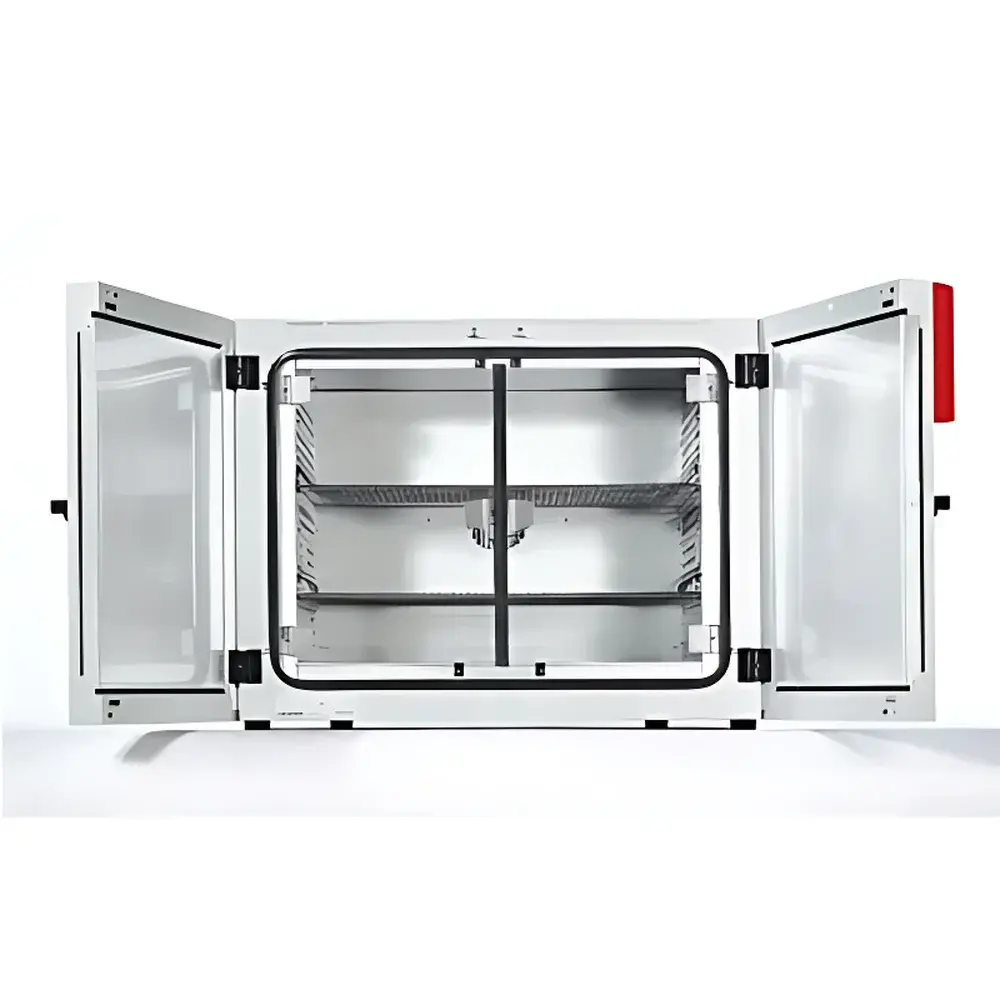
BINDER BD, BF & KB Series Biochemical Incubators
| Brand | BINDER |
|---|---|
| Origin | Germany |
| Model Series | BD, BF, KB |
| Temperature Range (BD) | Ambient +5 °C to 100 °C |
| Temperature Resolution | 0.1 °C |
| Control System | DS Controller with Electronic Timer (0–99 h) |
| Ventilation | Rear 50 mm exhaust duct + front adjustable air damper |
| Safety | Class 3.1 Overtemperature Protection (DIN 12880) |
| Interface | RS422 for APT-COM Data Control Software |
| Interior Door | Tempered Glass |
| Shelf Capacity | 2 chrome-plated adjustable shelves (standard) |
| Sterilization Capability | Dry-heat decontamination at 99 °C |
| Stackable | BD models ≤115 L |
| Compliance | DIN 12880, IEC 61000-6-3, IEC 61000-6-2 |
Overview
The BINDER BD, BF, and KB Series Biochemical Incubators are precision-engineered environmental chambers designed for reproducible, stable cultivation of biological samples under strictly controlled thermal conditions. Unlike conventional incubators relying on simple on/off heating or basic convection, these units employ microprocessor-regulated forced-air circulation combined with high-stability PID temperature control algorithms. The BD series emphasizes cleanability and thermal uniformity across its full operating range (ambient +5 °C to 100 °C), making it suitable for applications requiring periodic dry-heat decontamination at 99 °C—critical in microbiology labs adhering to GLP or ISO 17025 quality systems. The BF series prioritizes rapid thermal recovery and uniformity during high-throughput workflows, delivering <±0.3 °C temperature homogeneity (at 37 °C, measured per DIN 12880) even after frequent door openings. The KB series integrates dual-stage refrigeration with optimized airflow geometry to maintain precise low-temperature setpoints (down to 0 °C) under ambient conditions up to 40 °C—a key requirement for blood product storage and psychrophilic organism cultivation where external thermal drift must not compromise internal stability.
Key Features
- DS digital controller with intuitive menu navigation, 0.1 °C temperature resolution, and programmable electronic timer (0–99 hours)
- Class 3.1 overtemperature safety device (DIN 12880 compliant), featuring visual alarm indication and independent cut-off circuitry
- Front-access adjustable air damper and rear 50 mm exhaust duct for fine-tuned ventilation control—enabling CO2-compatible modifications or humidity management integration
- Tempered glass inner door minimizes condensation while permitting non-intrusive sample observation without thermal disturbance
- RS422 interface standard on all models for bidirectional communication with BINDER’s APT-COM software, supporting real-time monitoring, data logging, and remote parameter adjustment
- Electropolished stainless-steel interior chamber (BD/KB) or powder-coated steel (BF), corrosion-resistant and compatible with common laboratory disinfectants
- Stackable configuration available for BD models ≤115 L—optimizing floor space in core facilities without compromising structural integrity or thermal isolation
Sample Compatibility & Compliance
These incubators accommodate a broad spectrum of sample formats—including Petri dishes, multiwell plates, flasks, and vials—across academic research, pharmaceutical QC, food safety testing, and biomanufacturing environments. All series comply with DIN 12880 for incubator performance verification and meet electromagnetic compatibility standards IEC 61000-6-2 (immunity) and IEC 61000-6-3 (emission). The BD series’ validated 99 °C dry-heat cycle supports sterilization protocols aligned with EU GMP Annex 1 requirements for non-sterile compounding areas. When integrated into validated workflows, the RS422/APT-COM interface enables audit-trail generation compliant with FDA 21 CFR Part 11 for electronic records and signatures—essential for regulated biotech and clinical diagnostics laboratories.
Software & Data Management
APT-COM software provides secure, role-based access to incubator parameters via local network or direct serial connection. It supports configurable alarm thresholds (e.g., deviation >0.5 °C for >2 min), automatic CSV export of time-stamped temperature logs, and event-driven notifications via email or SNMP traps. Data integrity is reinforced through cyclic redundancy checks (CRC) on all transmitted values and timestamped firmware-level logging of operator actions—including parameter changes, door open/close events, and safety system triggers. Exported datasets include metadata such as instrument ID, calibration status, and environmental context—facilitating traceability during regulatory inspections or internal quality audits.
Applications
- Microbial growth studies (bacteria, yeasts, molds) under standardized ISO 8583 or ASTM D6400 conditions
- Cell culture maintenance for hybridoma lines and primary isolates requiring strict thermal consistency
- Enzyme activity assays and protein stability profiling across defined temperature gradients
- Accelerated shelf-life testing of food products and pharmaceutical excipients
- Cold-chain validation support for blood bank storage (KB series) and vaccine stability assessment
- Environmental simulation for polymer degradation kinetics and material aging analysis
FAQ
What is the maximum allowable ambient temperature for stable operation of the KB series?
The KB series maintains specified temperature stability (±0.5 °C) with ambient temperatures up to 40 °C, thanks to its oversized condenser and adaptive compressor modulation.
Can the BD series be used for depyrogenation?
No—while the BD series achieves 99 °C dry-heat decontamination, it does not meet the minimum 250 °C / 30-minute dwell time required for endotoxin removal per USP .
Is humidity control available as a factory option?
Humidity regulation is not integrated into the BD/BF/KB base configurations; however, external humidification modules can be interfaced via optional analog I/O ports on select DS controller versions.
How frequently should temperature mapping be performed?
Per ISO/IEC 17025 and EU GMP Annex 1, initial qualification requires 3-point mapping; routine requalification is recommended annually—or after major maintenance, relocation, or firmware updates.
Are calibration certificates included with shipment?
A factory-issued calibration certificate (traceable to PTB, Germany) is provided for the primary temperature sensor; user-performed field calibration using NIST-traceable reference thermometers is supported via the DS controller’s calibration mode.



