
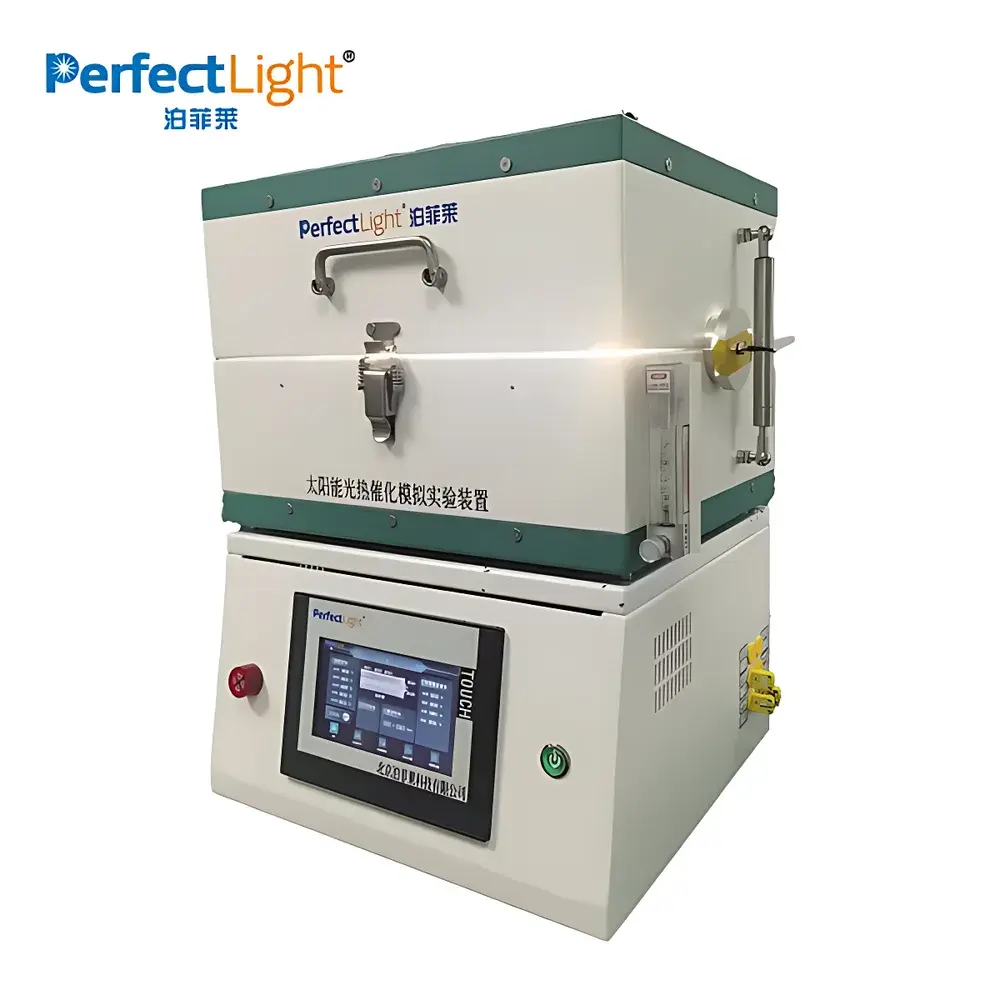
PerfectLight PLR PTCS-31 Solar Photo-Thermal Catalysis Simulation System
| Brand | PerfectLight |
|---|---|
| Origin | Beijing, China |
| Model | PLR PTCS-31 |
| Power Supply | AC 220 V, 50/60 Hz |
| Total Power | 1500 W (LED source: 900 W |
| Water cooling | 600 W) |
| Maximum Achievable Temperature | ≥500 °C (center zone, ±5 cm) |
| Reaction Tube Dimensions | Φ10 × Φ7 × 400 mm (quartz glass standard |
| Collector Tube Dimensions | Φ58 × Φ43 × 330 mm |
| Collector Tube Material | High-borosilicate glass with selective solar-absorbing coating |
| Long-term Operating Temperature Range (collector) | 5–300 °C |
| Short-term Exposure Limit | up to 500 °C (coating degradation risk above 300 °C) |
| Illumination Uniformity | >90% across irradiated surface |
| Peak Irradiance | ≥300 mW/cm² (at 1-sun equivalent, initial condition) |
| Spectral Control | Three-zone independently adjustable LED array (UV–vis–NIR) |
| Temperature Monitoring | Multi-point thermocouple interfaces along U-shaped reaction tube |
| Cooling | Integrated closed-loop water circulation system |
| Ambient Operating Conditions | 0–45 °C, non-condensing |
| Storage Conditions | −10–60 °C, 30–85% RH (drain coolant before storage below 0 °C) |
Overview
The PerfectLight PLR PTCS-31 Solar Photo-Thermal Catalysis Simulation System is an engineered laboratory platform designed to replicate and quantitatively investigate solar-driven photo-thermal catalytic reactions under controlled indoor conditions. Unlike conventional photoreactors relying on broadband lamps or outdoor solar concentrators, the PLR PTCS-31 employs a high-power, spectrally tunable LED array as its sole energy source—enabling precise decoupling of photonic input from thermal output. Its core architecture integrates a vacuum-insulated, solar-selective absorber tube with a U-shaped quartz reaction channel, forming a coaxial photo-thermal conversion zone where incident photons are converted into localized, gradient-free heat via radiative absorption. This configuration supports true “pure photo-thermal” operation—i.e., no external resistive or furnace-based heating—making it uniquely suited for mechanistic studies requiring unambiguous attribution of reaction kinetics to photon-induced thermal effects versus direct electronic excitation. The system operates within defined pressure regimes (typically ambient to 0.5 MPa) and accommodates exclusively gas-phase or gas–solid heterogeneous catalysis—aligning with ISO 21348 definitions of solar spectral irradiance and ASTM E2795–21 guidelines for laboratory-scale photo-thermal reactor validation.
Key Features
- Three-Zone Spectrally Resolved LED Illumination: Composed of independently controllable UV (365 nm), visible (450–630 nm), and near-infrared (740–850 nm) LED modules, the light source enables programmable spectral shaping—including AM1.5G solar spectrum emulation or band-selective enhancement—to isolate photonic contributions from thermal contributions in catalytic turnover.
- 500 °C Photo-Thermal Core Zone: Achieved through optimized optical coupling between the LED array and a custom high-absorptance/low-emissivity vacuum collector tube, delivering stable, spatially uniform temperatures exceeding 500 °C at the central 100 mm segment of the U-tube—without auxiliary heating elements.
- Multi-Point In-Situ Temperature Mapping: Six standardized thermocouple ports distributed along the reaction tube axis (inlet, mid-bed, outlet, and corresponding wall positions) allow real-time acquisition of axial and radial temperature gradients—critical for kinetic modeling, hotspot identification, and catalyst deactivation analysis per IUPAC recommendations on heterogeneous catalysis characterization.
- Modular U-Tube Reactor Architecture: The quartz reaction tube (Φ10 × Φ7 × 400 mm) is mechanically isolated within the collector and features rapid-access clamping—enabling catalyst loading/unloading, tube replacement, and routine maintenance without recalibration or optical realignment.
- Active Thermal Management: A dedicated 600 W closed-loop water-cooling subsystem maintains LED junction temperature below 65 °C during continuous 900 W operation, ensuring spectral stability, luminous flux consistency (>98% retention over 100 h), and compliance with IEC 62471 photobiological safety thresholds.
Sample Compatibility & Compliance
The PLR PTCS-31 is validated for use with gaseous reactants (e.g., NOx, SO2, CH4, CO2, H2) and solid-phase catalysts (e.g., TiO2-based composites, plasmonic Au/TiO2, Ni–CeO2, perovskite oxides). All wetted components meet USP Class VI biocompatibility standards for quartz and comply with REACH Annex XIV substance restrictions. The control firmware supports audit-trail-enabled data logging aligned with FDA 21 CFR Part 11 requirements when paired with validated third-party SCADA software. System design adheres to CE machinery directive 2006/42/EC and electromagnetic compatibility per EN 61326-1:2013.
Software & Data Management
A Windows-based control interface provides synchronized regulation of LED power per spectral zone, real-time display of up to six thermocouple channels, and automated ramp-hold-soak temperature profiling. Experimental parameters—including irradiance setpoints, gas flow rates (via optional mass flow controller integration), and time-stamped thermal profiles—are stored in CSV-compatible structured logs with UTC timestamps and operator ID tagging. Exported datasets conform to ASTM E2500–22 metadata conventions for reproducible catalysis experimentation, supporting downstream analysis in MATLAB, Python (Pandas/NumPy), or commercial kinetic modeling suites such as CHEMKIN-Pro.
Applications
- Gas-phase photocatalytic denitrification (NO → N2) and desulfurization (SO2 → S or SO3) under simulated solar irradiation
- CO2 hydrogenation to CH4 or CO (reverse water–gas shift) via plasmon-enhanced thermal activation
- Methane dry reforming (CH4 + CO2 → 2CO + 2H2) under concentrated photo-thermal conditions
- Fundamental studies of thermal vs. electronic contributions in semiconductor-catalyzed reactions (e.g., distinguishing band-gap excitation from lattice heating)
- Accelerated aging tests of solar thermal catalysts under controlled irradiance–temperature–atmosphere triads
FAQ
Can the PLR PTCS-31 operate under vacuum or elevated pressure?
Yes—the U-tube reactor is rated for operation from 10−3 mbar to 0.5 MPa; pressure-rated quartz variants and stainless-steel alternatives are available upon request.
Is spectral calibration traceable to NIST standards?
Each LED module undergoes factory spectral radiometric calibration using a NIST-traceable CCD spectroradiometer (model CAS 140D); full calibration reports are supplied with delivery.
How frequently must the collector tube coating be replaced?
Under continuous operation at peak irradiance and temperatures >300 °C, coating integrity should be verified every 200 operational hours via reflectance measurement; typical service life is 500–800 h at ≤300 °C.
Does the system support integration with online GC or MS analyzers?
Yes—standard 1/8″ Swagelok fittings and pressure-rated sampling lines are provided; optional heated transfer lines (up to 200 °C) and gas chromatography interface kits are available.
What safety interlocks are implemented?
Hardware-enforced interlocks include LED overtemperature cutoff (>75 °C), coolant flow failure shutdown, door-open radiation inhibition, and emergency thermal runaway termination (triggered at >550 °C sustained for >10 s).
Related Products



