
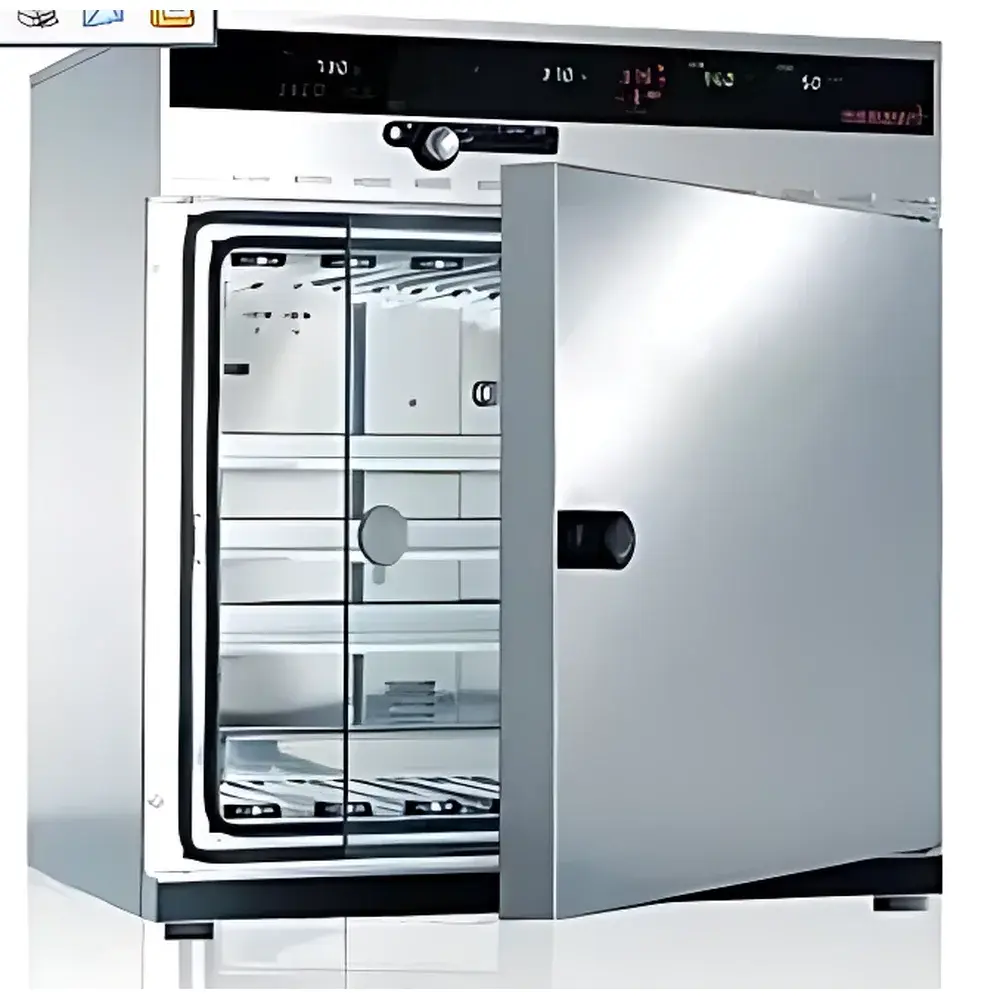
MEMMERT INC246 Carbon Dioxide Incubator
| Origin | Germany |
|---|---|
| Manufacturer Type | Authorized Distributor |
| Origin Category | Imported |
| Model | INC246 |
| Pricing | Upon Request |
Overview
The MEMMERT INC246 Carbon Dioxide Incubator is a high-precision, laboratory-grade CO₂ incubation system engineered for consistent, contamination-free cell culture under tightly controlled physiological conditions. Designed and manufactured in Germany, it employs a dual-mode thermal management architecture—featuring a thick mineral wool jacket that bridges the performance gap between traditional water-jacketed and air-jacketed systems—delivering superior thermal stability, low maintenance, and rapid temperature recovery after door openings. Its core operational principle relies on infrared (IR) CO₂ sensing with automatic zero calibration every 12 hours, ensuring long-term accuracy of CO₂ concentration control (0–20% v/v). Temperature regulation is achieved via a five-sided heating system (top, bottom, left, right, and door), eliminating cold spots and enabling exceptional uniformity (< ±0.3 °C at 37 °C) across its 246 L working volume. Integrated humidity control (88–97% RH) utilizes a feedback-driven solenoid valve to introduce filtered ambient air when humidity exceeds setpoint—preventing condensation without requiring water reservoir refills or manual intervention.
Key Features
- Electropolished stainless steel (ASTM 304 / 1.4301) seamless inner chamber with welded joints for full cleanability and corrosion resistance
- Infrared CO₂ sensor with auto-zero function (calibration cycle: 12 h) and digital concentration display (0–20% CO₂)
- Five-directional heating system (including door-back heating) minimizes thermal gradients and prevents condensation on observation windows
- Full internal sterilization mode: automatically heats all critical components—including CO₂ and humidity sensors, circulation fan, and water pan—to +160 °C for validated decontamination
- Dual CO₂ cylinder connection with automatic gas source switching and interlocked supply cutoff upon door opening
- Humidity control via humidity probe–actuated solenoid valve and hydrophobic membrane filter; eliminates need for humidification water top-up during extended unattended operation
- Microprocessor-based controller with real-time digital display of temperature, CO₂ concentration, and relative humidity; built-in self-diagnostic system and overtemperature protection
- Insulated stainless steel door with four-point adjustment, double-lock mechanism, and integrated 8 mm sampling port in inner glass door
Sample Compatibility & Compliance
The INC246 supports routine and sensitive mammalian cell culture applications—including stem cells, primary cultures, and hybridoma lines—where strict environmental fidelity is essential. Its sealed construction, electropolished surfaces, and validated sterilization protocol align with Good Laboratory Practice (GLP) and Good Manufacturing Practice (GMP) requirements for preclinical research environments. While not certified for ISO 13485 or FDA 21 CFR Part 11 out-of-the-box, the system’s data logging capability (via optional RS232/USB interface) supports audit-ready documentation when integrated into compliant laboratory information management systems (LIMS). All materials meet EU RoHS and REACH directives; the stainless steel chamber complies with ASTM A240/A240M for 304-grade austenitic stainless steel.
Software & Data Management
The INC246 operates via an embedded microcontroller with non-volatile memory for parameter retention during power loss. Optional connectivity modules enable serial (RS232) or USB data export for external logging. Temperature, CO₂, and humidity values are timestamped and exportable as CSV files—facilitating traceability and regulatory review. When deployed in validated workflows, users may configure alarm thresholds and generate event logs (e.g., door open duration, sterilization cycle completion, sensor fault alerts) compatible with GLP-compliant electronic lab notebooks (ELNs). No proprietary cloud platform is required; raw data remains under user control at all times.
Applications
- Mammalian cell expansion and maintenance in academic, biotech, and pharmaceutical R&D labs
- Embryology and assisted reproductive technology (ART) workflows requiring stable pH buffering via precise CO₂ control
- Long-term unattended culture runs (e.g., weekend experiments) enabled by autonomous humidity regulation and robust thermal inertia
- Quality control testing of biological reagents, monoclonal antibodies, and viral vectors under ISO 5-class cleanroom-adjacent conditions
- Teaching laboratories where reliability, ease of validation, and intuitive operation support student training in aseptic technique
FAQ
What is the internal volume and chamber material specification?
The usable chamber dimensions are 640 × 640 × 600 mm (W × H × D), yielding 246 L net volume. The interior is constructed from electropolished AISI 304 stainless steel (1.4301), fully welded and passivated for optimal bioburden resistance.
How does the mineral wool jacket compare to water-jacketed and air-jacketed designs?
Unlike water-jacketed units, it requires no periodic water replacement or microbial monitoring; unlike standard air-jacketed models, its high-density mineral insulation provides thermal mass comparable to water—ensuring < ±0.1 °C temperature fluctuation and fast recovery (<15 min to stabilize after 30 s door opening at 37 °C).
Is remote monitoring or network integration supported?
Standard configuration includes local digital display only. Optional RS232 or USB interfaces allow connection to PCs or PLCs for data capture; Ethernet or Wi-Fi modules are not available natively but may be added via third-party industrial gateways compliant with Modbus RTU.
What safety certifications does the INC246 hold?
It conforms to IEC 61010-1:2010 for electrical safety and IEC 61326-1:2013 for electromagnetic compatibility (EMC). CE marking is affixed per EU Directive 2014/30/EU (EMC) and 2014/35/EU (LVD).
Can the unit be installed in a Class II biosafety cabinet or laminar flow hood?
No—it is designed for standalone placement on stable, level laboratory flooring with ≥10 cm rear clearance for ventilation. Its heat dissipation (ca. 2,000 W peak) and exhaust requirements preclude enclosed installation.
Related Products





