
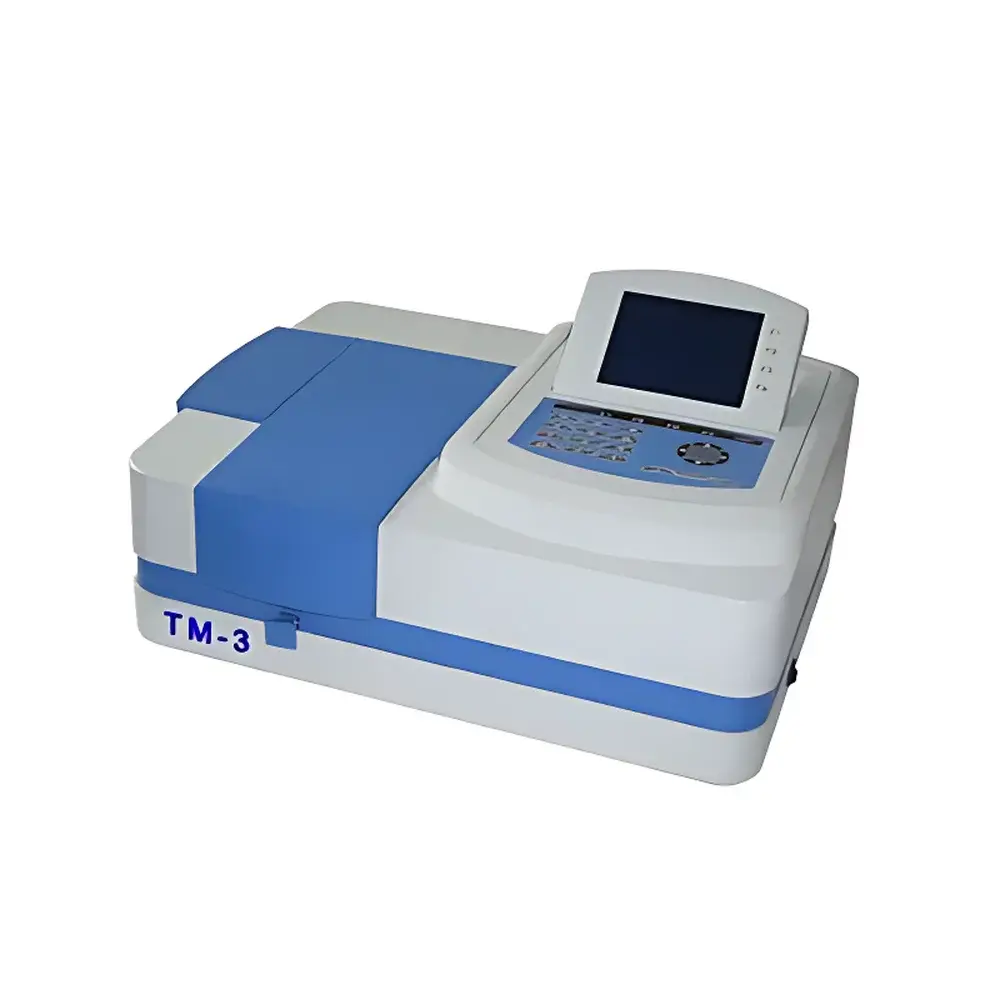
SOLY TM-3 Dedicated Spectrophotometer for Lens Luminous Transmittance Measurement
| Brand | SOLY |
|---|---|
| Origin | Japan |
| Model | TM-3 |
| Wavelength Accuracy | ±0.5 nm |
| Wavelength Repeatability | ≤0.2 nm |
| Stray Light | ≤0.05% T (NaI solution, 220 nm) |
| Transmittance Accuracy | ±0.3% T (0–100% T) |
| Transmittance Repeatability | ≤0.15% T |
| Baseline Linearity | ±0.002 A |
| Drift | ≤0.002 A/30 min (after 500 nm warm-up) |
| Spectral Range | 280–780 nm |
| Compliance Standards | EN 1836:2005+A1:2007, ISO 8980-3 / 14889, ANSI Z80.3-2008, AS/NZS 1067:2003, AS/NZS 1337:1992, GB 10810.3, QB 2457-1997, QB 2506-2001 |
Overview
The SOLY TM-3 Dedicated Spectrophotometer is a precision optical instrument engineered specifically for the quantitative measurement of luminous transmittance in ophthalmic lenses and protective eyewear. It operates on the principle of double-beam UV-Vis spectrophotometry, delivering high-fidelity spectral data across the biologically relevant 280–780 nm range—spanning the ultraviolet-A (UVA), visible, and near-ultraviolet (NUV) regions critical for photobiological safety assessment. Unlike general-purpose spectrophotometers, the TM-3 integrates optical path optimization for plano and curved lens geometries, including prescription-grade ophthalmic lenses, polarized sunglasses, and driver’s vision-enhancing optics. Its optical architecture minimizes beam divergence and vignetting effects inherent in non-planar samples, ensuring traceable, reproducible transmittance values aligned with regulatory test protocols.
Key Features
- Optimized optical design for direct transmittance measurement of both flat substrates and curved ophthalmic lenses (including ±12 D spherical equivalents)
- High-stability tungsten-halogen and deuterium lamp source with automatic switching at 350 nm for seamless UV-Vis coverage
- Double-beam configuration with real-time reference compensation to mitigate source drift and environmental fluctuations
- Automated wavelength calibration using built-in holmium oxide and didymium filters, traceable to NIST SRM standards
- Integrated CIE 1931 colorimetric engine enabling chromaticity coordinate (x, y) calculation and correlated color temperature (CCT) derivation from spectral transmittance data
- Preloaded firmware modules for eight internationally recognized optical safety standards—EN, ISO, ANSI, AS/NZS, GB, and QB—with auto-parameter selection based on selected standard
Sample Compatibility & Compliance
The TM-3 accommodates plano and spherocylindrical ophthalmic lenses up to 80 mm diameter and 25 mm edge thickness. Polarized lenses may be measured provided the analyzer axis is aligned perpendicular to the incident beam; the instrument includes a motorized rotating sample holder (optional accessory) to facilitate angular alignment verification per ISO 8980-3 Annex B. All measurements comply with the geometric and spectral requirements defined in EN 1836:2005+A1:2007 (Category 0–4 classification), ISO 8980-3:2010 (transmittance uniformity), and ANSI Z80.3-2008 (luminous transmittance and UV cutoff thresholds). The system meets GLP documentation requirements and supports audit-ready reporting for ISO/IEC 17025-accredited laboratories. Full compliance with FDA 21 CFR Part 11 is enabled via optional software module with electronic signature, audit trail, and user access control.
Software & Data Management
The proprietary TM-3 Control Suite runs on Windows OS and provides full spectral acquisition, baseline correction, and multi-standard report generation. Raw absorbance/transmittance spectra are stored in ASTM E131-compliant .jdx format. Each report includes instrument identification, calibration history, operator ID, date/time stamp, sample metadata (curvature, material type, coating status), and pass/fail evaluation against selected standard thresholds. Data export options include CSV, PDF/A-1b (ISO 19005-1), and XML for LIMS integration. Audit trails record all parameter modifications, result overrides, and report revisions—retained for ≥10 years per internal SOPs. Software validation documentation (IQ/OQ/PQ protocols) is available upon request for regulated environments.
Applications
- Verification of luminous transmittance (Tv) and UV-blocking performance (UVA/UVB cutoff) for CE-marked sunglasses and occupational eye protection
- Quality control of resin, polycarbonate, and high-index ophthalmic lenses during manufacturing and incoming inspection
- Validation of photochromic activation kinetics and fade recovery profiles under standardized illuminants
- Development and certification of blue-light filtering lenses per ISO 13666:2021 and IEC 62471 photobiological safety assessments
- Regulatory submission support for FDA 510(k), Health Canada Medical Device License, and TGA ARTG applications
FAQ
Can the TM-3 measure lenses with anti-reflective or hydrophobic coatings?
Yes—the double-beam design compensates for specular reflection losses, and the 280–780 nm spectral range captures coating-induced interference effects critical for broadband transmittance validation.
Is polarization-dependent measurement supported out-of-the-box?
Basic polarized lens testing is supported with manual orientation; for automated azimuthal scanning and extinction ratio calculation, the optional Motorized Polarization Analyzer Module (MPAM-3) is required.
How often must the instrument be recalibrated?
Wavelength calibration is recommended before each daily session; photometric calibration using certified neutral density filters is advised weekly or after lamp replacement.
Does the system support networked deployment in multi-user labs?
Yes—client-server mode enables concurrent access from up to 16 workstations, with role-based permissions and centralized database logging via SQL Server or PostgreSQL backend.



