
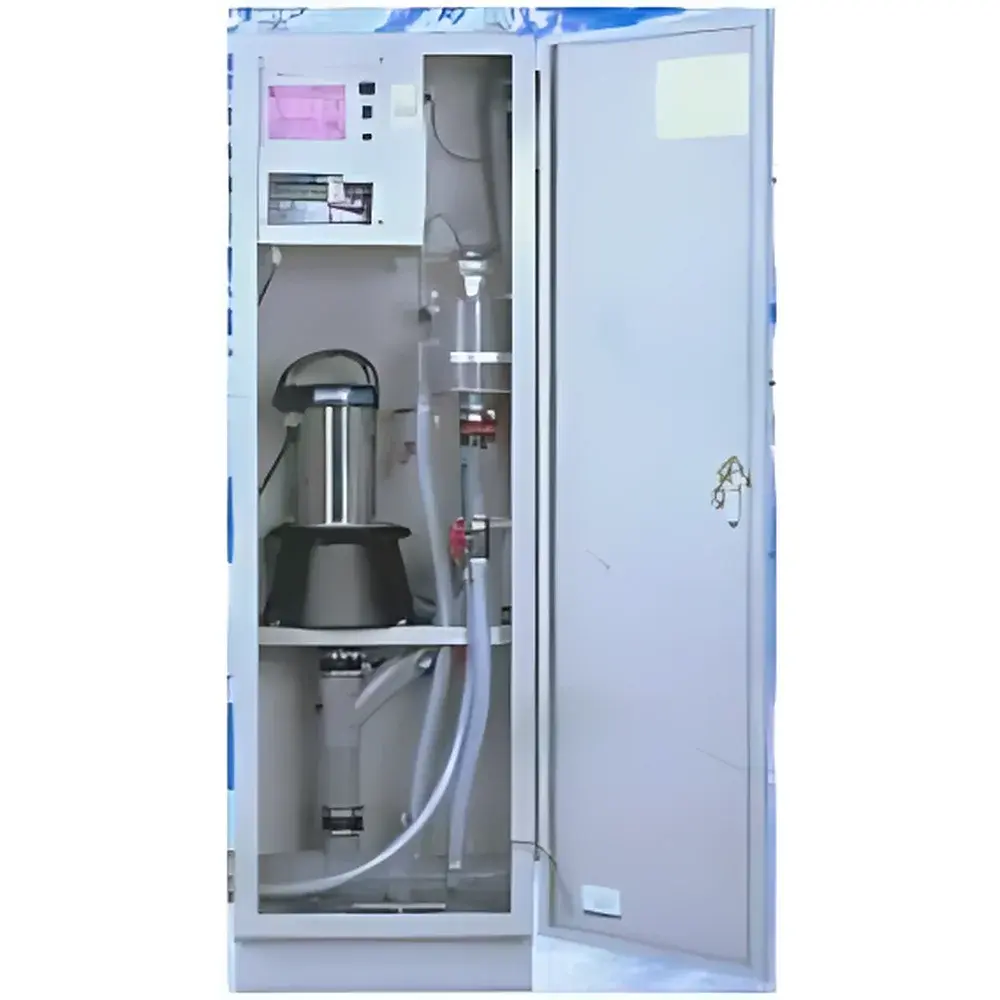
HORIBA UV-2500 Continuous COD Monitor & SDY Electrochemical COD Analyzer
| Origin | Japan |
|---|---|
| Manufacturer Type | Authorized Distributor |
| Origin Category | Imported |
| Model | UV-2500 (UV Absorption Method) & SDY (Electrochemical Oxidation Method) |
| Pricing | Available Upon Request |
Overview
The HORIBA UV-2500 Continuous COD Monitor and SDY Electrochemical COD Analyzer are dual-technology, industrial-grade online water quality analyzers engineered for real-time, unattended monitoring of chemical oxygen demand (COD) in diverse aqueous matrices. The UV-2500 employs ultraviolet absorption spectroscopy at 254 nm — a non-destructive, reagent-free optical method correlating absorbance (expressed in m⁻¹ SAC or Abs) with dissolved organic carbon content via the Beer–Lambert law. It is calibrated against standard potassium hydrogen phthalate (KHP) solutions per ISO 15705:2002 and validated for compliance with national discharge permit requirements. In contrast, the SDY series utilizes amperometric electrochemical oxidation in acidic sodium sulfate electrolyte, enabling rapid, stoichiometric oxidation of organics at a catalytic anode — a principle aligned with ASTM D1253-22 for residual oxidant quantification and adapted for continuous flow applications. Both instruments are deployed in regulatory-compliant effluent monitoring, raw water intake surveillance, and process-critical wastewater streams where temporal resolution, operational safety, and long-term stability are non-negotiable.
Key Features
- UV-2500: Rotating optical pathlength adjustment mechanism (0.1–100 mm), eliminating zero drift induced by fouling and enabling seamless measurement across 0–10 m⁻¹ SAC (low-range) to 0–500 m⁻¹ SAC (high-range) without manual recalibration.
- UV-2500: Integrated turbidity-compensated COD calculation algorithm; simultaneous real-time display of COD (mg/L O₂ equiv.) and turbidity (NTU) on a 7-inch capacitive touchscreen interface with guided setup wizard.
- UV-2500: Onboard data logger storing hourly averaged absorbance, temperature, and diagnostic flags for ≥8,760 hours (1 year); exportable via industrial-grade CF card compliant with FAT32 formatting and ESD protection.
- UV-2500: Continuous mechanical wiper system operating synchronously with measurement cycles — no optical shutter interruption, ensuring uninterrupted data continuity and eliminating step-change artifacts during cleaning events.
- SDY: Electrochemical cell with Pt/Ir anode and Ag/AgCl reference electrode; oxidation potential programmable from +1.2 V to +2.0 V vs. SCE, optimized for broad-spectrum organic oxidation without dichromate or mercury catalysts.
- SDY: Adaptive sampling protocol: high-frequency mode (up to 1 measurement/2 min) for dynamic influent tracking; low-frequency mode (1 measurement/hour) to extend electrolyte lifetime and reduce power draw.
- SDY: Self-cleaning cycle triggered by conductivity threshold or time interval; integrated peristaltic flush pump using deionized water or process water — no external air or compressed gas required.
- Both: Dual 4–20 mA analog outputs (isolated), Modbus RTU/TCP, and optional Profibus DP v1 support for integration into SCADA, DCS, or PLC-based plant automation systems.
Sample Compatibility & Compliance
The UV-2500 is validated for use with clarified surface water, municipal secondary effluent, and pre-treated industrial discharges exhibiting turbidity ≤100 NTU and suspended solids <50 mg/L. The SDY analyzer accommodates higher-solids samples (up to 200 mg/L SS) due to its open-flow cell design and automatic rinse sequence. Both systems meet IP66 enclosure rating (IEC 60529) and operate within 0–45 °C ambient and 5–40 °C sample temperature ranges. Regulatory alignment includes adherence to EPA Method 410.4 (UV absorbance correlation), ISO 15705:2002 (UV spectrophotometric COD estimation), and JIS K 0102 (Japanese Industrial Standard for water analysis). Data integrity conforms to FDA 21 CFR Part 11 requirements when paired with HORIBA’s optional audit-trail-enabled software package (version 3.2+), including electronic signatures, user role management, and immutable event logging.
Software & Data Management
HORIBA’s WQMS (Water Quality Monitoring System) software provides centralized configuration, remote diagnostics, alarm management (e.g., flow loss, sensor timeout, calibration overdue), and trend visualization for up to 32 analyzers. Raw absorbance (m⁻¹ SAC), calculated COD (mg/L), temperature, and system status are timestamped with UTC synchronization and stored in SQLite3 databases compliant with IEC 62443-3-3 security profiles. Historical data exports support CSV, PDF report generation, and OPC UA server connectivity for MES-level integration. All firmware updates undergo cryptographic signature verification prior to installation, ensuring supply-chain integrity per NIST SP 800-193 guidelines.
Applications
- Municipal wastewater treatment plants: Continuous compliance reporting at final effluent discharge points per EU Urban Wastewater Directive (91/271/EEC) and U.S. NPDES permit limits.
- Drinking water source protection: Early-warning detection of organic contamination at reservoir intakes and river abstraction points.
- Pharmaceutical and chemical manufacturing: In-line monitoring of biodegradable load in batch reactor blowdown and cooling tower bleed streams.
- Food & beverage processing: Real-time tracking of COD spikes during CIP cycles or production line washouts.
- Industrial park centralized treatment facilities: Multi-point networked deployment with centralized data aggregation and anomaly detection algorithms.
FAQ
Does the UV-2500 require daily calibration or reagent addition?
No — it operates reagent-free and uses factory-established absorbance-to-COD correlation curves traceable to NIST SRM 2974. Verification checks are recommended weekly using certified KHP standards.
Can the SDY analyzer replace traditional dichromate-based COD methods in regulatory reporting?
It serves as a validated surrogate for trend monitoring and process control; however, official compliance reporting may still require wet-chemistry validation per local authority protocols (e.g., UK Environment Agency MCERTS QA/QC framework).
What maintenance intervals are recommended for each system?
UV-2500: Quarterly optical window inspection and wiper blade replacement; annual lamp intensity verification. SDY: Electrolyte replenishment every 6 months (under typical operation); anode polishing every 24 months.
Is remote firmware update supported over cellular or Ethernet?
Yes — both instruments support secure OTA (Over-The-Air) updates via HTTPS with TLS 1.2 encryption and device authentication via X.509 certificate exchange.
How is data integrity ensured during power interruption?
Non-volatile FRAM memory retains critical configuration and last valid measurement; onboard supercapacitor sustains real-time clock and volatile RAM for ≥72 hours during outage.
Related Products







